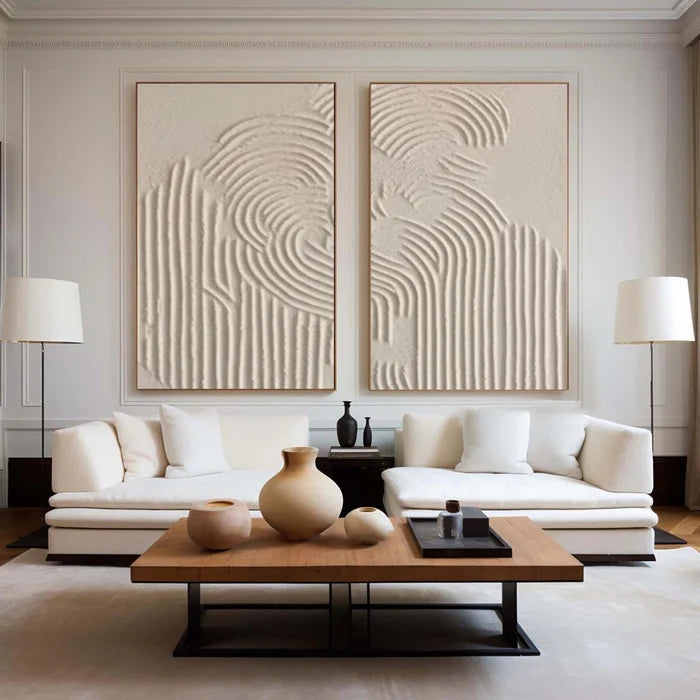
3D Textured Art vs Prints: What Depth Changes
A print is a picture of an image. A textured painting is an object with a surface of its own. The two can sit side by side on the same store page with prices that differ several times over, yet the real gap is not the number on the tag — it is what depth changes once the work is on your wall: how the surface handles light, how pieces repeat across an edition, how the canvas behaves for years of hanging, and how much presence it gives a room. This comparison goes through those differences one at a time, so the choice fits the wall you actually have rather than the one in a showroom photo.
What depth means on a textured canvas
Depth is not a trick drawn into the image. It is the physical surface of the work. Textured paintings are built in layers of paint and modeling paste, with ridges, waves and peaks pressed by palette knife and fingertip while the material is still soft. Those raised areas stand proud of the canvas and catch their own light, which means a textured painting carries real weight and real shadow — the surface is the subject as much as the color. A print, by contrast, is pigment on a flat plane: paper or canvas locked to one level, always the same from edge to edge.
That is why a smartphone photo flatters both the same way. Seen from above at a slight angle, a textured piece can pass for a flat print. Seen from three metres across a living room, with a lamp angled across it, the two could not be more different. Depth is not decoration bolted onto an image; it is the medium. Judge it the way you would judge a sculpture, not a photograph.
To see the difference clearly, try the pencil-texture test. Run your hand across a textured canvas and then across a flat print: one has relief you can feel, the other is smooth. That tactile difference is not a gimmick — it is what makes the wall feel less like a screen and more like a material surface. In rooms designed around warmth — reading corners, bedrooms, casual living spaces — that material presence is often the entire reason people trade a print for an original.
Light: the biggest difference, and the most visible
Hold a print flat and light bounces off it evenly, because its surface exists on one plane. The image looks the same at nine in the morning and nine at night, under a ceiling globe and under a lamp. A textured canvas behaves differently: the top of each ridge catches the light and the valley behind it falls into soft shadow, so the highlights move as you walk past, and the piece quietly changes character through the day. That movement is the single reason people say textured art feels alive — the artwork keeps answering the light instead of merely holding it.
How much this matters depends on where the painting hangs. On a wall that takes directional light — a floor lamp angled at the frame, a picture light above the sofa, a morning window to the side — texture does most of its work. On a hallway with only flat overhead light, the ridges flatten out, and a textured canvas can look closer to a print than buyers expect. The honest takeaway is not that texture is always better; it is that the surface performs only where the lighting lets it. If your wall has no angled light at any hour, a print will serve the room almost as well.

One design, many canvases: the natural variation
Prints are copies by design. Every unit of a printed edition is identical in hue, edge and texture, which is precisely what makes them useful when you want matching pairs or a predictable gallery wall. A textured original carries variation between pieces: the artist's hand moves slightly differently on each canvas, the ridges pool a little here and sit a little there, and the material takes the color blend in its own rhythm. For the same design, two textured canvases are clearly the same painting and clearly not the same object.
That is neither a defect nor a risk — it is the definition of an honest original, and it makes sets of two or three particularly charming: the repeated motif gains its own subtle cadence across the panels. When you buy a textured piece, expect the real canvas to differ in small ways from the product photos, because it has to. A shop that photographs its originals once and sells hundreds of identical copies is selling prints, whatever its marketing says.
The practical side: weight, dust and care
Every benefit of depth comes with household logistics a print never raises. It helps to know them before you hang:
- Weight. A textured canvas with a deep frame weighs more than a framed poster of the same size, because the raised paint and solid frame add real mass. Use the right wall anchor, especially over a sofa or bed.
- Dust. Ridges catch dust in a way flat paper does not. A soft dry cloth or a brush attachment on a low-suction vacuum, run gently over the peaks every few months, keeps the surface clean. It is a small recurring task, not a burden.
- Moisture. A textured canvas should stay out of damp walls and high-humidity rooms; the paint is tough, but the canvas and frame breathe unevenly when the air is wet. Keep textured pieces to dry, well-ventilated areas.
| Care point | Textured canvas | |
|---|---|---|
| Light response | Static all day | Shifts with angle and hour |
| Variation between copies | None by design | Small natural differences |
| Dust | Minimal | Collects in ridges; gentle cleaning |
| Handling | Light, wipe-clean | Heavier; proper anchors and dry walls |
What the price difference actually buys
A print is cheap because it is produced at almost no marginal labor. A textured original costs more because each panel is built by a human hand: the paste is laid, the ridges are shaped, the paint is blended and pressed, and the surface usually sets over days. Part of what you pay covers the materials for the heavy layer; part covers the person who shaped it. That does not mean expensive is always right — it means the honest comparison is between two different things, about money and about labor.
For many homes the sensible mix is to use prints for the walls that want coverage and scale — hallways, bathrooms, the grid above a desk — and to spend once on a textured original for the wall that matters: above the sofa, behind the bed, or on the entry console where guests arrive. That two-pronged approach gives you the practical coverage prints are for, and spends on depth exactly where it earns its price.
There is also a quieter reason the price gap feels fair in practice: a textured original rarely needs replacing. Prints are easily swapped when a trend passes; a hand-painted canvas with real depth tends to stay because it has anchored the room. Owners who buy texture for a space they plan to keep usually frame that decision as one purchase for many years, which changes how the upfront cost reads.
The placement exercise before you decide
Instead of choosing between categories, choose a spot first, then let that spot answer. Stand where the piece would hang and watch the wall at the hour you use the room the most. See whether the light arrives at an angle; check what else shares that line of sight. A textured painting wants a light source that skims its surface; if the spot only has flat light, the depth will go underground, and your money is better spent on a quality print that wears flat light without embarrassment.
Then think about interaction. A bedroom judgment is made at night when you arrive; a hallway uses the brief light of passage; a living room holds the evening hours together. Match the decision to the hour: the living room lit at eight at night hangs the textured anchor; the corridor that is never still is print territory. Walk past the spot at both day and evening, and the right choice usually announces itself.
The same money, two different rooms
At the end of the comparison, the decision is not better or worse — it is which room you are furnishing. A print is the right choice when the wall wants a clean image, a matching set, or coverage at a modest price. A textured canvas is the right choice when the wall wants an object that changes as light changes, carries the honest signs of a human hand, and asks for a little care in return for a lot of presence. Start with one textured piece on the wall that earns it, and let a year of watching it in moving light change the rest of your standards. That is the honest test, and it will not be fooled by a tag on a page.
To explore more options, see the textured painting collection and white 3d textured art.