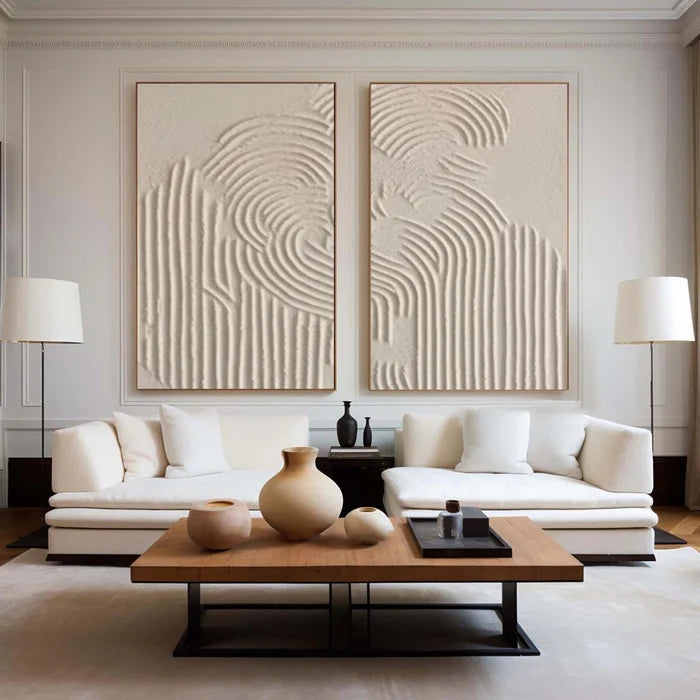
Art Advisory for Your Home: How a Consultation Works
Choosing wall art is a design decision, and some walls deserve more than a search session: an art advisory consultation matches the room's measurements, the owner's taste, and the collection's range into a shortlist of pieces that fit. The service is not a mystery — it follows a clear process of measure, interview, propose, and preview — and this guide explains exactly what the consultation covers, who it suits, and how to begin.
What an Art Advisory Covers
An art advisory starts where the buyer's search usually stops: with the room. The advisor works from the wall's measurements, the furniture beneath it, the room's light, and the palette already in place, then filters the collection to the pieces that fit those numbers. The output is a shortlist — pieces sized, toned, and styled for the specific space, not a catalogue of everything the store sells.
The advisory also covers the decisions the search page cannot: orientation for an awkward wall, one piece versus a set, framed versus rolled, and the budget range that fits the room's role. The advisor's job is to translate the room's constraints into art choices, and the consultation's value is the translation.
The art advisory page describes the service's scope, and the same room-first logic runs through the whole process.
Who Should Use It
The advisory suits the buyers the search page serves least: the buyer with an awkward wall, the buyer who has searched for weeks without a shortlist, the buyer decorating a whole room or home at once, and the designer or stylist working for a client. For those situations, a structured consultation saves hours and lands on pieces the search would have missed.
The advisory also suits the buyer who knows what they do not want — a clear sense of "not busy, not dark, not another landscape" with no positive image of what they do want. The interview step of the consultation turns the negatives into a direction.
The how-to-buy-art-you-love page is the self-guided route for the buyer who prefers to search on their own, and the advisory is the guided route for the walls that need it.
The advisory also fits the buyer who is ready to buy but blocked by choice: the shortlist arrives sized, toned, and reasoned, and the final decision is a review instead of a search. For a designer, the same structure becomes a client-ready proposal; for a gifter, it becomes a recommendation with the fit already worked out. The service adapts its depth to the buyer, and the room-first logic holds in every case.
The Four-Step Process
The process has four steps. Step one is the brief: the buyer shares the room's measurements, photos of the wall, the furniture, and the palette, plus the budget range and the timeline. Step two is the interview: the advisor asks about the room's use, the style direction, and the pieces the buyer has loved or rejected, turning preferences into criteria.
Step three is the proposal: the advisor returns a shortlist of pieces — sized and toned for the room — with the reasoning for each choice. Step four is the preview: the chosen piece goes through the standard preview step, the buyer approves the exact piece, and the order proceeds with the made-to-order process. The four steps make the service predictable: brief, interview, proposal, preview — and the same four steps set the timeline, with the proposal returning on the service's stated turnaround and the preview following the standard made-to-order window once the piece is chosen.
The editors-picks collection shows the kind of curated shortlist the proposal step produces, and the process itself is the same one the studio uses for its own walls.
Advisory vs. Self-Guided Shopping
The advisory and self-guided shopping answer different needs. Self-guided shopping works when the buyer knows the room and the style: the size guide, the collections, and the search filter are enough, and the buyer enjoys the process. The advisory works when the room is complex, the buyer is stuck, or the stakes are high — a whole room, a designer's client, a gift that must land.
The difference is the decision effort, not the quality of the pieces: both routes end at the same collection and the same made-to-order process. The advisory simply moves the research and the filtering off the buyer's shoulders, and the buyer reviews the shortlist instead of building it.
The self-guided route is free and immediate; the advisory route trades time for structure. Neither is better — the wall and the buyer decide which one fits.
The two routes can also combine: a buyer can self-guide the first room, see how the process feels, and bring the harder wall to the advisory — the second room's awkward proportions or the whole-home project. The routes are not rivals; they are two levels of the same collection, and the room's difficulty picks the level.
How to Get Started
Starting is a small step: reach the art advisory page, send the room's basics — measurements, photos, palette, budget range, timeline — and the conversation begins with the brief. The advisory page states how the service begins and what the buyer should prepare, and the FAQ page answers the common questions about the process.
The consultation is also flexible about its ending: some buyers take the shortlist and make the final choice themselves, others ask the advisor to narrow it to one piece, and designers often take the proposal back to their clients for approval. The service scales to the buyer's need, and the four-step process holds the structure while the depth flexes. The advisory page describes the options, and the interview step settles the level of hand-holding the room wants.
The preparation is simple: photograph the wall, measure the furniture beneath it, and note the room's tones. The better the brief, the sharper the proposal — the advisor works from what the buyer provides, and a documented room produces a shortlist that fits. The timeline matters in the same brief: a wall that must be ready for a gathering or a move-in sets the pace for the making and shipping window, and the advisor plans the proposal around it.
The consultation's first reply is usually the confirmation of the brief and the questions that sharpen it — the advisor may ask for a photo at a different angle or the sofa's exact tone before proposing. That back-and-forth is part of the service, and the buyer who answers it quickly moves the process forward.
Vinchy Art Studio Recommendation
In the Vinchy Art studio, an advisory consultation follows the room: measure, interview, propose, and preview — with the wall's numbers, the owner's taste, and the collection's range meeting in a shortlist. The studio recommends the advisory for awkward walls, stuck searches, whole-room projects, and designer clients, and the self-guided route for buyers who enjoy the search. Both routes end at the same preview step, and the piece is confirmed before it ships.
Conclusion
An art advisory is a structured translation of the room into art choices: the brief and interview set the criteria, the proposal delivers a shortlist sized and toned for the wall, and the preview confirms the exact piece. It suits the awkward wall, the stuck search, and the whole-room project, while the self-guided route serves the buyer who enjoys the hunt. Start with the room's numbers, and the consultation turns "find me something" into a shortlist that fits.
Advisory Checklist
- Room measured and photographed
- Furniture and palette documented
- Budget range and timeline noted
- Brief sent through the advisory page
- Interview answers prepared
- Proposal reviewed before the preview
FAQ
What happens in an art advisory consultation?
Four steps: the brief (room measurements and photos), the interview (taste and constraints), the proposal (a shortlist sized and toned for the room), and the preview (the chosen piece confirmed before shipping).
How much does an art advisory cost?
The service's pricing and details are stated on the art advisory page. The value is the structured shortlist — the room's constraints translated into pieces that fit — and the page describes the service's scope.
Who should use an art advisory?
The buyer with an awkward wall, the stuck search, a whole-room or whole-home project, a designer working for a client, or a gift that must land. The advisory suits the walls the search page serves least.
What should I prepare before the consultation?
Photograph the wall, measure the furniture beneath it, note the room's tones, and set the budget range and timeline. The better the brief, the sharper the proposal.
Is the advisory different from the preview step?
Yes — the advisory is the selection service (brief, interview, proposal), and the preview is the standard made-to-order confirmation of the chosen piece. Both routes to the same collection end at the preview, and the preview is where the piece is finally approved.
Book a Consultation
Start with the art advisory page above at Vinchy Art — send the room's measurements and photos, and the studio turns the brief into a shortlist that fits.