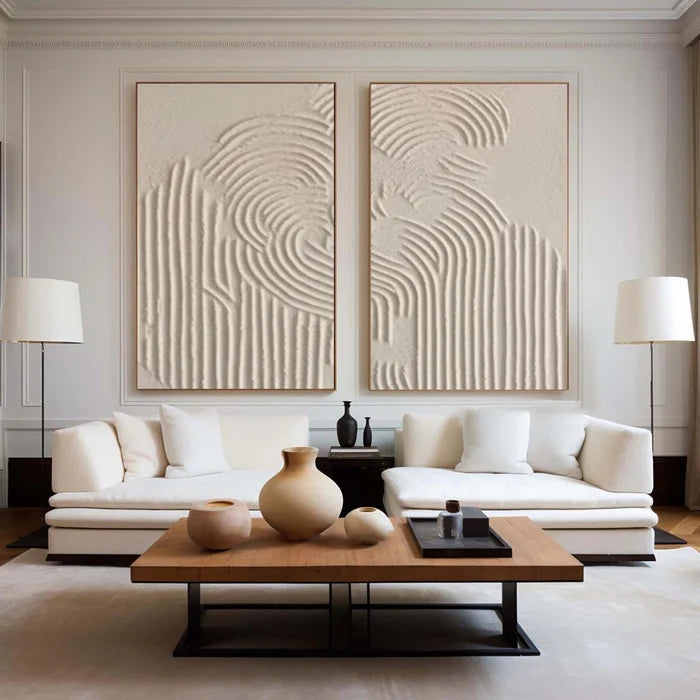
Bathroom Wall Art: Humidity-Safe Choices
Bathrooms ask more of wall art than any other room, and the honest part of the answer is that not every canvas belongs there. Steam, splashes and constant humidity are real risks for natural materials: a canvas is a porous surface designed to breathe, and water vapour is exactly the thing that settles into it. None of this means you cannot hang art in a bathroom. It means the smart plan is to choose the right piece, place it in the driest zone, and manage the moisture with a few simple habits. This guide explains what humidity actually does to a textured canvas, how to read the signals your own bathroom gives you, where the safe zones are, and when a framed print or a ceramic piece is the honest better call.
What humidity does to a canvas
Canvas responds to humidity slowly, which is why the damage is easy to miss until it is established. The most common effect is the one you feel before you see: the fabric relaxes, and the surface begins to sag or loosen from the stretcher bars. High moisture can also soften the sizing, the natural layer that gives a textured painting its stiffness, and in the worst cases condensation sitting on the back of an unframed canvas creates the damp pockets where mould finds a foothold. Textured paintings add one specific weakness: the raised ridges are little pockets where moisture lingers, and the deeper the texture, the longer the surface stays damp after a hot shower. None of these outcomes is immediate, and a well-ventilated bathroom may never trigger them. But the risk is cumulative, and it is the kind of thing that turns a canvas you love into a disappointment after a humid season or two.
Read your own bathroom before you buy
Before you hang anything, measure the moisture of the room rather than the beauty of the painting. The decisive question is whether your bathroom dries out between uses. Walk in ten to fifteen minutes after a shower: if the mirror fogs every single time, if the walls feel cool and damp, or if you can see condensation on the window, that is a room with a real humidity load, and any canvas will be fighting uphill without mitigation. The same walk in a powder room with no shower, or in a bathroom with a window that opens and a ceiling extractor that runs, points to a much lighter risk. As a general rule, a bathroom that returns to dry air within an hour of use is a reasonable home for canvas; one that stays damp all day deserves sturdier materials or a different spot.
The zoning rule: not all walls are equal
Risk is not uniform across the room. Treat the layout like approximate moisture zones. The wall directly facing the shower head is the highest risk, because warm steam travels straight at it and lands on the surface. The wall behind the door, and the stretch opposite the shower, have the least exposure depending on where the steam goes. The dryest spot is generally the wall farthest from the shower, or the wall opposite an open window if you have one. If you are working with a powder room that has no bathtub or shower at all, you have the rare luxury of a room where canvas is as safe as it is in a hallway. For a full bathroom, a workable rule is to keep canvas at least 1.5 to 2 metres from the shower opening, and never directly above a radiator, where drying heat and rising steam meet on the frame and stress the surface from both sides.

When a textured canvas can work
Having said all of that, many people do hang textured canvases in bathrooms, and in the right slot they last for years. The conditions that make it work are a ventilated room, a wall roughly a metre and a half or more from the shower head, and a habit of running the extractor during and after showers. If your home cannot keep that balance, protect the canvas in the simplest ways: leave the back open to the air rather than sealing it shut, keep it out of the top corners where humidity pools, and hang it high enough that daily splashes never reach it. And be honest about the trade-off: if the only wall that shows well is directly opposite the shower, a canvas is the occasional luxury decision, and it should be treated as an item with a shorter planned life in that spot, or moved on before it degrades.
The honest alternatives when the room says no
- Framed prints under glass - the glass keeps water off the paper, and as long as the back of the frame can breathe, condensation forms on the glass rather than inside the fibre.
- Art on a waterproof medium - ceramic, glazed porcelain or sealed metal panels shrug off steam and can be wiped clean without stress.
- Canvas in a dry corridor - the same canvas you love can hang in a hallway or a landing instead, giving the whole home the texture while the steamy room gets a more weatherworthy piece.
- Fix the room first - an extractor fan that actually moves air, a window left ajar, and a door left open after a shower change the risk profile of every artwork you already own, not just the new one.
A practical working checklist
- Check the room 10 to 15 minutes after a shower: if it is still damp, expect canvas to sag over months.
- Hang canvas in the dry zone: the far wall from the shower, or a powder room with no shower at all.
- Keep canvas at least 1.5 to 2 metres from the shower opening, and away from the direct steam path.
- Vent: extractor on during and after the shower, window cracked, door ajar. If there is no extractor, this is the single most useful fix.
- Inspect the back of the canvas every few weeks in a borderline room: softness, sag or a musty smell is the signal that the room is slowly hurting the surface.
Seasonality and the steamy season. Humidity is rarely constant across the year, so review the same bathroom in different seasons before you judge it. In many homes, summer brings open windows and low indoor humidity, while winter showers with closed windows create the heaviest load. A bathroom that feels fine in July can challenge a canvas by January. If the room is borderline, make seasonal checks part of your routine: after a couple of cold months, look at the back of the canvas and the stretcher for signs of sag. Knowing the room’s peak season tells you whether a canvas is a reasonable year-round choice or a fair-weather guest that should move to a dry wall when the weather turns.
Size and placement do the work that material alone cannot. A smaller canvas high on the driest wall will shrug off a bathroom’s humidity far longer than a large piece in the steam zone, simply because there is less surface area collecting moisture. If you are set on canvas in a borderline room, favor a piece sized to the wall and placed above towel storage rather than directly across from the shower. Mount it with a little air space at the back, using a frame or hanging system that stands a few millimeters off the wall, so vapor can escape instead of pooling behind the canvas. Those choices ask nothing of the material and everything of the position, which is where the real protection lives.
Match the art to the wall, not the room’s idea. Advertising photos and showroom bathrooms almost always show canvas in a dreamy steamy space, which quietly sets an expectation that reality cannot meet. The honest version is the reverse: the art should match the wall it will live on every day, not the room you imagine. If the bathroom wall is exposed to steam, choose the ceramic or the glass-fronted print for that wall, and keep the textured canvas for the hallway or the landing where it will stay handsome for decades. That is not settling; it is placing each piece where its life is longest, which is what this guide has been about all along.
The takeaway
Bathroom wall art is a decision about your specific room, not a universal yes or no. If the bathroom dries out promptly, the shower is contained at one end, and the canvas hangs on the dryest wall with air at the back, a textured piece can live a happy daily life. If the room is humid and there is no easy way to change that, choose glass or ceramic instead, or let the texture live in a dry room and enjoy it there. The kindest thing you can do for a canvas you love is put it where the walls can keep it, and the kindest thing you can do for a bathroom is choose art the walls there can host for years without a mark. That trade-off is the whole guide in one line.
To explore more options, see blue-green abstract art and our full painting collection.