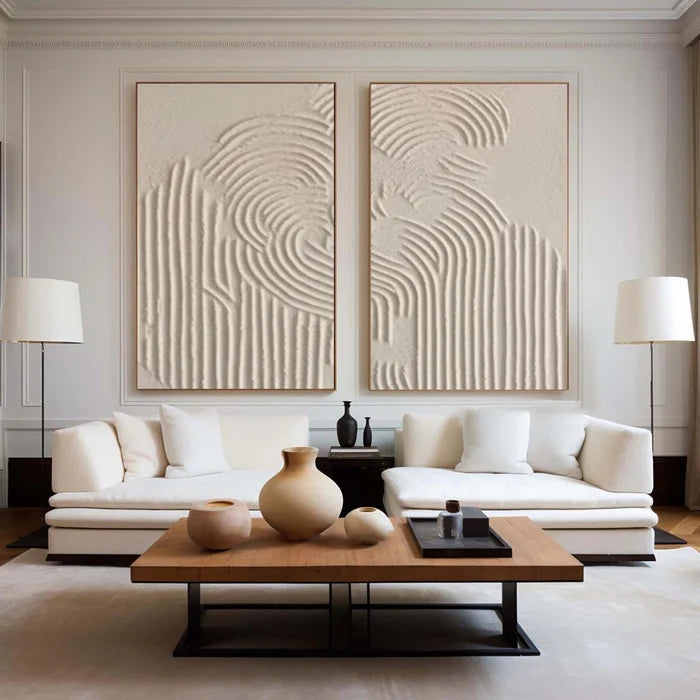
Bedroom Textured Wall Art: Layering Guide
Bedrooms are the one room where wall art is seen from lying down, sitting up and walking past, sometimes all within the same hour. That mix of viewing heights is exactly what textured art is built for: its depth changes with your angle and with the light, so a single canvas keeps giving the room something new, while a flat print stays flat from every direction. But texture in a bedroom also needs a plan. The headboard, the bedding, the window light and the bedside lamps decide whether the canvas reads as sculptural or as a heavy dark rectangle on the wall. This guide walks through the layering from the wall out: the anchor, the support, the light, and the mistakes that quietly flatten everything.
Start with the anchor above the bed
The most important position in the room is the wall above the bed, and the sizing convention is reliable enough to follow without anxiety: the art should span roughly two-thirds to three-quarters of the bed width, with the bottom edge about 15 to 20 cm above the headboard. A single textured statement here does most of the room's design work, and it deserves to be the piece with the most depth, not the safest. If the bed is a king or queen, the anchor will be a substantial canvas, so check the weight and the fixing before you commit; a heavy textured canvas needs two mounts, properly rated, rather than one optimistic hook. Once the anchor is right, every other decision in the room can be taken against it, which is a surprisingly calming way to finish a bedroom.
The second layer: support pieces at sitting height
Not every wall needs an anchor. The wall beside the bed, or the one opposite it, takes a quieter layer: a smaller textured piece hung at what we can call resting height, roughly where the eye lands when you sit in bed with a book, not standing height in the doorway. That support piece should stay visually lighter than the anchor, especially if the room is small, so the hierarchy of the wall stays clear. If you have a reading corner or a deep window wall, this is where a second piece earns its place without crowding. When you pair two pieces, echo one material or one colour family from the anchor, so the wall reads as a set rather than two canvases that happened to share a room.
The headboard: the texture you already own
The headboard is the most overlooked layer in a bedroom composition. A textured canvas above a smooth wooden headboard works instantly, because the wall then has two clearly different surfaces for the eye to separate. Against a padded or upholstered headboard, the canvas should stay calm; when both layers are heavily textured, the eye skips between two competing surfaces in the same glance. A simple working rule is one strong texture per sight line: if the headboard is fabric, choose a canvas with gentle ridges; if the headboard is smooth wood or painted, let the canvas carry real depth. On a bed with a tufted headboard, a calm textural canvas tends to feel more composed than a heavy one, because the tufting is already doing the pattern work.
Lighting: the layer that reveals the surface
Texture only exists for the eye when light crosses it from a direction. A ceiling fitting straight above washes the surface flat, and a textured canvas in that light looks thinner than it is. A bedside lamp, or better, a wall light aimed across the surface, makes the ridges cast soft shadows and the material suddenly reads. If the only light in the room is a ceiling fitting, a picture light above the piece is the single highest-impact addition you can make; it transforms a textured canvas more than it could ever change a flat print. In rooms with strong morning sun, texture will do most of its showing in the first part of the day, so place the anchor on a wall that receives side light rather than one the sun hits dead on.

Side walls, corners and the foot of the bed
Bedrooms rarely need art on every wall, and that restraint is correct. A single smaller textured piece on the side wall, hung at resting height, gives the room a second beat without competing with the anchor. Corners between windows borrow light beautifully and are among the easiest places to make texture visible, but only if the wall is wide enough that the canvas does not touch the trim. Over the foot of the bed, a long low horizontal piece can make the view from the pillow calm and grounded, especially in a guest room. The helpful pattern is simple: the farther the piece sits from the bed, the smaller it can be, and its texture becomes an accent that supports rather than shouts.
Colour, mood and the light you live with
Textured art also behaves differently with wall colour. On a mid-toned wall, the raised surface needs contrast to be visible, so a slightly deeper ridge or a tone with more shadow in it helps; on a pale wall the same texture reads soft and quiet. A bedroom with warm white walls and a neutral textured canvas looks airy and calm; if the wall is already moody and dark, keep the texture gentle and light it deliberately, or the piece will sink into the wall at night. In dim evening light, a very dark textured canvas can almost disappear except for its highlights. If the canvas is the room's evening focal point, choose medium tones with visible ridge light rather than a near-black surface that only photographs well.
A room layout you can follow
- Measure the bed, and size the anchor to two-thirds to three-quarters of its width.
- Hang the anchor so its bottom edge sits roughly 15 to 20 cm above the headboard.
- Watch the sides: add one smaller textured piece at resting height, in the same colour family.
- Light the anchor from one side, with a wall lamp or a picture light, rather than from the ceiling.
- Keep the texture hierarchy: no more than one heavily textured surface per sight line.
Layering with the bedding palette is the layer everyone forgets, and it can be done in a quiet way. The bedding does not need to match the canvas; it needs to sit in the same warmth axis. A neutral textured canvas above warm white sheets and a linen throw reads complete, while the same canvas above bright, saturated bedding starts to feel disconnected. If the room has many colors in the pillows and the throw, keep the canvas quieter, and let the texture do the talking. If the bedding is plain, the canvas can carry more presence. That exchange - bedding energy against canvas energy - is the fastest way to fine-tune a bedroom without buying anything new.
Texture and scale in small bedrooms. In a compact room, a large textured anchor can still work if the supports stay small and the wall color stays light. Scale is not the enemy; clutter is. If the room is small, choose one textured piece with deep but even relief rather than several smaller textured pieces scattered around, because each scattered texture pulls the eye somewhere new. One confident surface, supported by plain walls and plain textiles, makes a small bedroom feel bigger than five interesting surfaces fighting for attention. The texture then reads as a material feature of the room, not as a collection of objects.
Test the axis by taping first. Before you commit the hardware, tape the outline of the canvas on the wall and look at it from the pillow for a couple of evenings. The tape test settles the two questions that photos cannot: whether the anchor is the first thing you see when you lie down, and whether it should sit 15 cm or 20 cm above the headboard. Textured pieces are heavier to move than prints, so a tape trial costs nothing but saves the one chore every bedroom owner knows - patching, repainting and rehanging after the first sight line disappoints. Give the axis one honest evening and the piece will earn its permanent spot.
The real takeaway
Bedroom textured wall art succeeds by layers, and by judging the room from where you actually sit and lie, not from the doorway. Anchor above the bed, support at resting height, side light to reveal the surface, and restraint around the headboard. When you give a textured canvas a clear wall, a measured position and the light to show its material, the bedroom stops being a collection of decorations and becomes a place where the walls quietly reward their lookers every evening. That is the difference decoration makes when it respects the room instead of competing with it.
To explore more options, see bedroom wall art and our full painting collection.