Choosing Wall Art for Modern Farmhouse Rooms That Need Warmth Without Clutter
Modern farmhouse rooms can feel incomplete when the wall art leans too rustic, too polished, or simply too small for the furniture below it. The right wall art for modern farmhouse interiors brings together the style’s best tensions: clean-lined architecture and aged-looking materials, neutral palettes and dark contrast, relaxed comfort and deliberate editing. Rather than filling every wall with signs, sayings, or matching décor, choose art that gives the room a focal point and a sense of hand-finished depth. A large landscape, a quiet abstract, or a textured painting can do more for a shiplap wall or plaster-toned living room than a collection of generic farmhouse motifs.
Start With the Room’s Existing Contrast
Modern farmhouse style is not defined by a single subject such as barns, cows, or botanical sketches. It is defined by balance. A room may have white oak flooring, black window frames, linen upholstery, warm white walls, and a vintage wood table; the art should connect those elements without repeating them too literally.
For a living room with substantial beams, reclaimed wood, or a stone fireplace, a contemporary abstract painting can provide welcome restraint. Look for broken neutrals, charcoal gestures, muted olive, soft blue-grey, or earthy terracotta rather than a heavily detailed rustic scene. The hand-painted surface keeps the piece from feeling cold beside natural materials.
In cleaner spaces with flat-panel cabinetry, simple lighting, and fewer architectural details, a pastoral landscape, soft floral painting, or tonal tree composition can introduce the organic note that makes modern farmhouse feel lived-in. Kitchen-focused farmhouse art often draws on botanicals, rural scenes, culinary subjects, and black-and-white imagery, but it works best when the palette relates to the room instead of introducing several unrelated colors.
Choose a Subject That Feels Collected Rather Than Themed
The most convincing modern farmhouse walls usually avoid turning a room into a literal farm narrative. A single animal painting or rural landscape can be charming; several pieces featuring the same motif can quickly feel like a retail display.
A landscape does not need to show a barn to feel at home in this style. Misty hills, coastal horizons, distant trees, and open fields offer a slower visual rhythm. Likewise, abstract art does not need to be loud or urban. Broad brushwork in limestone, sand, taupe, faded green, or smoke blue can hold the room together while allowing wood grain, textiles, and vintage objects to remain visible.
Let Size Do the Heavy Lifting
One common mistake with wall art for modern farmhouse interiors is choosing a piece based on the empty wall alone. Art should be measured against the furniture, fireplace surround, or architectural zone it is meant to anchor.
Above a sofa, a single horizontal painting generally has more presence than several undersized frames. Above a long sideboard or dining bench, a wide composition or a measured set of two can create a calm visual line. In a narrow entry, vertical artwork can lift the eye and make the ceiling feel more generous.
As a practical starting point, aim for artwork that spans roughly two-thirds to three-quarters of the furniture width beneath it. This is a proportion guideline, not a rigid rule; a heavy fireplace mantle, tall ceiling, or deeply textured painting may call for a different visual balance.
A painting can be technically “large” and still look lost if it sits over an oversized sectional or a wide console. Conversely, art that is too wide may crowd lamps, shelves, or architectural trim. Tape the intended dimensions on the wall before ordering, then view them from the room’s main seating position.
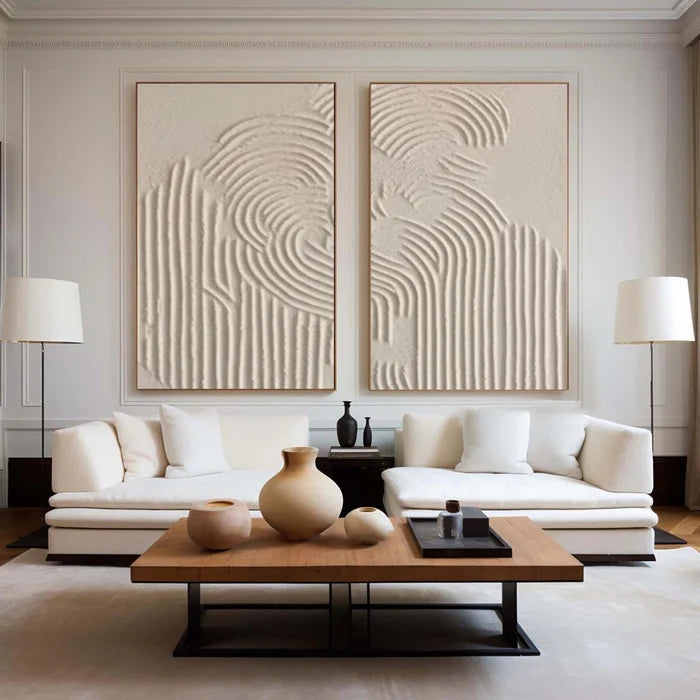
Sets of two work especially well over sideboards, paired nightstands, and long dining-room walls. A set of three can suit a larger sofa wall, but only when the spacing is consistent and the individual canvases have enough scale. If each panel is small, more panels usually create more visual noise rather than more impact.
Texture Is Often the Missing Farmhouse Element
Modern farmhouse décor relies on tactile contrast: woven linen beside smooth metal, rough timber beside clean plaster, aged ceramic beside glass. Flat printed décor can match the colors of the room yet still leave the wall feeling visually thin.
A handcrafted painting with visible brushwork, layered pigment, or plaster texture brings shadows and depth that change gently throughout the day. This matters most in neutral rooms, where texture often has to do the work that bright color would do elsewhere. A beige or off-white textured painting can read as subtle in direct daylight and more sculptural under evening lamps.
That said, texture is not automatically the right answer. Highly raised plaster art can compete with heavily grained wood, stacked stone, or a busy patterned rug. In those rooms, choose a smoother hand-painted abstract or a landscape with restrained brushwork. The aim is contrast, not a contest between surfaces.
Build a Palette From the Fixed Elements
Before choosing color, identify the room’s least changeable elements: flooring, sofa upholstery, cabinetry, stone, window trim, and large rugs. Modern farmhouse rooms often have creamy whites, mushroom beige, greige, natural oak, black, faded greens, and soft blues already in play.
Art does not need to match each shade precisely. In fact, exact color matching can make a room feel overly coordinated. A better approach is to repeat one or two existing tones while introducing a related note. For example, a room with oatmeal linen and black metal details may suit a warm neutral abstract with charcoal marks. A white kitchen with oak shelves can take a sage botanical or a dark, moody still life that gives the room needed grounding.
Lighting deserves equal attention. Under warmer 2700K bulbs, beige, brown, and ochre tones often appear richer, while blue-grey paintings can look quieter. Cooler 4000K light may make whites appear sharper and reveal cooler undertones in grey, green, and blue artwork. Product photos are useful, but your own room lighting determines the final experience.
Avoid the Modern Farmhouse Clichés That Date a Wall
Typography signs, distressed faux-wood prints, and overly literal farm imagery are not inherently wrong. They simply have a narrow window of success. They work when the home is intentionally casual, nostalgic, or country-forward; they feel less convincing in a modern farmhouse space built around clean shapes and edited materials.
A stronger approach is to use art as the layer that makes the room specific to its owner. An abstract with raw plaster ridges may echo a limewashed wall. A moody animal painting can add character near a breakfast nook. A quiet floral can offset angular black fixtures. These choices still acknowledge the farmhouse vocabulary of nature, warmth, and craftsmanship, but they avoid treating the room as a theme.
If the space already has statement tile, patterned drapery, or a dramatic light fixture, choose art with simpler composition and fewer colors. If the room is almost entirely neutral and rectilinear, the wall art can carry more gesture, texture, or asymmetry.
Buying Handcrafted Art Online With More Confidence
Buying original-looking wall art online involves a practical concern that store displays do not: you need to judge scale, surface, color, and framing without standing in front of the piece. Read the listed dimensions carefully, including whether the measurement refers to one canvas or a full multi-panel arrangement. Check close-up images when texture matters, and review framing, delivery, and return information before making a final decision.
For buyers who want a more tactile alternative to flat printed décor, Vinchy Art offers handcrafted paintings across abstract, landscape, minimalist, textured, and large-format directions. Its Room Preview can help you upload a photo of your blank wall to assess scale before deciding, while its complimentary Art Advisory can help coordinate artwork palettes with paint swatches or fabric textures.
This kind of support is especially useful when a room has competing warm and cool undertones, when a sofa wall needs an oversized focal point, or when you are deciding between one horizontal canvas and a set. It is less necessary when you already know the exact dimensions, orientation, and palette you want—but it can reduce the uncertainty that leads to costly scale mistakes.
Frequently Asked Questions
What type of wall art looks best in a modern farmhouse living room?
Large landscapes, muted abstract paintings, textured neutral art, florals, and selective animal subjects all work well. The strongest choice depends on whether the room needs softness, contrast, color, or a more substantial focal point.
Should modern farmhouse wall art be rustic?
It can include rustic references, but it does not need to look distressed or overtly country-themed. Modern farmhouse art is usually more successful when it combines natural warmth with a cleaner composition or contemporary color treatment.
What colors work best for modern farmhouse wall art?
Warm whites, beige, taupe, brown, charcoal, black, sage, dusty blue, olive, terracotta, and muted gold are reliable directions. Choose colors that relate to fixed materials in the room rather than trying to match every accessory.
Is one large painting better than a gallery wall in a farmhouse-style room?
One large painting often feels calmer and more contemporary, particularly above a sofa, mantel, or dining sideboard. A gallery wall can work in an entry or stairwell, but it needs a clear visual thread in framing, palette, or subject.
Can textured wall art work with shiplap or a stone fireplace?
Yes, but the texture should complement rather than compete with the surrounding architecture. Choose restrained plaster texture near visually busy stone or wood, and consider bolder relief on simpler painted walls.