

How to Hang a Canvas Painting Without a Frame (And When to Frame It Instead)
Quick answer: Frameless canvas — the modern, gallery-style look — hangs with simple hardware. On drywall, use picture hooks (2 hooks for wide pieces) or heavy-duty Command strips for small/light canvases; never hang a heavy canvas with one thin nail. The center of the piece should sit at 57–60" / 145–152 cm from the floor. Vinchy Art''s frameless canvases arrive ready to hang (hooks included); framed originals ship in wooden crates and hang the same way. Here is the full how-to, including the catches (studs, plaster, humidity) and when framing is actually the right call.
1. What "Frameless" Means (And Why You Have It)
A frameless (gallery-wrapped) canvas has the artwork painted around the edges; there is no frame — the canvas itself is the finished object. It''s the modern look for abstract, 3D-texture, and minimalist originals, and it costs less than framed. Vinchy Art ships frameless canvases ready to hang, hooks included — your only job is picking the right wall hardware and the right spot.
Ready-to-hang vs. rolled: Vinchy''s frameless option arrives mounted and ready (which is what this guide covers). Rolled canvas arrives in a tube without a frame — that''s the "buy framing locally" version, and yes, it usually deserves a real frame (section 5).
2. The Quick Method (Drywall, Most Paintings — 5 Minutes)
Light canvas (under ~3 kg / 7 lb):
- Mark the center height: 57–60" to the middle of the piece (145–152 cm).
- Use a picture hook (not one thin nail) — two hooks for wide pieces, one per mounting point.
- Level it, done.
Heavy canvas (large originals, thick 3D texture):
- Find the stud with a stud finder, or use two anchors rated ≥10 kg (22 lb) — never a single nail for large textured pieces.
- Use D-rings / hooks on the canvas''s back bar (it has them) and appropriate wall hooks.
- Center at eye level; for pieces above a sofa, leave 6–12" / 15–30 cm between sofa and canvas bottom.
Rule: for anything larger than ~60×90 cm (24×36"), use two anchor points, not one. One nail is how walls get gouged.
3. The Alternate Method (No Nails — Command Strips, Renting, Tile)
Heavy-duty Command picture-hanging strips work for smooth, painted drywall and light-to-medium canvases (check the weight rating; many hold up to ~7 kg / 16 lb per pair set).
- Clean the wall with rubbing alcohol, let it dry.
- Attach strips to the canvas back bar (two sets for wide pieces), press firmly.
- Press the canvas to the wall for 30 seconds, then wait 1 hour before "testing" — the bond needs time.
- Removal: pull the tab straight down slowly (not toward you) to release without damage.
When Command is the wrong answer: textured/plaster walls, humid rooms, anything heavy, or if the installer is even slightly impatient (the 1-hour wait is real). Do not trust strips for a $1,000+ original in a humid coastal room.
4. Leveling, Positioning & the Three Rules That Make It Look Right
- Eye level rules: center of the artwork at 57–60" (145–152 cm). For above a sofa, 6–12" gap; for a fireplace, still center at eye level, not floating above the mantel.
- Size rules before hanging: artwork = 60–75% of wall width (or 50–65% of the sofa). If it looks small, fix the size before you fix the nail.
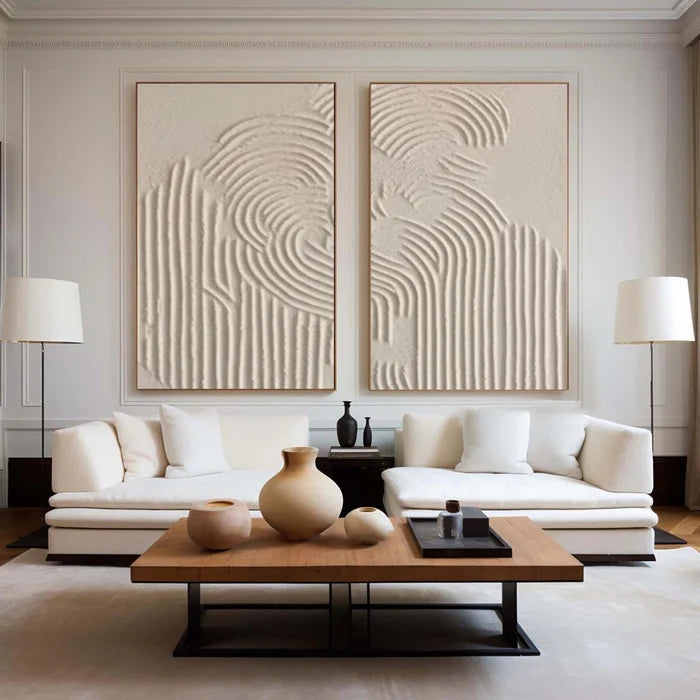
- Group balance: hang sets (diptych/triptych) as one unit — combined width is the artwork; keep 2–3" between panels; level the set, not just the first piece.
Pro tip: lay the canvas where it will hang, step back, live with the spot for a day — moving a nail is cheaper than moving a hole.
5. When You Should Frame It Instead
Frameless is clean, but some pieces genuinely want a frame:
- Rolled canvas — always: it has no hanging system until you frame or stretch it locally. A floater frame is the classic choice for a gallery wrap.
- Classic/heirloom portraits or landscapes — a frame adds formality and protection; custom family portraits read better framed.
- Very large or very valuable pieces — a frame protects the edges and reinforces the structure; consider a shallow floater frame so the canvas stays the star.
- Design demands — a gold or black frame can tie a room together; Vinchy''s framed option (colors: black/silver/white/wood/gold) is the easy path for this exact reason.
When framing is a mistake: 3D-texture and impasto pieces shine bare — a frame competes with the texture and can crowd a work meant to be a wall's tactile centerpiece. Frameless is also cheaper and lighter to ship.
6. Safety & Care After Hanging
- Never hang above direct heat or radiators.
- Avoid direct sunlight on the canvas — UV fades oil paint.
- Dust with a soft dry brush; never spray cleaner on the painted surface.
- Check the hardware twice a year — heavy canvases slowly loosen their hooks; a 30-second re-check prevents a crash.
- In humid rooms, use anchors rated for the weight and expect Command strips to fail — go with screws.
FAQ
Q: Do I need a frame for a vinyl/frameless canvas?
A: No — frameless canvases are designed to hang bare (hooks included). Framing is optional and often unnecessary, especially for textured/abstract pieces.
Q: How high should the center of a canvas be?
A: 57–60" / 145–152 cm from the floor; 6–12" above a sofa; center at eye level above a fireplace.
Q: Can I hang a heavy canvas without a stud?
A: Yes — use two anchors rated for the weight (≥10 kg / 22 lb for large pieces). One thin nail is never enough.
Q: Do Command strips work for canvas?
A: Yes for light/medium pieces on smooth painted drywall, with the 1-hour bond wait and straight-down removal. Not for heavy, textured, or humid locations.
Q: What''s the difference between Vinchy''s framed and framed-not options?
A: Frameless arrives ready to hang, hooks included. Framed arrives in a wooden crate, framed in your chosen color (black/silver/white/wood/gold). Rolled arrives in a tube for local framing.
Q: Should a 3D-texture painting be framed?
A: Usually not — frameless lets the texture be the centerpiece. If you frame it, use a slim floater frame.
Related reading: part of the Vinchy Art Review — The Complete, Data-Backed Guide. For sizing before you hang, How to Choose the Right Size Abstract Painting; for style placement, Abstract Art for Living Room: Placement & Styling.

%20or%20heavy-duty%20Command%20strips%20for%20small/light%20c...)