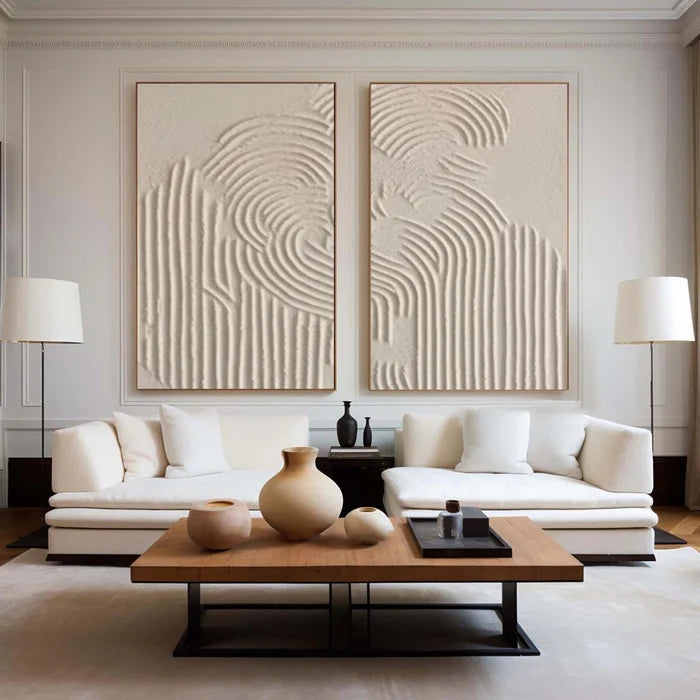
How to Layer Wabi-Sabi: Texture, Light and Quiet Color
Wabi-sabi rooms photographed beautifully in magazines share a secret that has nothing to do with money: they are layered. The calm you see is not one perfect object - it is a sequence of surfaces that hold different jobs: a textured canvas that anchors the wall, light that arrives at an angle and carves shadows, and a quiet palette that lets both breathe. When those three layers cooperate, the room looks effortless. When they are bought separately and simply hung, the result looks like a storage room for beige. This guide explains the order of layering, how to choose each layer, and how to verify the combination before you commit.
The order matters: texture first, light second, color last
The instinct is to choose color first, but wabi-sabi works in reverse. Begin with the textured canvas because it is the most physical object in the room - the one thing that casts its own shadows. Then place the light to make that texture visible; then let the palette fall quietly around both. If you start with color, you will end up matching a painting to a sofa and discovering too late that the wall has lost its depth. Starting with texture gives the eye a center, and everything else arranges around it.
Write that order down: surface, light, palette. It will resolve most layering debates before they start, because most failed wabi-sabi rooms are not wrong in any single choice - they are wrong in sequence, with color chosen before the surface had a say.
Layer one: one honest textured surface
The first layer is a single textured canvas with real relief - plaster ridges, combed waves, or heavy brush marks that stand above the canvas. Choose it in the tonality you want the room to breathe: sand and clay for warmth, ash and stone for quiet. The size should claim the wall's center without filling it - about half to two-thirds of the wall width is the reliable band, and the relief should be visible from your main sitting position, not merely from close up.
Test the surface before falling for the picture: run a phone light at a low angle and watch whether the ridges catch and break it. A canvas that passes is worth the space of five flat objects, which is what makes the layering honest - the first layer does so much work that the later ones can stay humble.

Layer two: light that arrives at an angle
The second layer is the light, and it is the layer most people skip. A textured canvas under an overhead globe looks flat and gray; the same canvas under side light comes alive with shadow and glow. The wabi-sabi standard is a lamp or window that sends light across the surface at roughly 30 to 45 degrees, from one side. That angle makes the high ridges glow and the valleys hold dark, and it turns a static surface into a slowly changing one as the day moves.
Move the lamp before you move the canvas. Place the light where it skims the surface, then walk the room and watch the change; if raising or shifting the lamp by thirty centimetres makes the ridges readable, the canvas has found its light. This is a two-minute test and it is more reliable than any photo of the room.
Layer three: quiet color that repeats the surface
Once the surface and light are placed, the palette becomes simple: let the colors echo the canvas instead of competing with it. Take one tone from the painting - the sand, the clay, the ash - and repeat it at low strength in the room: a cushion, a throw, a vase, a curtain line. The repetition is what makes the canvas feel native rather than bolted on, and because the tones are quiet, the room stays calm.
The rule that protects the layer: repeat one tone, not the whole painting. If the canvas has three tones and you buy objects in all three, the room turns into a palette spreadsheet. Pick the tone that appears most in the largest area of the canvas and repeat just that one; the other tones stay exclusive to the painting, which is exactly what makes it the center.

Furniture as a layer, not an interruption
Furniture is the fourth layer, and it should be lower and simpler than the eye expects. Wabi-sabi layering thrives on contrast of height: the canvas and its light up high, the furniture deliberately low - a floor-low sofa, a squat stool, a low sideboard. The vertical gap between the high textured surface and the low furniture is what creates the breathing space the aesthetic lives on.
Keep the furniture natural in material and neutral in color, and resist the urge to add a second textured item in the same sight line. If the rug already has texture, let the canvas be the only raised surface on that wall, and let the rug's texture stay low and horizontal. Each layer has its own plane: wall texture vertical, floor texture horizontal - and the room holds both without argument.
Layering one room first, then the next.
Wabi-sabi layering does not demand the whole home change at once, and trying to layer everything at once usually fails because the light and color steps are skipped under time pressure. The disciplined route is one room - the one you actually sit in - layered fully in the order above, and only then moved outward. A single well-layered corner changes how the whole apartment feels through the doorway, which is more persuasive than three half-finished rooms.
The doorway is the honest viewpoint. Layer the reading corner or the bedside wall first, then stand at the room's entrance and check whether the layer triangle reads from there. If it does, the next room becomes a repetition of a proven formula rather than a fresh gamble, and the light and palette habits carry over.
The one-layer failure and how to spot it
Most wabi-sabi disappointments come from a single-layer room: one textured canvas, overhead light, and furniture bought before the canvas existed. The symptoms are predictable - the painting looks flat, the room looks unfinished, and the owners blame the painting. The check is simple: stand at the doorway at night with a floor lamp off, then turn it on and point the light at the surface from the side. If the room instantly improves, the layers were always there; they were just missing the light step. If it does not improve, the canvas itself may be too shallow or too dark for its wall - the one case where the first layer, not the order, was the mistake.
A layering plan for one corner, in order
- Hang the textured canvas first, center it, and leave its wall otherwise empty.
- Move in the light: one lamp or the window's natural angle crossing the surface from the side.
- Look at the canvas at night and in daylight; adjust the lamp until the ridges read clearly in both.
- Repeat one quiet tone from the canvas in two or three small objects in the room.
- Bring in one low natural piece of furniture, keeping the vertical gap generous.
- Stop. Add nothing for two weeks, then decide if a fourth object is truly missing.
The last step is the one that protects the layered look. Wabi-sabi is achieved by stopping, not by completing, and the two-week pause is how you tell the difference between a room that is done and a room that is merely still empty.
Verifying the whole composition in one evening
When the layers are in place, run the evening test. At dusk, switch to the side lamp only, stand in the doorway, and let your eyes move from the canvas to the repeated tone object to the low furniture. If the eye travels a relaxed triangle - up to the texture, across to the quiet color, down to the low line - the layering is working. If the eye jumps straight to a bright object or a second texture, that object is out of layer and the room will tell you by feeling busy. Wabi-sabi layering done right reads as a composed pause; the test simply checks whether the pause has arrived.
Why three layers are enough
The discipline of wabi-sabi layering is that three elements - one true surface, one angled light, one quiet repeated tone - carry a room that a hundred objects could not. The canvas gives the wall its heartbeat, the lamp gives the surface its life, and the palette gives the composition its voice. Add the low furniture as the frame and then stop, and the corner will keep being beautiful on days you never think about it. That is the real test of layering: not whether it photographs well in afternoon sun, but whether it still holds the room on a Tuesday night with one lamp on and everything else quiet.
To explore more options, see wabi-sabi art and beige and brown minimalist art.