

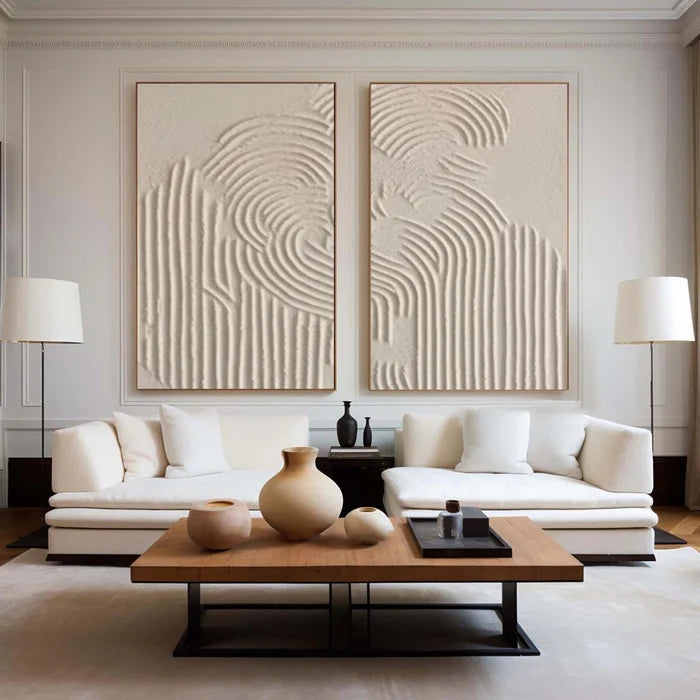

Large paintings for sale that actually solve the problem of oversized empty walls
A vast wall can make even well-designed spaces feel unfinished. This is where large paintings for sale become less about decoration and more about architectural balance. In hotel lobbies, double-height living rooms, or wide hallway expanses, small or medium artworks simply disappear. The real challenge is not just filling space, but choosing a piece that holds visual weight, maintains detail at scale, and survives the logistics of shipping and installation. Oversized hand-painted art works when it combines presence with surface depth, giving the wall something to “do” rather than just something to “show.”
Why scale alone is not enough in large-format art
A common mistake in sourcing large paintings is assuming that bigger automatically means better. In reality, scale without structure often results in flat, lifeless walls.
Large surfaces need compositional strength. This means the artwork must carry rhythm, contrast, and movement across its entire width, not just a focal center. Abstract compositions tend to perform well here because they can distribute visual interest evenly, while textured techniques—such as layered plaster or heavy brushwork—prevent the piece from feeling like an enlarged print.
Texture becomes critical at this size. From a distance, it creates depth; up close, it rewards inspection. Without it, oversized paintings can feel surprisingly hollow, especially under strong lobby lighting.
For those evaluating options, browsing a curated selection like Large Format Art can clarify how scale and surface interact in real pieces rather than isolated product images.
Where oversized paintings make the strongest impact
Large paintings behave differently depending on the environment. A hotel lobby, for example, demands immediate visual anchoring. Guests enter, scan, and form impressions within seconds. The artwork becomes part of that first impression.
In residential settings, the role shifts slightly. A grand living room or stairwell benefits from a piece that unfolds slowly, revealing layers over time rather than delivering instant impact.
Consider how placement changes perception:
-
A lobby wall benefits from bold contrast and readable forms at a distance.
-
A long corridor works better with horizontal compositions that guide movement.
-
A double-height residential wall needs vertical emphasis to connect levels.
-
A minimalist interior requires texture over color to avoid visual noise.
The same painting can succeed or fail depending on where it is placed and how it interacts with light, flooring, and nearby materials.
The technical side buyers often underestimate
Sourcing large paintings is not only an aesthetic decision. It is also a logistical one.
One overlooked issue is damage during transit. Large-scale original paintings require proper protection, often through custom wooden crating rather than standard packaging. Without this, corners, surfaces, or frames can be compromised before the artwork even reaches the wall.
A real-world mismatch that happens more often than expected
A hotel installs an oversized painting that looked vibrant online, but under warm lobby lighting, the colors flatten and the surface reads as glossy and artificial. Guests pass by without noticing it. The scale is correct, but the presence is missing.
This situation highlights a key point: large art must be evaluated in context, not isolation. Lighting temperature, wall color, and viewing distance all affect how the piece is perceived. Digital images rarely capture these variables accurately.
Hand-painted vs print at large scale
At smaller sizes, prints can sometimes mimic original work convincingly. At large scale, the difference becomes obvious.
Hand-painted works carry irregularities—brush direction, pigment density, surface variation—that give them life. Prints, even high-quality ones, tend to reveal uniformity when enlarged. This is especially noticeable in commercial spaces where lighting is strong and consistent.
For buyers sourcing art for lobbies or large residences, this distinction matters because the artwork is not just seen—it is experienced spatially.
When oversized art does not work
Despite its advantages, large-scale artwork is not always the right solution.
Spaces with heavy architectural detailing, multiple competing focal points, or low ceilings can feel overwhelmed by oversized pieces. Similarly, highly colorful paintings can clash with branded environments in hotels or carefully controlled residential palettes.
In these cases, a set of coordinated works or a more restrained palette may perform better than a single dominant piece.
Bringing it together for real projects
For buyers managing large spaces—whether a hospitality project or a private residence—the goal is alignment between scale, texture, and environment.
Vinchy Art operates as an online handcrafted painting shop focused on these oversized formats, offering pieces designed to maintain visual integrity across large canvases. For complex spaces, their Art Advisory can help match artwork to architectural plans or material palettes, while a Room Preview tool allows you to upload a wall photo and test proportions before committing.
For procurement teams or homeowners working on larger installations, reaching out directly through their project inquiry channel can clarify customization, sizing, and handling considerations. You can start that process via their Contact Us page.
Frequently Asked Questions
What size qualifies as a large painting for a lobby or hall?
In most cases, anything above in width begins to function as large-scale art, but lobby spaces often require widths of or more to achieve proper visual balance.
Are large paintings difficult to ship safely?
They can be, which is why proper crating and structural support are essential. Oversized works should be packaged to prevent frame stress, surface damage, and corner impact during transit.
Should I choose abstract or figurative art for large walls?
Abstract art is often more adaptable for large surfaces because it distributes visual weight evenly. Figurative works can still work well but need strong composition to avoid feeling isolated within a large canvas.
Can I preview how a large painting will look in my space?
Yes, many online art providers offer preview tools where you can upload a photo of your wall and simulate scale. This helps avoid common sizing mistakes.
Is one large painting better than multiple smaller pieces?
It depends on the space. A single large painting creates a strong focal point, while multiple pieces can add rhythm and flexibility. For expansive, uninterrupted walls, one oversized work is usually more effective.