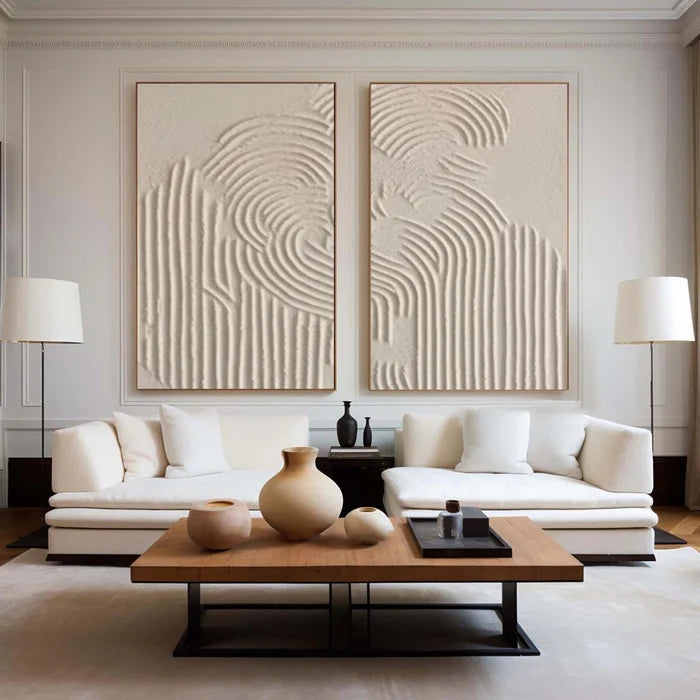
Light and Texture: How 3D Paintings Change Through the Day
A textured painting is a different artwork at nine in the morning than it is at nine at night - and that is not a defect, it is the entire reason to own one. The ridges cast shadows that move with the sun, the highlights travel across the crests as you walk past, and the same canvas can read as calm sand at noon and dramatic terrain at dusk. This guide explains the physics of that daily change, how to know if a piece will perform in your room's light, where to place it so it changes for the better, and how to test the light behavior before you commit.
The short physics of texture and shadow
Texture only exists for the eye as a contrast between light and shadow. Where a ridge rises, the surface facing the light glows; the slope turning away from the light falls into shadow - and our eye reads that bright-to-dark pair as depth. Flat surfaces produce no such pairs, which is why a smooth canvas stays visually the same at every hour while a textured one never stops changing. The two things that control the show are the light's direction and the light's angle: direction decides which ridges glow, angle decides how deep the shadows reach.
Keep that pair in mind for every decision: move the light's direction and the painting changes character; lower the angle and the depth intensifies; raise it toward the ceiling and the relief flattens almost to nothing.

Why the hours change a textured canvas
The sun moves, so light direction and angle move too. In the morning, light arrives low and rakes from the east, sliding across the surface at a shallow angle; the relief casts long soft shadows and the texture looks its deepest. At midday, the sun is high, light comes down almost vertically, and it fills the valleys - texture flattens, colors brighten, and the piece looks its calmest. By late afternoon and evening, light again arrives low, now from the west, and the relief wakes up from the opposite side, catching different ridges and making the painting look like a fresh piece.
That hourly shift is the texture experience: the same canvas is a morning landscape, a midday calm and an evening drama. Flat art gives you one image all day; textured art gives you a sequence, and the sequence is free - it is just the sun doing its work on a real surface.
Reading the light in your room before you hang
Not every wall gets this gift. A wall facing a window receives raking light as the sun passes; a wall lit only by an overhead globe receives flat vertical light that hides relief; a north-facing wall at midday may receive soft even light that never rakes. The quickest evaluation takes one day: tape a piece of ridged cardboard - or the painting itself - at the intended spot and visit it at morning, midday and evening. Note when the ridges read deepest, when they flatten, and whether the room's real light ever crosses the surface at a low angle.
If the wall never rakes, do not give up on texture - give it a lamp. A picture light or side lamp at 30 to 45 degrees replicates the grazing morning effect at the press of a switch, and an evening without natural raking light is exactly the hour most rooms are actually used.
The four light setups every textured canvas meets
| Setup | What it does to relief | Where it belongs |
|---|---|---|
| Low raking (window, side lamp) | Deepest shadows, most drama | Living room feature wall |
| 45-degree picture light | Balanced depth, evening show | Over the sofa or console |
| Even overhead | Flattens to calm, quiet color | Rooms active at midday |
| Backlight (sun behind the viewer) | Soft silhouette, color in valleys | Reading corners, offices |
Match the setup to the room's life. A living room is used at night, so a picture light or side lamp matters more than the window; a breakfast corner is used in morning, so the east raking light is the free show. The table is the toolbox; the room's schedule picks the tool.
Walking past: the texture that moves
The most underrated behavior of a textured canvas is what happens when you move. As you walk past a piece with real relief, the highlights slide across the crests and the shadows rotate from ridge to ridge, so the painting appears to change - not just brighten, but shift. Flat prints cannot do this: their highlights are painted in and fixed, so moving past changes nothing. This is the test gallery-goers use unconsciously, and it is free to try in your own home with any textured piece and one lamp.
Placement makes the movement visible. In a corridor or entryway, the passing motion itself becomes the art show; in a static seating area, the movement comes from the sun's travel instead. Either way, real relief rewards motion, and the reward is the quietest proof that the depth is genuine.
Choosing depth for your light reality
The depth you choose should match the light you can actually give the piece. If your room has a strong raking window, medium relief performs beautifully - the shadows do the work. If the room is lit mostly by overhead and you do not plan a lamp, light relief keeps the texture subtle enough to survive flat light without looking muddy, while heavy relief under harsh vertical light can glare and throw confusing shadows. And in a room you control at night, heavier relief plus a picture light gives the strongest effect for the hours you most spend there.
The honest pre-buy question is not "does this texture look good in the photos" but "has this room got a side light I will actually switch on." The answer decides the depth better than any aesthetic comparison.

Practical lighting moves that cost nothing
- Set the lamp at table height rather than ceiling height and aim it across the canvas from one side.
- Try a warm bulb at 2700K for evening drama; it deepens the shadows and flatters the ridges.
- Angle a picture light at about 45 degrees rather than pointing straight at the surface.
- Use sheer curtains to turn harsh direct sun into a broad, softer raking light.
- Test at the hour you use the room, not the hour that photographs best.
None of these cost more than a lamp and a curtain, and together they decide ninety per cent of the textured experience. The ridge depth is bought at checkout; the quality of its shadows is bought by placement.
Testing a piece's light behavior in two minutes
You can verify the whole argument with a phone flashlight and a wall. Hold the light low and to the side of the canvas, about thirty centimeters away, and sweep it horizontally. Watch the crests: genuine relief produces a moving highlight that races across the ridges as you sweep, followed by a traveling shadow. A printed texture keeps its highlights fixed. Then change the angle from low to overhead and watch the relief flatten toward nothing - if it flattens convincingly, the depth is real; if it never changes no matter the angle, the "texture" is drawn, not built.
Use the same test on listings: if the photos show the piece at a single flat angle with identical highlights, the depth is suspect; if the listing shows multiple angles and light setups, it is showing a surface that genuinely responds to light.
Room-by-room light plans for textured art.
Put the physics to work room by room. A living room is seen at night, so give its canvas a 45-degree picture light that switches on the evening drama and turns the wall into the room's slow centerpiece. A bedroom should keep light gentle - a small side lamp or a sheer-curtained east window offers the morning rake that says awake without shouting. A hallway, lit briefly as people pass, rewards the passing motion of the ceiling light mixed with one warm side spot that catches the ridges as footsteps go by. And a home office, where harsh overhead glare is the enemy, benefits from a lower lamp that skims the surface and keeps the relief present without creating distracting glint in your peripheral vision.
The plan changes how you buy: a living-room canvas can carry deep relief because the picture light will feed it; a bedroom canvas should stay shallow or medium because its light vocabulary is soft. Depth is not a universal score - it is a contract with the room's schedule.
Embracing the daily change as the design goal
Once you understand texture as a light-reactive medium, hanging decisions become simpler and more joyful: you are not buying one image, you are buying a room that performs at every hour. Place the canvas where the morning rakes it if you want drama at breakfast, where the evening lamp catches it if you want the show at dinner, and trust the midday calm as a natural rest rather than a flaw. A textured painting that looks different at every visit is not inconsistent - it is alive, and that daily life is the reason genuine relief outlasts flat reproduction in the homes that own it.
To explore more options, see the textured painting collection and white 3d textured art.