Mastering the Landscape Canvas Painting: The Definitive Room-by-Room Art Integration Guide
A landscape canvas painting often feels like the safest choice for home wall art, but it is simultaneously one of the easiest design elements to get wrong. The issue is rarely the natural subject itself; rather, it dictates a complex balance of spatial scale, horizon placement, color temperature, and tactile dimension interacting with your existing furniture and architectural lighting. A wide, majestic mountain scene that looks breath-taking online can feel distant, clinical, and undersized on an expansive living room wall. Conversely, a richly textured palette knife ocean painting can completely overwhelm a quiet master bedroom if the color palette is too high-contrast.
The ultimate goal of interior design is not simply to "add nature" to an empty wall, but to select a handcrafted landscape canvas painting that structurally elevates the spatial psychology of your specific room.

The Spatial Psychology of Landscapes: Why Scenery Changes a Room
Landscape art introduces depth where vertical architectural boundaries are flat. Unlike non-objective abstract work, a landscape carries implied visual distance, skies, terrain, and structural horizon lines that physically stretch a room's perceived footprint.
Different natural themes dictate different psychological and spatial outcomes:
-
Forests, Dense Woodlands, & Misty Groves: These compositions bring a grounding, calming, and organic presence into living rooms or bedrooms, celebrating changing seasons and deep vertical lines that make low ceilings feel loftier.
-
Deserts, Vistas, & Mountains: Featuring warm earth tones, dramatic horizons, and striking topography, these options inject a rustic, adventurous, or contemporary mid-century edge to minimal walls.
-
Oceans, Coastal Scenes, & Waterways: These palettes introduce tranquil, fluid energy, acting as visual stress-relievers ideal for bedrooms and high-traffic entryways.
In a narrow living room, a panoramic horizontal landscape layout can visually widen the room's perception. In a compact bedroom, a soft, low-contrast horizon line drops visual tension, signaling the brain to rest.
However, that same depth can turn into visual noise if misapplied. A high-contrast sunset featuring sharp, jagged mountain tonal shifts will create immense friction in a room already styled with heavy patterns, marble, or dark walnut wood. Conversely, a muted, foggy Nordic landscape can disappear entirely on a large accent wall if it lacks a commanding tonal framework.
This is exactly where genuine handcrafted paintings stand apart from factory prints. Visible brushwork, layered acrylics, and genuine oil pigments create subtle structural shifts that mass-produced prints completely flatten out. The physical texture catches ambient light uniquely throughout the day, keeping the artwork visually active without relying on loud, distracting colors.
Architectural Scale Guide: Size, Formatting, and Budget Allocation
Most dissatisfaction with online art purchasing stems from improper proportions. Buyers routinely underestimate how large a landscape painting needs to be to properly anchor a furniture grouping.
When planning your home improvement budget, selecting original art or high-end textured canvas work should be viewed as a long-term investment in your property's aesthetic value. Below is a professional-grade architectural scale and budgeting matrix based on common residential layouts:
| Wall Situation & Layout | Recommended Canvas Width | Orientation & Layout Insight | Expected Investment Range & Pros/Cons |
| Above a Sofa (3–4 Seats) | 60% – 80% of total sofa width | Horizontal Panoramic: Mirrors the linear plane of the sofa to ground the seating zone. | High Investment ($$$): Creates an instant luxury focal point. Pro: High visual impact. Con: Difficult to rehome if you move. |
| Above a Bed (Queen/King Master Suite) | 50% – 75% of the headboard width | Calm Horizontal Biophilic: Soft, low-contrast compositions to preserve sleep hygiene. | Moderate Investment ($$): Aids relaxation and acoustics. Pro: Soothing atmosphere. Con: Limited viewing angles. |
| Entryway, Foyer, or Main Hallway | 30 – 50 Inches total width | Vertical or Long Gallery Format: Guides physical movement and sets the home's design tone. | Low-to-Moderate ($ - $$): Direct guest impression. Pro: High utility traffic. Con: Susceptible to accidental bumps. |
| Large Empty Accent Wall / Dining Room | 60 Inches and Above | Oversized Single or Multi-Panel Triptych Sets: Fills expansive voids without crowding. | Premium Investment ($$$$): Factory-direct pricing on oversized pieces balances cost. Pro: Museum feel. Con: Requires structural hanging. |
While horizontal formats are standard for anchoring furniture lines, a vertical landscape serves an entirely different architectural purpose. Instead of widening a room, a vertical tree line or a towering mountain peak draws the eye upward, emphasizing vertical clearance. This is an invaluable optical trick for historical ranch houses, compact urban apartments, or rooms with low ceilings.
Color Temperature Dynamics and Lighting Interactivity
Many homeowners attempt to directly match a landscape painting to the exact color of their sofa or area rug. This literal approach almost always results in a flat, clinical, and uninspiring interior. A professional design methodology balances color temperature and contrast instead.
[Warm Room Decor]   <--->  Balances With  <--->   [Cool-Toned Landscapes]
(Beige, Tan, Wood)                                (Blue Skies, Mist, Snowy Peaks)

[Cool Room Decor]   <--->  Balances With  <--->   [Warm-Toned Landscapes]
(Grey, Charcoal, Slate)                            (Sunsets, Autumn Fields, Deserts)
Ambient and artificial lighting play an active role in how canvas art behaves inside a home:
-
Warm Indoor Lighting (2700K): Under soft residential lighting, warm landscapes (autumn hues, red plum blossoms, golden hour sunsets) become incredibly rich, deep, and saturated. Cool landscapes (maritime scenes, winter forests) can appear slightly muted or muddy.
-
Cool/Neutral Daylight Lighting (4000K): Under crisp, clean natural light, blues, emerald greens, and stark whites become intensely pronounced, while warm tones lose some of their softness but gain modern clarity.
This atmospheric shift is uniquely striking in heavy-texture, hand-painted art where raised palette knife ridges catch directional sunlight at varying angles from morning to evening.
Texture Analysis: Handcrafted Originals vs. Flat Visual Prints
A premium landscape canvas painting is not merely a flat image; it is a three-dimensional surface. High-end handcrafted artwork utilizes layered acrylic mediums, heavy oil paint, palette knife sculpting, and subtle plaster texturing to introduce physical dimension.
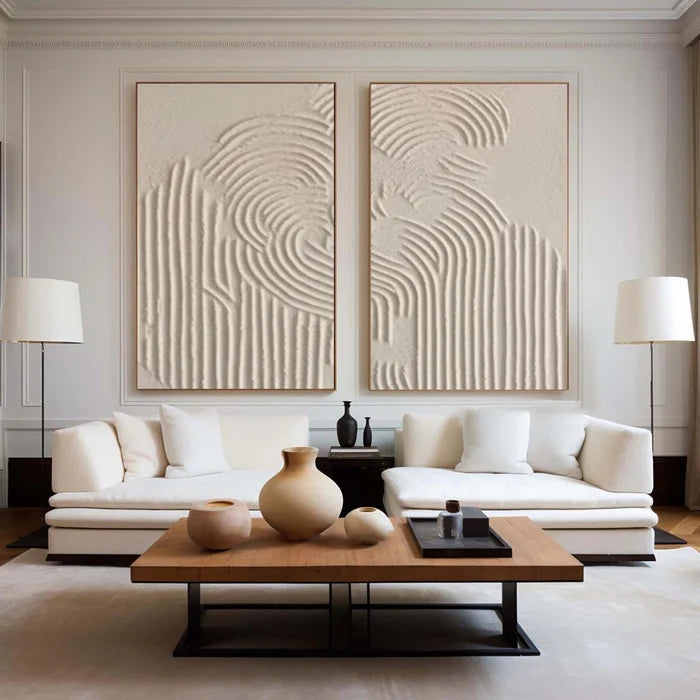
If your interior design strategy relies on minimalist decor—such as neutral furniture, clean architectural lines, and limited accessories—heavy-texture canvas art becomes absolutely mandatory. The physical topography of a textured tree of life or a heavily layered city streetscape prevents a minimalist or Nordic space from feeling sterile, cold, or commercial.
| Art Construction Type | Visual Depth under Side-Lighting | Material Authenticity & Longevity | Tactical Aesthetic Value |
| Hand-Painted Textured Canvas (Acrylic/Oil) | Dynamic: Ridges cast shifting mini-shadows throughout the day. | Excellent: Authentic material presence that retains value over time. | Luxury: Feels alive, unique, and premium to the touch. |
| Flat Digital Canvas Print (Mass Produced) | Static: Absorbs light uniformly; looks entirely flat from side angles. | Poor-to-Fair: Can fade quickly; lacks physical paint layers. | Budget: Reads as a commercial copy rather than a gallery object. |
Style Classifications: Matching Art to Architectural Aesthetics
Landscape art spans a massive spectrum of artistic movements. Selecting the right style variant ensures your canvas complements, rather than clashes with, your home's structural architecture.
-
Abstract Landscape Art: Focuses on color blocks, emotional geometry, and implied nature. It is highly versatile and acts as an exceptional design bridge for ultra-modern, industrial, or urban spaces with strict geometric layouts.
-
Impressionist & Palette Knife Styles: Defined by visible, thick paint applications showing raw energy and movement. Perfect for adding a rich, classic, or eclectic luxury feeling to traditional living spaces, dining halls, and boutique office environments.
-
Beachy, Coastal, & Marine Realism: Captures open skies and rolling surf using soft gradients. Ideal for coastal modern, transitional, or Scandinavian home updates looking to capture an airy, peaceful, and sincere atmosphere.
When a Landscape Painting is the Wrong Choice
Despite its versatility, landscape art is not a universal solution. Avoid landscape compositions in the following interior scenarios:
-
Strict Ultra-Modern Minimalist Architecture: Spaces dominated by high-gloss glass, raw concrete, and hyper-sharp lines require highly simplified abstract art. Organic, highly detailed realism landscapes will introduce visual friction.
-
Hyper-Compact Wall Spaces: Small, isolated wall fragments make complex scenes look cramped and trapped, particularly if the horizon line contains intricate detail. Opt for pure structural texture blocks instead.
-
Rooms with Massive Panoramic Windows: If a room already features a sweeping real-world nature view or a striking city skyline, hanging an explicit scene on an adjacent wall creates visual redundancy. In these spaces, non-objective abstract art offers a superior counterweight.
Mitigating Risk: Simulating Art Placement in Digital Galleries
Purchasing art online introduces real variables: scale calibration errors, digital screen color variations, and integration uncertainty. To eliminate these pain points and execute a flawless home refresh, follow this professional verification checklist before ordering:
-
Utilize Interactive Room Preview Tools: Premium online art galleries, such as Vinchy Art, provide advanced digital room preview modules. Homeowners can upload a direct, well-lit photo of their own wall to scale and preview different canvas dimensions relative to their actual furniture layout.
-
Request Art Advisory Consultations: When dealing with complex lighting situations or unique architectural materials (like exposed brick, shiplap, or concrete), leverage gallery design consultants to review your color palette.
-
Verify Handcrafted Authenticity: Ensure the gallery focuses explicitly on 100% hand-painted, original artisan craft rather than flat, ink-jet digital reproductions. True texture ensures your home improvement investment looks premium from every single angle.
Architectural & Design FAQ
What size landscape canvas painting is optimal for a standard living room wall?
The baseline rule of thumb is to select a canvas width that covers 60% to 80% of the furniture piece it sits above (such as a sofa or console table). This anchors the artwork securely to the furniture layout, preventing it from looking isolated or ungrounded on the wall.
Can I integrate an abstract or impressionist landscape into a minimalist master bedroom?
Yes. Look for restrained, low-density compositions featuring fewer individual elements, soft color transitions, and controlled, relaxing color palettes. This introduces comforting biophilic elements into the bedroom without disrupting the clean, uncluttered, and relaxing sanctuary feel of the space.
Why does a handcrafted, heavy-texture landscape painting look superior to a high-end print?
A digital print lacks physical thickness and surface topography. Hand-painted canvases utilize thick oil or acrylic layers that actively interact with changing ambient room lighting throughout the day, casting subtle shadows and giving the landscape a vibrant, lifelike depth that a flat image cannot replicate.
How do I choose between a single oversized horizontal canvas and a multi-panel set?
Single oversized canvases deliver a bold, seamless, and high-end gallery finish. Multi-panel landscape sets (such as diptychs or triptychs) allow a single continuous scene to breathe across a massive wall space, making them excellent choices for long corridors, open-concept dining rooms, or walls requiring a lighter visual footprint.