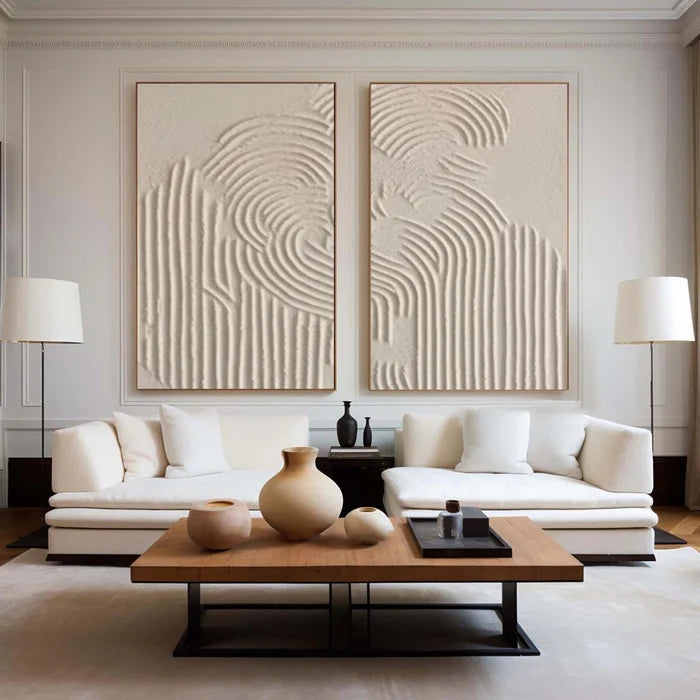
Neutral Living Room With Texture: Warm Minimalism in Practice
Warm minimalism is the decorating style that lives and dies on material: a beige living room stays beige-gray and forgettable until something real sits on the wall. The style's unwritten rule is that every surface must earn its neutrality, and texture is what makes neutrality warm instead of blank. A textured canvas in cream or umber gives a neutral room its tactile center, the one object the eye can rest on without the room becoming busy. This guide covers how to bring texture into a neutral living room without breaking its calm, choosing the right tone and depth, and the practical checks that keep warm minimalism warm rather than sterile.
What neutral walls actually need
A neutral room is a room of light and proportion, and its walls ask for the same calm they return. The mistake is adding texture in the wrong register: a gray-on-gray texture on a gray wall disappears, and a dark brown relief on a pale wall reads as an accent that breaks the minimalism. The tone math of warm minimalism is a family: the canvas should sit one or two steps darker or lighter than the wall, in the same temperature - warm white with cream, greige with taupe, sand with umber - so the relief reads as a shadow and a depth, not as a contrast element. When the palette family holds, the texture delivers the warmth.
The one test that proves the pairing: photograph the wall, drop the candidate image over it at true scale, convert to grayscale, and look at the result. In grayscale the tone family is laid bare - if the canvas vanishes into the wall, it is too close; if it jumps out, it is too far; the winning register holds the same value family with just enough difference to read. This is the fastest honest check in neutral decorating, and it takes minutes.

The texture temperature rule
Warmth in a neutral room is temperature as much as color. Warm plaster-like relief, cream and umber strokes, and soft peaks carry the sun through the room; cool grays with hard ridges keep it clinical. The rule is not about banning gray but about registering the temperature of each surface: if the sofa is greige and the floor is oak, the canvas can be a sandy taupe and the room stays warm at every glance. Check the temperature pairing with the evening lamp test - two warm light sources on a cold canvas read as muddy, while one lamp on a warm relief reads as honey.
Depth and the minimalism contract
Minimalism lives on restraint, and texture in a neutral room obeys a depth contract: enough relief to be felt at a distance, soft enough to never shout. Moderate texture with rounded peaks is the warm-minimalist class - it catches light across the room and asks nothing when seen close. Deep sculptural relief is the wild card: it can carry a wide neutral wall beautifully, but it also becomes the room's one loud statement, so it suits a room where everything else is quieter than usual. The scale of the room decides: a deep canvas in a small neutral room crowds; in a taller open space it gives the room its center.
One canvas or a set in the neutral room
Warm minimalism favors fewer objects, and a single textured canvas is the most minimal answer: one surface, one light story, one calm pole. A matched set of two or three panels changes the rhythm without breaking the calm, as long as the panels share the palette family and the depth character; a set that differs panel to panel breaks the contract. Vinchy Art sells beige and brown minimalist collections and matched texture sets across formats, which fits the rule directly - choose the family first, then the format. The tie-breaker is the wall width: a single wide canvas crowns a 180 to 220 cm sofa; a trio or pair fills the same target with rhythm when the wall is wider.
Placement moves for the neutral room
In warm minimalism, placement follows architecture: the canvas centers on the wall span, hangs at the resting sight line of the main seat, and sits 15 to 25 cm above the sofa back. What differs from a decorated room is the negative space - the neutral canvas needs air around it to breathe, so resist filling the adjacent wall with prints or shelves. One canvas, generous margins, and the room does the rest. If the room has a second wall that needs a beat, a single small canvas in the same palette family keeps the calm; the texture continues the material story instead of starting a new one.
The grayscale test, the lamp test, and the three day rule
Three checks finalize the neutral-room selection. First the grayscale test above, which settles the tone family. Second the lamp test: live with the canvas for three evenings at the room's true night lighting, and confirm the relief warms rather than dulls under the lamps. Third the three-day rule: if after three days the canvas asks for attention, it is too strong; if the room looks unfinished without it, it is the right register. These three checks replace the entire mood board and they run on the actual room, which is the only surface that matters in minimalism.
Neutral companions: what the relief echoes
In a neutral room, the textured canvas should echo the other tactile surfaces - the weave of the rug, the grain of the wood, the linen of the cushions - without repeating them. The pattern works when the canvas shares one material trait with the room (soft, tactile, matte) and differs in the others (surface, scale, color). The check is the materials inventory: list the tactile surfaces in the room, then confirm the canvas adds a new register. If the canvas repeats the rug exactly, the room reads flat; if it introduces matte plaster relief where everything else is shiny, it gives the room its first real depth.
The honest failures of warm minimalism
Warm minimalism fails most often in two quiet ways. The first is over-restraint: a canvas chosen so close to the wall tone that the room reads unfinished rather than calm - the grayscale test catches this. The second is texture clutter: two textured pieces in the same sight line, or texture and pattern fighting across a single view - the one-texture-per-sight-line rule catches this. Both failures are corrections, not design flaws, and both are settled by the same discipline: choose the tone family, check it in grayscale, keep one calm pole per view, and let the neutral room be the quiet triumph it was always meant to be.
Texture rhythm across the room
Warm minimalism tolerates more than one texture in a room as long as the family holds: the canvas can be joined by a woven pouf, a wool throw, a ceramic vase - the rule is that each tactile surface sits in the same temperature and value family. The rhythm works when the textures repeat at different scales: a small woven object close to the floor, the canvas mid-wall, a linen shade above. The canvas stays the wall event; the smaller surfaces echo it without competing. One honest caution: two textured canvases in the same sight line always break the rule, so a room with a statement canvas on the main wall should keep the side wall quiet or mirror the same family at a small scale.

Living with warm minimalism over time
The style ages well when the canvas ages with it. Over years, a textured neutral canvas collects a little dust in its ridges and a little patina on its peaks, and both are part of the material story - a dry brush a few times a year keeps the surface true without stripping the calm. When the room changes, the neutral canvas stays the anchor: warm minimalism is a house style that recedes around the object, and the canvas is the object that holds the room s temperature for the long run. Choose the tone family honestly, keep the checks seasonal, and the neutral living room stays the most forgiving, warmest backdrop the house can own.
The same discipline answers the room s smallest question: where the room s one texture event should live. It belongs on the wall seen from the most seats, at the resting line, with the family checks passed. Give it the generous negative space, keep the rest of the room s surfaces quiet, and the neutral living room finishes itself.
And when guests ask what makes the room feel warm, the answer is already on the wall: the canvas that holds the family line, the relief that catches the lamp, and the quiet confidence of a neutral room that trusted texture to finish it.
To explore more options, see beige and brown minimalist art and white minimalist art.