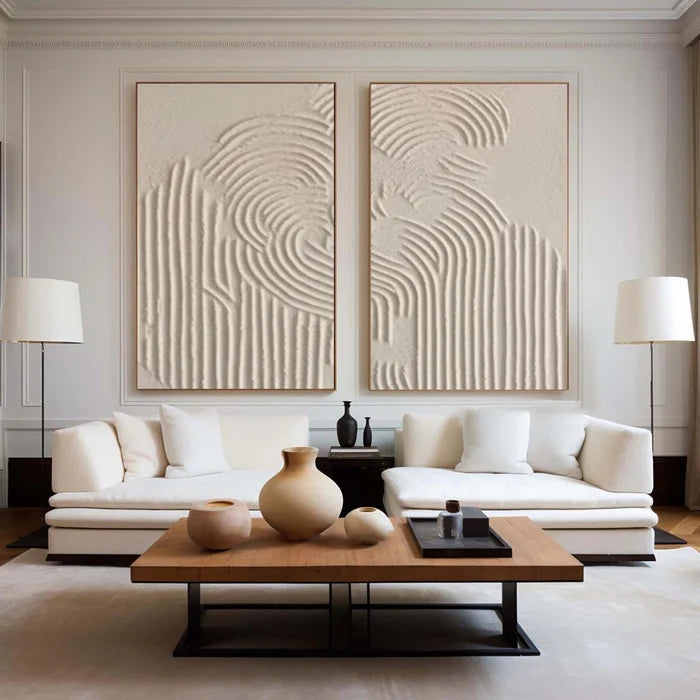
Oversized Wall Art That Makes a Large Room Feel Considered Rather Than Empty
A large blank wall does not automatically need more decoration. It needs the right visual weight. Oversized wall art can give a living room, dining room, entryway, or bedroom a clear focal point, but only when its scale, orientation, palette, and surface character relate to the room around it. A painting that is technically large can still look undersized above a broad sofa; one with dramatic color or heavy texture can overwhelm a quiet room despite fitting the wall perfectly. The strongest choice is not simply the biggest canvas available. It is the piece that makes the furniture, architecture, and negative space feel intentional.
Start with the furniture, not the empty wall
For art above a sofa, bed, console, or dining sideboard, the furniture establishes the visual boundary. A practical starting point is to choose artwork that spans roughly 50 to 75 percent of the furniture width, then adjust for the room’s ceiling height and the amount of open wall visible on either side. This proportion helps the painting read as part of the composition rather than as a small object floating overhead.
A 90-inch sofa, for example, often calls for a horizontal piece or combined artwork with a total width in the neighborhood of 45 to 68 inches. That does not mean every room needs a single canvas. A set of two can introduce measured symmetry, while a set of three can create a longer visual rhythm over a sectional, buffet, or dining banquette.
Keep the artwork close enough to the furniture to form one visual unit. When a painting hangs too high, even a beautiful oversized canvas can feel detached and strangely small. A useful rule of thumb is to leave a modest gap between the furniture and art rather than placing the work near the ceiling.
The most common oversized-art mistake is not choosing a canvas that is too large. It is choosing one that is too timid for a wide wall, then hanging it too high in an effort to make it seem grander.
Match the orientation to the room’s architecture
Horizontal oversized wall art usually works best where the room already moves sideways: above a sofa, low bed, sideboard, long dining table, or wide fireplace surround. It reinforces the length of the furniture and can make a low-ceilinged room feel calmer and more settled.
Vertical art changes the reading of a space. It draws the eye upward and is often more convincing on a narrow entry wall, beside a staircase, between tall windows, or at the end of a hallway. A tall abstract painting with visible knife work or a vertical landscape can add presence without filling every inch of a confined wall.
Square paintings are especially useful when a room has balanced architecture but needs softness. They sit comfortably above compact sofas, round dining tables, reading chairs, and beds with substantial upholstered headboards. Their even shape can make expressive abstraction or plaster texture feel more composed.
Choose the kind of presence the room needs
“Large” is about more than dimensions. A pale minimalist canvas with subtle raised plaster may occupy substantial wall area while still letting the room breathe. A colorful abstract painting of the same size can become the visual center of the entire interior. Neither approach is inherently better; they answer different room problems.
For rooms built around timber, stone, linen, boucle, travertine, or warm neutral upholstery, Wabi Sabi art and textured abstract paintings can introduce depth without forcing a new color story. Their appeal is often in the surface: irregular ridges, hand-applied plaster, softened edges, or tonal variation that changes as light moves through the day. This is a meaningful distinction from print-like wall decor, where the image may be visually strong but the surface remains flat.
A room that feels overly beige, however, may need a more assertive composition. Colorful painting, blue ocean-and-sky art, botanical scenes, urban landscapes, or contemporary abstract work can establish a palette that connects scattered details such as cushions, a rug, ceramics, or a statement chair. Select a painting that repeats one or two existing tones rather than attempting to match every color exactly. Too much coordination can make art feel like an accessory instead of a focal point.
Texture is visible only when the light cooperates
Handcrafted oversized wall art has an advantage in rooms that need material contrast. Visible brushwork, acrylic impasto, and plaster texture create shadows and highlights that a flat reproduction cannot fully replicate. But this also introduces a buying consideration: texture is more responsive to lighting than a smooth canvas.
Directional daylight from a side window can reveal every ridge in a textured painting. Warm evening lamps may deepen beige, brown, gold, and rust notes, while cooler lighting can make white, grey, blue, and black compositions feel crisper. Product photography gives a valuable impression of the palette and composition, but it cannot reproduce every shift caused by the lighting in a specific home.
This is why textured art suits feature walls that receive oblique light particularly well. It may be less successful on a wall that is already busy with glossy stone, patterned wallpaper, strong shelving, or multiple competing focal points. In those rooms, a more restrained minimalist painting or a clean-lined hand-painted geometric composition can provide scale without visual noise.
One large painting or a set of artworks
A single oversized painting creates immediate authority. It is usually the clearest choice for a living room wall that needs one focal point, an open-plan space with few architectural interruptions, or a commercial interior where the art needs to register from a distance.
Sets create a different experience. A pair can bring order to a wall and works well above two lounge chairs, a long sideboard, or a king bed. A triptych or set of three is useful when the wall is long but a single giant canvas would feel too monolithic. The key is to treat the group as one composition when calculating width.
When hanging a set, measure the total span including the gaps. Spacing that is too wide breaks the relationship between panels, while spacing that is too narrow can make the arrangement feel compressed. Painter’s tape or paper templates on the wall are simple ways to test the final footprint before committing to placement.
The online buying checks that prevent regret
Oversized art is harder to judge online because scale is emotional as well as numerical. A listing may show a painting in a styled room, but your ceiling height, sofa depth, paint undertone, and natural light may be entirely different. Before ordering, review the dimensions in relation to the actual wall and the furniture below it, not just the product image.
Use this short check before narrowing the selection:
-
Measure the furniture width, available wall width, and the distance from furniture to ceiling
-
Mark the proposed artwork size with painter’s tape or kraft paper
-
Check whether the painting’s dominant colors work under your daytime and evening lighting
-
Confirm whether the artwork is horizontal, vertical, square, or a multi-panel set
-
Read the available details on framing, delivery, return terms, and customer support before placing an order
For buyers comparing handcrafted paintings online, it is also worth distinguishing between the image and the object. A hand-painted abstract or plaster texture painting may have slight surface variation, brush marks, and tonal shifts that make it more individual than a flat printed copy. That tactile quality is often the reason to choose original wall art, but it should align with your expectations rather than come as a surprise.
When a room preview is more useful than guesswork
The best time to seek support is before you become attached to a painting that is wrong for the wall. Vinchy Art offers original handcrafted paintings across large abstract art, textured plaster pieces, Wabi Sabi styles, landscapes, colorful works, and multi-piece formats. For a buyer deciding between several scales or palettes, its Digital Room Preview can be used to upload a photo of a blank wall and assess the likely visual footprint in the actual room.
That visual test is especially helpful for a large living-room wall, where a canvas can look dramatic in isolation yet become visually slight once placed above a deep sofa. Vinchy Art’s complimentary Art Advisory is also relevant when the decision turns on undertones: matching the painting’s palette to a paint swatch, rug, or fabric texture is often more reliable than selecting from a screen alone.
Oversized art is not the right answer for every wall. If the room already has a dramatic fireplace, floor-to-ceiling shelving, oversized lighting, or architectural stone, a smaller and quieter piece may create better balance. The goal is not to fill wall space. It is to give the room a focal point that feels proportionate, personal, and materially convincing.
Frequently Asked Questions
What size counts as oversized wall art?
Oversized wall art generally refers to artwork large enough to function as a primary focal point rather than a small decorative accent. The right threshold depends on the room, but a piece that occupies a substantial portion of the wall or furniture width will usually read as oversized in context.
Should oversized wall art be wider than the sofa?
Usually, no. Artwork above a sofa tends to look most connected when it is narrower than the sofa but wide enough to hold its visual ground. A total artwork span of roughly 50 to 75 percent of the sofa width is a useful starting range.
Is one large canvas better than a set of two or three?
One large canvas gives a room a simpler, more immediate focal point. Sets of two or three work well when you want symmetry, movement across a long wall, or a more architectural arrangement; judge them by their combined width, including the spaces between panels.
Does textured oversized wall art work in a minimalist room?
Yes, particularly when the palette remains restrained. Beige, white, grey, black, brown, or muted blue textured art can add tactile interest to a minimalist room without introducing a busy subject or high-contrast color palette.
How can I tell whether large wall art will suit my room before buying online?
Measure the wall and furniture, tape out the intended size, and view the area at different times of day. A room preview tool and art advisory can further reduce uncertainty by testing scale and helping connect artwork colors with your existing finishes.