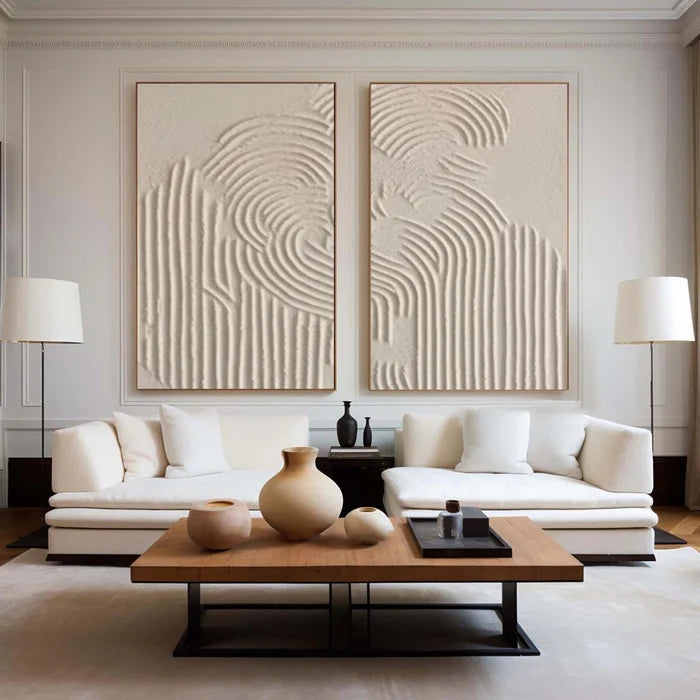
Plaster Art for Small Spaces: Big Texture Without the Bulk
The plaster art guide defines the medium these compact pieces use. Small rooms do not need small art — they need proportionate art and one clear focal point. A single compact plaster piece can give a small room presence without covering the wall. Measure the wall and the furniture beneath it, consider a vertical format on narrow walls, and keep the rest of the styling quiet.
Why Small Rooms Need a Strong Focal Point
A small room feels cluttered when attention has nowhere to land. One strong focal point organizes the space, and textured art is efficient at creating one because the surface itself carries interest — you do not need a large piece or a busy arrangement to make a wall matter.
Think of a small room as a stage: one strong element gives the eye a place to rest, and everything else becomes supporting cast. A textured piece does this without square footage because its depth reads as presence — the shadows and highlights give the wall something to look at even from the doorway. The common mistake is adding more elements to compensate — more pieces, more frames, more color — which shrinks the room visually. Restraint is the small-space strategy, and one correctly scaled textured piece is the most efficient form of restraint.
In a studio apartment, for example, an eight-foot wall above the sofa may be the only display surface in the room. One textured piece scaled to the sofa gives that wall a job; three smaller pieces ask the eye to read a collection, which a small room does not have the spare attention for.
Size Rules for Compact Walls
Size comes from the wall and the furniture, not from the room's overall dimensions. As a practical guideline, keep a piece above a sofa or console at roughly two-thirds of the furniture's width, and on an empty wall keep it within about half to three-quarters of the wall width. Mark the proposed edges with painter's tape and step back — the tape test tells you more than any formula.
Run the tape test properly: mark the art's width on the wall, then live with the outline for a day. Check it from the doorway and from the sofa. If it reads as too small from the doorway, go up a size; if it crowds the wall, go down. The furniture-width rule handles the most common case, but check the doorway view too — a piece that looks right from the sofa can look small from the entrance, and the entrance is often the first impression. When the two views disagree, split the difference or size up. Because plaster art is made to order, a size between standard options is often available — that is the moment to ask, not after delivery.
For the full set of layout rules, including furniture sizing and gallery walls, the wall art display guide covers the general framework; this guide focuses on the single-piece logic that works best in compact rooms.
Vertical Pieces for Narrow Walls
Narrow walls are where vertical formats earn their keep. A tall, slim piece adds height to an entryway, fills the space between two windows, and turns a corridor into a destination without eating into the floor plan. Because vertical plaster art concentrates texture in a narrow band, it keeps the focal point strong while leaving the rest of the wall quiet.
Vertical pieces also keep the floor line clear, which matters in apartments where furniture already fills the perimeter. A slim textured painting above a narrow console or beside a door uses wall space that would otherwise stay empty, and the upward line makes the ceiling feel higher. Match the piece's height to the wall rather than to the furniture: on a tall, narrow wall, a vertical piece that fills most of the height anchors the space, while a short piece would look stranded. Above a narrow console, keep the piece comfortably narrower than the console so the composition reads as deliberate. The vertical collection shows how these proportions look in real rooms.
Styling With Furniture and Lighting
In a small room, everything around the piece should support it. Hang the art above a console or low shelf, keep the surface beneath it mostly clear, and give the texture a light source that grazes it at an angle — a small lamp or picture light is enough. Match the palette to the room's tones so the piece belongs rather than shouts.
Negative space is the friend of small rooms. One textured statement, simple furniture lines, and a restrained color story make the space feel larger than a wall covered with competing elements. If the room already has patterned textiles or a busy rug, let the art stay tonal; the texture provides the interest, so the color can afford to be quiet.
Lamp placement is the cheapest upgrade in a small room: a small floor lamp beside the art, angled so the light skims the surface, gives the texture depth without adding wall coverage. Frame color matters less than the gap around the piece — a little breathing room makes the wall feel larger. The same logic applies to the frame itself: a slim, neutral frame lets the texture carry the wall, while a heavy frame can eat into the space the piece is trying to open up.
3 Mistakes That Make Small Rooms Feel Smaller
Three common errors turn a promising piece into a room problem. The pattern behind all of them is scale without intent: a piece that is not sized to its wall, or a wall that asks the eye to sort through several objects, undermines the very clarity a small room needs.
| Mistake | Why it hurts | The fix |
|---|---|---|
| Choosing a piece too small for the wall | Gets lost; the room feels unfinished | Size from the wall and furniture, then use the tape test |
| Hanging several competing pieces | Visual noise in a limited space | Let one focal piece lead and restrain the rest |
| Ignoring light and palette | Texture flattens or clashes | Angle light across the surface; match tones to the room |
A piece that is too small never anchors the room — it reads as a placeholder. Several competing pieces ask the eye to sort through them, which is exactly what a small room cannot afford. And texture without light is wasted depth: a plaster surface in flat, shadowless light looks like pattern, not dimension. Correct these three and the room reads as deliberate rather than crowded.
Vinchy Art Studio Recommendation
In the Vinchy Art studio, small-space advice comes down to three steps: proportion first, format second, texture as the single statement. A vertical piece for a narrow wall, a compact horizontal piece above a console, and one family of texture — that combination gives a small room presence without bulk. The preview step matters here too: seeing the finished surface before shipping helps you judge whether the scale and texture fit the room you have. If the room allows only one piece, make it the one that would hurt most to lose — that is the focal point the room actually wants.
Conclusion
Plaster art works in small spaces when it follows proportion instead of size rules: one focal piece, scaled to the wall and furniture, vertical on narrow walls, and supported by simple styling and angled light. The room gains presence without clutter, and the texture does the work a large wall of art would normally do. Small spaces reward the same principle in every object: choose less, choose well, and let one thing do the talking.
The Small-Space Art Checklist
- Wall and furniture measured, edges marked with tape
- One focal piece chosen
- Vertical format considered for narrow walls
- Palette matched to the room's tones
- Light source planned to graze the texture
- Rest of the styling kept quiet
FAQ
Can textured art make a small room feel bigger?
It can add depth and focus, which helps a small room feel intentional rather than crowded. Texture alone is not a guarantee; proportion and light matter more.
What size should I choose for a small wall?
Measure the wall and the furniture beneath it, keep the piece within about two-thirds of the furniture's width, and use painter's tape to test the scale before ordering.
Are vertical pieces better for apartments?
Often useful: a vertical format adds height and suits narrow walls, entryways, and spaces between windows. It is a strategy, not a rule.
Should I hang one piece or a set?
In a small room, one strong piece usually creates a clearer focal point. Sets can work when they stay restrained and aligned with the room's palette.
Does heavy texture overwhelm a small space?
It can, if the piece is too large or the room is already busy with pattern. Choose one textured statement and keep surrounding surfaces simple.
Shop Compact Textured Pieces
Browse the 3D textured plaster art collection at Vinchy Art for pieces that add presence without bulk — hand-painted, made to order, with custom sizes and preview before shipping.