Texture Art Techniques: Impasto, Relief and Palette Knife Compared
Three words do the heavy lifting in textured art - impasto, relief and palette knife - and most guidance uses them as interchangeable buzzwords. They are not the same technique, and the difference decides how a painting will look, feel and age on your wall. This guide compares the three properly: what each technique actually does to the surface, how to recognize each one in a photo or in person, which effects each produces under light, and how to choose the technique that matches the look you want before you pay for it.
The one sentence for each technique
Impasto is thick paint applied so the brush or knife marks stay visible; relief is paste or modeling medium built up in shapes above the canvas; palette knife is the tool - the blade used to apply, scrape and shape either paint or paste. One is a material habit, one is a construction method, and one is a hand tool; they overlap constantly, and the confusion starts when sellers use all three words for any textured canvas. Knowing the difference lets you read the product correctly: an impasto painting is all paint, while a relief painting is paste plus paint - and the two behave differently in the hand, under light and over years.
Impasto: paint that stands up
Impasto is the oldest of the family, practiced by painters who forced thick oil or acrylic paint to hold a visible mark - a heavy brushstroke, a knife smear, a dollop of color that stays raised after drying. The material is paint itself: no separate paste is involved, and the texture is the paint's own body. Its signature is visible in the strokes: you can see the direction of each pass of the brush or knife, and the highlights follow those directions.
Impasto reads as painterly and warm - the hand of the artist is in every mark. Under side light it shows groove-and-crest rhythm along the stroke directions, but because the layers are paint-thick rather than paste-thick, the relief is usually lower than true plaster work. If a surface feels like ridged buttercream with a smooth signature of strokes, you are looking at impasto.

Relief: paste built in shapes
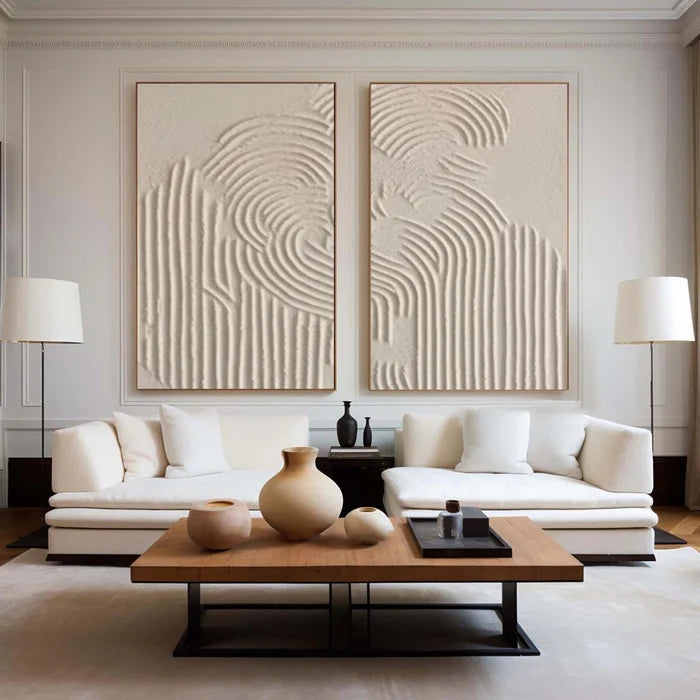
Relief goes a step beyond paint: the maker builds a separate paste - plaster mix or modeling medium - into the shapes the composition needs, letting it dry as an actual raised layer, then applies the color on top or works it into the surface. Relief is construction, not just painting: the surface is designed and built, combed into waves, pressed into ridges, shaped into organic terrain that sits well above the canvas.
Relief is what most people mean by "3D textured art" - the depth is in millimeters, not brushpaint levels, and it casts real shadows under side light. It also reads more architectural than impasto: clean ridge lines, deliberate surface design, an object-like presence in the room. The tell in a photo is the shadow gap: if you can see darkness between raised shapes, you are looking at relief.
Palette knife: the tool in both
The palette knife itself is not a texture type; it is the blade that builds either one. Dragged through thick paint it leaves flat, angular surfaces with sharp edges - impasto with an architect's restraint. Loaded with paste it shapes, scrapes and polishes relief ridges with a precision fingers cannot manage. Knife-made texture has a recognizable signature: crisp, angular planes, scraping lines, and a slight directional smear where the blade caught wet material.
Recognize knife work by the planes. A knife-built ridge has flat tops and clean slopes; a fingertip-built ridge has soft, rounded anatomy. Many pieces mix both, and the mix itself is the artist's signature - look for the flat planes to confirm the knife was there.
Side by side: what each technique gives a wall
| Technique | Visual signature | Relief height | Best light |
|---|---|---|---|
| Impasto | Directional strokes, painterly warmth | Low to medium | Any side light |
| Relief (paste) | Built shapes, clean ridges, deep shadows | Medium to high | Angle 30-45 degrees |
| Palette knife | Flat planes, crisp angles, scraping lines | Medium | Low raking light |
| Mixed (common) | Combined anatomy; human signature | Varies | Test it |
Use the table the way a buyer's eye works: first identify which technique is dominant, then match it to the wall's light. Impasto suits smaller rooms where you want warmth up close; relief suits larger walls where the object-quality carries the room; knife-finished texture suits modern spaces that like crisp geometry.
How to identify each technique from photos
Listings give the surface away in three details. Look at the highlights first: if the brightest lines follow curving strokes, it is impasto; if they follow straight ridge crests with shadow gaps, it is relief. Second, look at the edges of the raised marks: soft and rounded means fingertip shaping, flat and angular means the knife was used. Third, look for texture depth in the side-angle photo - a genuine technique shot will show the surface at an angle, because that is the only way the depth photographs truthfully.
If the listing only shows straight-on photos, treat the technique claims with caution. Not because the piece is fake, but because the seller is hiding the one feature a texture buyer needs to evaluate - and an honest maker is proud of the relief.
Which technique ages best?
Aging is where the techniques separate honestly. Impasto lives on paint alone, so its lifespan depends on the paint's quality: professional oil or acrylic color holds its body and tone for decades, cheap craft paint dries brittle and cracks at the thickest strokes. Relief depends on its binder: a proper paste stays firm for years, while filler without enough binder flexes, shrinks and cracks at the edges of high ridges within a couple of seasons. Knife-cut surfaces age differently at different heights - the sharpest planes are also the most exposed, so deep knife relief needs the same quality binder as any high relief.
The buyer's rule: let the material line be the age promise. A listing that names linen canvas and professional paint is offering a multi-decade object; a listing that stays silent on materials is offering a surface whose future is guesswork.
A practical test for technique, not just texture
Once the piece is in your hands, identify the technique in thirty seconds. Run a fingertip along the highest mark: if you feel ridged buttercream with stroke grooves, that is impasto. If you feel hard, built shapes with shadow gaps, that is relief. Run the light low and look at the plane tops: flat and sharp means knife work, rounded means fingers. Then press the edge of the thickest area - firm means quality binder, flexible or powdery means filler. Four touches and you have read the technique, the tool and the material quality without a single label.

Reading the mix: why most real pieces blend.
Once you can name each technique, expect to find them mixed. A genuinely built canvas usually starts as relief - paste shaped into the composition - and finishes with impasto strokes and a knife pass over the crests, so the signature is layered. That is not confusion; it is craft. The reading order is: identify the dominant method by the shadow gaps and ridge heights, then confirm the accent techniques by the stroke marks and flat planes. A piece that reads as one pure technique from edge to edge is either a masterwork of restraint or a mass-produced copy repeating one mold - and in practice, the mixed hand-built surface is the more honest signature.
When the mix is real, the listing usually says so in small words - "paste, acrylic and knife finish" or "modeling paste with oil color." The mention of more than one material is a reliability signal, because printers do not think in techniques at all.
What technique claims cost: photorealism of depth
One honest note before you compare prices: true relief costs more than impasto alone, because it adds material and labor - the paste, the drying time between layers, the shaping work that paint-only never needs. So when two pieces look similar and one is significantly cheaper, check which technique built it. A cheaper "textured" piece is often impasto-thin paint on flat canvas, photographed to match the depth of a true relief piece. Let the technique name set the expectation for both price and presence, and the thinner piece will stop disappointing you - or the thicker one will finally justify itself.
Choosing the technique for your wall.
Match the technique to the room's behavior, not to the trend. A brightly lit living room with windows on two sides shows off relief's shadow play at its best - choose built relief or knife-finished work. A reading corner lit only by a warm lamp wants the low texture of impasto, which stays interesting close-up without dominating the wall. A long corridor where people pass quickly rewards the strongest relief, because the passing eye needs the shadow gap to read the depth at speed. And a bedroom, where light is low on purpose, does best with gentle saved texture that whispers rather than carves.
Ask the listing one question that cuts through the marketing: "What is the relief built from - paint, paste, or both?" The honest answer names the technique, and the named technique tells you the height, the aging, and the light it needs. Any answer that talks only about the look is selling the surface without selling the truth, and texture is the one category where the surface and the truth are the same thing.
To explore more options, see the textured painting collection and black textured paintings.