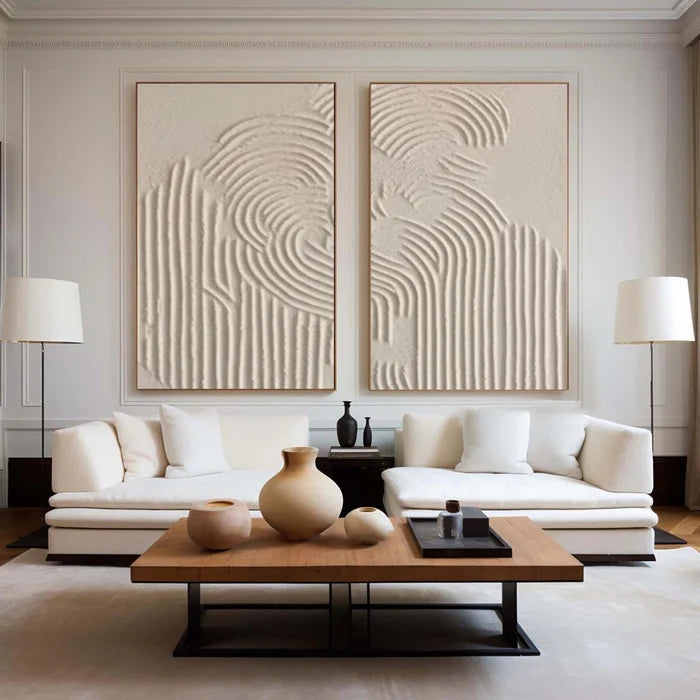
UV Light and Textured Paint: The Real Fading Risks and How to Place Your Canvas
Every painted surface fades eventually, and the fear of fading drives more decisions about art placement than almost any other factor. Understanding what sunlight actually does to a textured painting — which colors are vulnerable, how relief changes the story, and how to place a piece so it stays vibrant — turns that vague fear into a simple set of choices you can make in five minutes. This guide gives you the honest science of UV exposure for oil and acrylic canvas, the textured-specific nuance, and an at-home brightness check you can use to judge any wall in your home.
Light damages paint in two ways, and only one is usually fixable
Visible light and ultraviolet light both affect paintings, but they work differently. Visible light drives most of the everyday risk: the brighter and longer a color is exposed, the faster the binder and pigment game the race, and colors reach a lighter, less saturated version of themselves. Ultraviolet light is a smaller slice of the total but acts more aggressively — it can yellow the varnish or medium and break down pigment particles even in a dim room, which is why a painting kept out of direct sun can still fade over decades near a bright window.
For textured art there are two practical consequences. First, the deep recesses of relief fade more slowly than the ridge tips, because shadows sit inside the valleys; the effect is a slow increase in the relief contrast of the piece as its high points lighten. Second, a texture made with plaster and modeling paste is not itself a pigmented surface to fade — it is the carrier. So a textured canvas does not turn gray, it loses the intensity of the color on its high ridges first, which changes the piece subtly but permanently. Neither of these is dramatic in a normal room; both respond to the same placement logic.
The honest risk ranking: what fades fastest
| Exposure situation | Relative risk | What the eye notices |
|---|---|---|
| Direct sun through an unprotected window | Highest | Color loss visible within a few seasons, mainly on ridge tips and bright hues |
| Bright indirect light near a south or west window | High | Slow bleaching over years; bluer tones fade before warm earthy ones |
| Normal room light, away from windows | Low | Minimal noticeable change over a decade of normal home life |
| Spotlight or picture light aimed at the piece | Medium | Localized warm zone; heat accumulates where the beam lies, so the center may age faster than the edges |
The ranking is the whole strategy in one table. The goal is not to live in a windowless room; it is to keep the piece out of the two situations at the top for the largest part of its life.
Where the light arrives: window, facing, and the seasons
Placement advice read generically — "avoid direct sunlight" — misses the fact that sunlight moves and changes. The questions worth asking about any wall are practical: Which compass direction does the window face? South and west windows take the most intense and longest daily sun; north and east get softer, shorter doses. Does anything stand between the window and the canvas? A sheer curtain, a tree outside, or a deep overhang all cut UV meaningfully, so a painting near a protected window can be safer than one in a bright room at the back of the house.
Seasonal change matters too. In winter, low sun angles throw light deeper into a room and for longer across the floor; the same wall that felt safe in June receives real sun in December. The honest habit is a twice-yearly check: in early winter and early summer, stand at the wall and see whether direct sun touches the painting at any hour. If it does, either move the piece or add the layer that removes only the harmful slice.
The textured-specific length: relief works in your favor
Textured art has one genuine, underrated advantage against light: a flat print exposed to sun fades across a uniform plane, so every centimeter declines together. A textured ridge with the same exposure fades the high points first while the shadowed valleys, protected by their own geometry, hold deeper color. Owner reports in real textured-painting households consistently describe the surface as looking richer with age, because the color contrast between lit and shadowed terrain deepens even as the absolute intensity eases. It is small compensation for neglect, but it is real: given the same sun, relief ages more gracefully than flat ink, because half of its surface lives in shadow designed by the artist.
Relying on that effect is not a plan, though. The protection measures below are cheap, reversible, and take ten minutes — while color loss is permanent.
Five placement and protection measures, ranked by effect
- Keep bright words and images out of direct beams. Put the strongest pieces on the walls that never take direct sun, and place anything you love less near the brighter windows. Everybody owns a second-favorite; let it take the light duty.
- Use UV-filtering glazing when framing. If the piece is framed behind glass — common for mixed-material or heavily protected work — specify a UV-filtering glazing. It removes most of the harmful slice while leaving the image unchanged, which is the highest-value protection on this list.
- Hang the roll of the sun. Skip. Wait — no such rule exists. The real habit is orientation: a canvas on an east-facing wall with a west window rarely catches direct light, because the geometry protects it most of the day. Position the piece where the sun would have to turn a corner to reach it.
- Drape the window lightly. A sheer or light linen curtain cuts a meaningful share of UV while leaving the room bright. It is the least obtrusive protection and works without you thinking about it.
- Switch picture-light bulbs with care. Standard halogen spotlights push both heat and brightness into the center of the canvas; modern LED picture lights run cooler and can be positioned so the beam spreads beyond the edges, avoiding the hot-center effect.
Four of these five are placement and hardware decisions made once; only the curtain is a habit. The payoff is a canvas that still holds its deepest color when the room has been repainted twice around it.
The verification: the brightness check you can run with your phone
You do not need a light meter to audit a wall. Run this check in under a minute. On a clear day, at the time the room is brightest — usually mid-morning to mid-afternoon — stand at the painting location and face the window. Hold up a clean piece of white paper at the height of the piece. If the paper casts a strong, sharp shadow on your hand held behind it, the wall receives direct sun and the painting is in the high-risk column. If the paper stays softly lit with no hard shadow, the light is indirect and the piece is in the safe range. Repeat the same check in winter, because the sun angle changes; the December version of the check is the one that catches most surprises. This thirty-second paper test is exactly the kind of verification a collector uses: simple, honest, and repeatable every season.
What fading looks like when it starts, and what to do
Fading is slow and local, so it hides well. The honest signs to watch for are a lighter band along the sun-side edge of the canvas, a bluish hue pulling out of the sky areas before earthy tones, and the ridge tips losing their saturation while valleys hold color. Compare the piece twice a year with its own smartphone photo from the first week — the same angle, same light. If the comparison shows a real change, act in the direction of the protection list: move the piece, add the glazing, or swap walls with a favorite that can take the light. Do not oil, varnish, or re-touch the surface hoping to undo it; a wax is not a sunscreen, and unplanned coatings change the surface more than the sun would have. The honest repair for color loss on a textured original is placement discipline going forward, or a studio-led refresh, not a home chemistry experiment.

Placement audit: the ten sentences that decide a wall
- Does the sun touch this wall at any hour between October and March?
- Is anything between the window and the canvas — curtain, overhang, tree?
- Is this room's brightest wall holding my most protected or least favorite piece?
- Am I willing to move this canvas every summer if I cannot shield it?
- If this piece faded slightly in ten years, would I regret the placement more than the move?
Answer those five questions twice a year and the UV story for your collection resolves itself. Direct sun is the only truly hostile exposure; everything else is a slow, manageable, normal part of owning real paint — and the relief of a textured canvas, with its built-in shaded terrain, ages more gracefully than any flat print when the same rules are applied.

To explore more options, see the textured painting collection and white 3d textured art.