What Is a 3D Textured Painting? The Complete Visual Guide
Your search arrived at the right question. "3D textured painting" is a category that mixes real depth with printed imitation, and it has grown popular fast, which means most of what you see recommended online is actually flat artwork wearing a texture costume. This guide gives you the complete visual vocabulary: what a genuine 3D textured painting physically is, how the depth is made, how it behaves under light, how to tell a true raised surface from a printed one, and what it means for buying, hanging and caring. By the end you will be able to identify real relief in listings and in person, which is the one skill that keeps you out of the texture trap.
The core definition: a surface that stands off the canvas
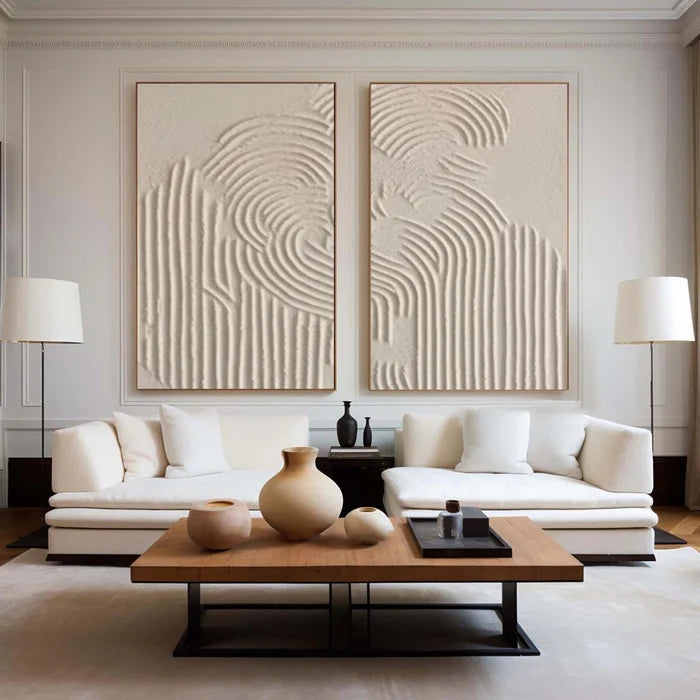
A 3D textured painting is artwork in which the paint or paste is built up above the canvas plane, creating physical relief that your eye - and your hand - can read. It is not an optical illusion painted to look three-dimensional; the third dimension is literally there, in millimeters of raised material. Ridges, waves, peaks and combed lines stand above the weave, and that relief is what separates the category from every flat print, including flat prints that photograph like texture.
The honest test of the definition is touch and light. If you can feel the peak and shadow with a fingertip, it is textured; if the surface is smooth and the depth only appears in the image, it is a printed imitation. That single distinction explains almost every confusion in this category, and it is the test to bring to any listing that calls itself 3D.

How the third dimension is made
Real depth is built in layers, not painted in one pass. The maker starts with a stretched linen canvas as the ground, then applies a thick base - usually modeling paste or plaster mix - in the shapes the composition needs. While the paste is still soft, the surface is combed, pressed, scraped and shaped with palette knives, brushes, combs and fingertips, which leave the organic marks that tell the story of a hand. More layers are added where the relief should be highest, and when the paste has set, professional acrylic or oil color goes on - sometimes scrubbed into the texture so the pigment lives inside the valleys as well as on the peaks.
Depth arrives in stages: a low-relief piece rises a few millimeters with quiet waves, a medium piece shows clear shadow gaps between ridges, and heavy relief can stand high enough to cast a shadow line across the room. The maker's phrase for the difference is dimension - a genuine piece is described by how far the surface rises, and a credible maker will be happy to call the relief by its physical character.
How light reveals or hides the depth
Texture is a light-dependent medium, and this is the visual core of the category. Under even overhead light, a 3D textured painting can look almost flat - the light fills the valleys and hides the relief. Under side light - a window at a low angle, a picture lamp set to one side - the peaks catch bright highlights and the valleys fall into shadow, and suddenly the surface looks like carved terrain. Move past the painting and the highlights travel across the ridges, so the artwork changes with your movement and with the hour.
That behavior is the authentic signature of real depth. A flat print under the same moving light stays exactly the same, because its shadows are painted into the image and do not move. If you want to test a piece you already own, put a lamp at a shallow angle and walk past; moving highlights mean real relief, fixed highlights mean printed depth.
Real texture vs printed texture: the side-by-side
| Feature | Genuine 3D textured painting | Printed or flat imitation |
|---|---|---|
| Surface | Raised paste, felt by touch | Smooth, depth only in the image |
| Highlight | Moves as you move past | Fixed inside the print |
| Shadow | Real shadow cast by relief | Drawn shadow, painted on |
| Edge | Ragged, organic, human | Uniform, repeated, molded |
| Repeatability | Each piece visibly unique | Identical from piece to piece |
| Weight | Heavier; relief has mass | Light as a poster |
Read the weight row carefully - it is the least romantic test and the most reliable. Real relief has mass; a canvas with genuine depth is noticeably heavier than the same size flat. If you have ever lifted a "textured" artwork that felt like cardboard, you have already held the answer.
The materials that make real relief stay real
Genuine 3D textured work names its materials because the materials are the guarantee: a linen canvas that will hold the weight of paste, professional acrylic or oil pigment that keeps color for decades, and a paste with enough binder to stay firm under a fingertip. Imitation texture skips the guarantee - unknown fillers that flex, crack or powder within a season, and paint that sits on top instead of living in the surface.
Two material checks settle the question. First, does the listing state the canvas type and paint type? Second, does the surface feel firm? Press the edge of a high ridge: genuine cured relief yields almost nothing; filler flexes and flakes. A maker who discusses linen, pigment and paste is describing a real object; a listing that only discusses the look is usually selling the look.
What genuine depth means for a room
The room is where the third dimension earns its keep. A flat artwork decorates with color; a textured one decorates with presence - it casts its own shadows, changes through the day, and gives a wall an object-like quality that reads even from across the room. In low-light rooms, texture does work that color cannot: a sandy neutral canvas with real ridges stays interesting after dark under a warm lamp, while a flat neutral canvas of the same tone disappears into the wall.
This is why the category is popular in modern and minimalist homes, where color is scarce and surface does the talking. The caution is placement: real texture needs side light to perform, so the wall the light already crosses is the right home, and a spotlight straight onto the canvas is the wrong one.

Buying a true 3D textured painting: a five-step check
- Request or look for a side-angle photo where the relief is visible; front-only photos hide the one thing that matters.
- Read the materials line for linen and professional oil or acrylic; be suspicious when neither is named.
- Ask whether the piece is painted to order or part of a series - hand-making means each one differs.
- Check the weight and delivery logic: rolled canvas in a rigid tube or framed work in a wooden box, because real relief needs protection.
- After arrival, run the flashlight test at a shallow angle and the fingertip test on the edge of a ridge.
Five steps, roughly ten minutes, and no step requires expertise - only the willingness to look at the surface rather than the photograph.
The sizing and care expectations on real relief
Because relief has physical presence, sizes and care follow. Common sizes range from about 60 x 50 cm up to 90 x 60 cm and larger in sets, and the weight rises with the relief - a heavily textured piece at a larger size is a solid object, worth planning for in hanging hardware. Care is dust-first: a soft dry brush over the ridges every few months, working top to bottom, and never a damp cloth on a textured surface. Keep the piece out of direct continuous sun, and the ridges will read the same in a decade as they do on day one.
The other expectation to plan is the made-to-order nature of genuine work. Because real depth is built by hand, a true textured painting is usually created after ordering, with a production period before shipping. That wait is the cost of a real object, and it is exactly the difference between a canvas built by hand and a poster printed by machine.
The visual guide checklist: before you call it 3D
- Run a finger across the surface: does the ridge rise above the weave?
- Move a light: does the highlight travel across the relief?
- Look along the edge: are the ridge shapes organic and varied, or identical and molded?
- Lift it: does the canvas have real mass?
- Read the listing: linen, professional paint, hand-built, made to order?
- Stand across the room: does the piece hold the wall like an object, not a picture?
Six questions is the whole course. Once you have handled one genuine textured painting, every imitation becomes obvious within seconds, because the difference is physical and your hand already knows the answer. That is the point of a 3D textured painting: it is not a clever image, it is an object with a surface of its own - and once you see it that way, the category finally makes sense.
To explore more options, see the textured painting collection and white 3d textured art.