What Makes Watercolour on Canvas So Unique? An Expert Guide to Materials, Techniques, and Archival Longevity
Watercolour on canvas merges the luminous fluidity of traditional water-based pigments with the structural durability of a stretched textile support. Historically confined to rag paper, modern pigment chemistry and advanced ground preparation now allow artists to achieve vivid, heavily layered compositions that withstand the test of time. By eliminating the structural limitations of paper, this modern hybrid medium grants contemporary artists complete freedom of technique, offering an unmatched balance of organic fluid movement and multi-generational archival longevity.(Edited on July 3, 2026)
How Does Watercolour on Canvas Differ from Traditional Paper?
Painting on canvas offers profound physical and aesthetic advantages over traditional 100% cotton rag or wood-pulp papers:
-
Absolute Structural Stability (No Buckling): Heavy washes or wet-in-wet techniques cause even the highest quality $300\text{g/m}^2$ (140 lb) watercolour papers to warp, wrinkle, or buckle unless meticulously stretched beforehand. Stretched canvas or rigid art boards remain perfectly taut under extreme water saturation, saving preparation time and preserving the physical flat profile of the artwork.
-
Infinite Reworkability and Clean Lifting: Because canvas fibers are non-porous compared to cellulose paper, pigments sit on top of the specialized ground layer rather than sinking deep into the core. This characteristic alters pigment behavior: mistakes can be effortlessly scrubbed, blotted, or completely wiped away with a wet, firm brush to re-establish crisp highlights, even with moderately staining mixtures like Permanent Sap Green (a blend of Ultramarine Blue PB29 and Benzimidazolone Yellow PY154).
-
Large-Scale Freedom: Traditional archival paper sheets rarely exceed full imperial dimensions ($76 \times 56\text{ cm}$), forcing large-scale artists to buy cumbersome paper rolls. Universally primed or bespoke stretched canvases easily scale up to $120 \times 150\text{ cm}$ or larger, empowering artists to execute monumental, fine-art watercolour installations.
-
Resilience Against Heavy Mechanical Stress: Paper is highly vulnerable to tearing, surface pilling, and degradation during intensive scraping, masking, or multi-layered scrubbing. Canvas possesses the tensile strength to withstand aggressive palette knife applications, heavy masking fluid removal, and multi-media layering without structural compromise.
What Materials Do You Need? The Chemistry of Watercolour Grounds
You cannot paint watercolours directly onto raw fabric or standard, universally primed acrylic gesso; the slick, non-porous surface will cause water to bead up and run off. To give canvas the precise absorbency and "tooth" required to stabilize water-based media, you must apply a specialized Watercolour Ground (an acrylic-based primer loaded with porous filler).
Selecting the correct ground dictates how your pigments interact with the surface:
| Material / Ground Type | Analytical Purpose & Performance | Recommended Professional Brands |
| Fine Absorbent Ground (e.g., Schmincke Aqua Primer Fine) | Creates a smooth, abrasive surface that preserves the underlying canvas weave. Highly responsive to granulating washes; provides an excellent tooth for dry mixed-media. | Schmincke, Golden |
| Coarse / Rough Ground (e.g., Schmincke Aqua Coarse) | Applied undiluted with a palette knife to completely obscure the canvas grain, perfectly replicating the heavily textured pits of rough, cold-pressed handmade paper. | Schmincke |
| Transparent Ground (e.g., Schmincke Aqua Transparent) | Dries to a clear, satin finish over raw canvas or existing acrylic paintings. Highly non-absorbent; allows extended blending times and 100% paint erasability. | Schmincke |
| Fibrous Cold Press Ground (e.g., QoR Cold Press Ground) | Infused with natural paper-pulp fibers to emulate the exact absorption, organic feel, and soft bleeding profiles of traditional cold-pressed rag paper. | Golden QoR |
| Pre-Tinted Metallic/Opaque Grounds (e.g., Iridescent Gold or Mars Black) | Highly pigmented, opaque primer coats that completely change the artwork's undertone, causing transparent pigments to glow with warm or cool luminous contrast. | Daniel Smith |
| Premium Brushes | For controlled washes, structural detailing, and fluid transitions without shedding on abrasive surfaces. | Synthetic or pure sable finish brushes |
| Archival Sealing Spray | Creates a water-resistant, UV-blocking barrier to lock pigments in place and eliminate the need for glass framing. | UV-resistant matte or satin archival aerosol varnish |
Which Techniques Work Best with Watercolour on Canvas?
The physical properties of a primed canvas alter standard liquid dynamics, unlocking advanced creative techniques that are impossible on paper.
Advanced Pigment Dynamics and Granulating Washes
Because water does not immediately sink into the support, dilute washes dry at a slower rate, allowing artists extended windows to blend smooth gradients seamlessly. This delay creates magnificent effects when using heavy or irregularly sized pigment particles, such as a granulating wash of equal parts Cerulean Blue (PB35) and Cobalt Violet (PV49). The heavy mineral particles have ample time to separate, settling deeply into the micro-valleys of the canvas weave or the coarse ground texture to create stunning, organic multi-tonal dimensions.
The Challenge of Glazing vs. Reworkability
On non-absorbent surfaces like a transparent or metallic ground, building up deep, multi-layered transparent glazes requires absolute precision. Because dried pigment layers are easily reactivated by moisture, applying a fresh wet wash can shift or remove the underpainting. Artists must either master a single-pass saturation technique, adjust to lighter brush pressures, or choose a highly porous, stable primer like Golden Absorbent Ground, which binds the binder more securely to prevent "bleeding" or unwanted backruns.
Controlling Backruns and "Cauliflowers"
When using highly diluted, vibrant pigments prone to blossoming—such as Quinacridone Purple (PR122)—water can pool unevenly on less porous grounds. As the moisture slowly evaporates, a bead of paint may gather and blossom outwards, creating dramatic structural textures known as backruns or "cauliflowers." On a non-absorbent ground, this excess water can leave a shiny area of concentrated dried gum arabic binder on the surface, an effect that contemporary abstract artists intentionally exploit for tactile depth.
Mixed-Media Integration and Texture Building
A highly abrasive ground provides an excellent tooth that grips dry media effortlessly. Artists can easily incorporate soft pastels, charcoal, graphite, or colored pencils directly into their watercolour washes without muddying the tones. For structural, three-dimensional effects, a coarse ground can be applied impasto with a palette knife before painting, allowing the brilliant watercolour washes to settle into sharp, architectural ridges.
Why Modern Artists and Collectors Prefer Canvas Over Paper
The shift toward watercolour on canvas is driven by both practical display requirements and modern aesthetic trends:
-
Framing Freedom (No Reflective Glass): Artworks on paper must be mounted behind heavy, reflective glass or acrylic sheets to protect them from environmental humidity and dust. This creates glare and distances the viewer from the art. A finished watercolour on canvas can be permanently sealed with an archival spray varnish and hung as a bare, modern canvas, offering an intimate, tactile, and sleek gallery aesthetic.
-
Simplified Conservation and Restoration: Stretched canvas is a remarkably modular art object. If the underlying wooden stretcher bars warp or become damaged due to climate changes over time, the canvas can be carefully un-tacked, stabilized, and re-stretched over a brand-new frame without altering the painted surface.
-
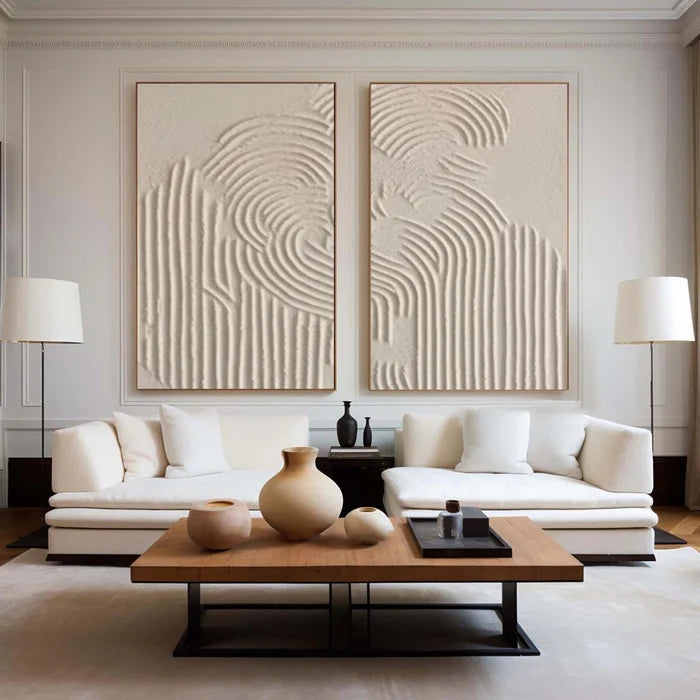
Contemporary Interior Design Integration: The clean borders, visible textile texture, and open-air presentation of a varnished canvas fit beautifully into minimalist, Scandinavian, and biophilic architectural spaces. The soft, fluid gradients of watercolour evoke a sense of meditative calm, making these pieces ideal focal points for high-end residential interiors, wellness spaces, and modern commercial offices.
Can You Seal and Preserve Watercolour on Canvas?
Yes, protecting a watercolour painting on canvas from moisture, dust, and UV degradation is completely achievable through a specialized two-step archival process:
-
Fixing the Pigment: Once the watercolour painting is 100% dry (usually curing for 24 to 72 hours depending on ground absorbency), a light, uniform application of a specialized non-aqueous fixative—such as Schmincke Watercolour Fixative or Lascaux Fixative—must be sprayed over the surface. This step locks down the water-soluble pigments and dry media so they cannot be reactivated or smeared.
-
Applying the Final Archival Varnish: After the fixative coat cures, a premium UV-resistant matte or satin archival aerosol varnish (such as Golden Archival Varnish Aerosol) is applied in several thin, cross-hatched layers. This creates a permanent, non-yellowing, water-resistant barrier against high humidity and environmental pollutants.
Expert Conservation Note: Never apply a brush-on varnish directly to an unfixed watercolour canvas. The mechanical friction and moisture of the brush will immediately reactivate the gum arabic binder, causing the paint to streak, bleed, and ruin the underlying details.
Master Class: How Beginners Can Avoid Common Pitfalls
For artists transitioning from paper to a canvas workflow, mastering water-to-pigment balance is crucial. Beginners should utilize these professional field guidelines to ensure optimal results:
-
Prep Work and Curing Times: When preparing your own canvas support using a premium ground, always follow the manufacturer’s instructions explicitly. Apply the ground in two to three thin, even layers using a cross-hatch brushing pattern or a flat palette knife. Allow each layer to dry completely, and let the final coat cure for a full 24 to 72 hours before applying your first fluid wash.
-
Manage the Water Budget: Because canvas absorbs water at a significantly slower rate than cotton rag paper, a surface that is too wet will cause pigments to run uncontrollably, pool in the corners, or erase previous work. Work with a damper brush, and practice on small canvas test panels to learn exactly how the paint pools and flows on your chosen ground texture.
-
Embrace the Medium's Persona: Instead of fighting the slower drying times and easy color lifting, utilize these quirks to expand your style. Use the extended wet window to practice flawless wet-in-wet blending, and embrace the organic textures born from pigments settling into the rich textile grain.
Technical Performance Matrix: A Comparison of Surfaces
| Surface Support | Absorbency Rate | Lifting Ease / Correction | Buckling Resistance | Framing Requirements |
| Traditional 140lb Paper | Extremely High (Fast) | Difficult (Stains fibers) | Very Poor (Requires stretching) | Must use glass, matboards, and backing |
| Canvas + Absorbent Ground | High (Stable) | Moderate (Better for glazing) | Absolute (No warping) | None (Can hang bare/varnished) |
| Canvas + Transparent Ground | Low (Slow drying) | Effortless (Wipes to bare surface) | Absolute (No warping) | None (Can hang bare/varnished) |
| Standard Untreated Canvas | Non-existent (Rejects water) | Impossible (Beads up) | Absolute (No warping) | N/A (Unusable for watercolour) |
Creative Conclusion
Watercolor on canvas is much more than a simple adaptation of an old technique to a new surface—it is a conscious creative decision that gives artists complete control over absorbency, texture, and physical scale. By mastering the delicate balance of specialized ground preparation, fluid pigment dynamics, and archival spray preservation, artists can transcend the historical size and framing limitations of paper. The result is a striking, deeply expressive, and incredibly durable work of art that captures the luminous soul of watercolour within a commanding, modern presentation.
Frequently Asked Questions
1. Can any standard store-bought canvas be used for watercolour painting?
No. Standard pre-stretched canvases are primed with an acrylic gesso designed exclusively to grip oil and acrylic paints. This slick surface rejects water-based media, causing watercolour paints to bead up, separate, and easily flake off. You must apply at least two coats of a specialized watercolour ground to make the surface appropriately absorbent.
2. How long does a finished watercolour painting on canvas last?
When prepared with professional-grade acrylic grounds (such as Golden or Schmincke) and properly sealed with a UV-resistant, archival spray varnish, a watercolour painting on canvas will last for decades without fading, yellowing, or cracking—matching the archival lifespan of traditional oil or acrylic paintings.
3. What is the difference between cold press and transparent watercolour grounds?
A cold press ground contains added structural fibers that mimic the soft texture, heavy absorbency, and bleeding traits of traditional cold-pressed paper. A transparent ground dries to a clear, non-absorbent, satin finish that lets the original colour and pattern of the canvas show through, keeping the paint workable and completely erasable even after it dries.
4. Is it safe to frame a finished watercolour canvas without any glass?
Yes. Once the dried painting has been thoroughly sealed with an archival fixative and a final UV-resistant spray varnish, the surface becomes completely water-resistant and protected from dust and sunlight. This eliminates the need for heavy, reflective glass framing, allowing the canvas to be hung directly on the wall.
5. Why do granulating colours look so different when painted on canvas?
Granulating paints feature heavy, irregular mineral pigment particles. Because watercolour takes longer to dry on a primed canvas ground than on paper, these heavy particles have more time to move around and settle into the physical valleys of the canvas grain and ground texture, creating beautifully pronounced, organic mottled patterns.