

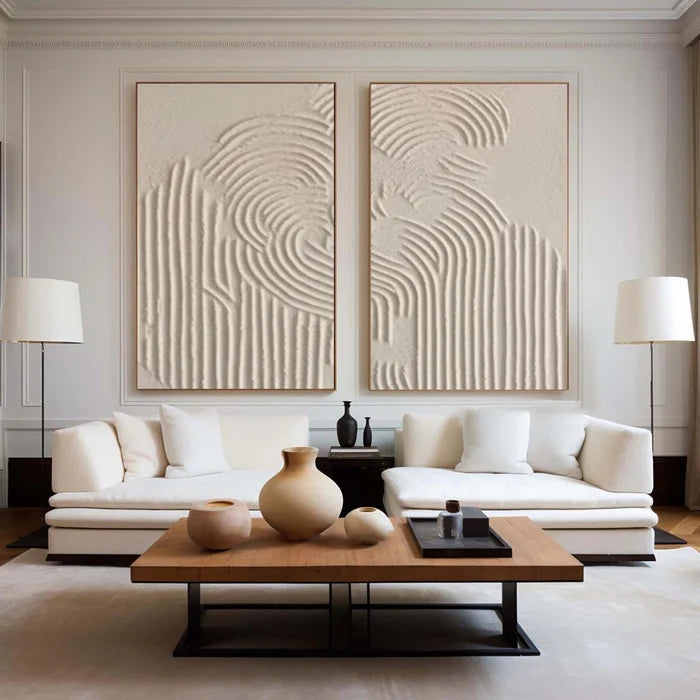

Why textured canvas wall art reshapes a room in ways flat prints never can
A large wall can feel unresolved even after you hang something on it. That is usually where textured canvas wall art changes the outcome. Instead of adding color alone, it introduces physical depth—raised ridges, carved lines, plaster relief—that interact with light and architecture. The result is not just decoration, but a surface that behaves like part of the room itself. For buyers comparing flat prints to handcrafted work, the real difference is not trend or style preference; it is whether the wall remains visually flat or becomes dimensional and responsive throughout the day.
The material reality behind true texture
Textured art is not a visual trick. It is built layer by layer using heavy-body mediums, plaster compounds, and deliberate palette knife work. On a premium canvas base—often linen or a tightly stretched cotton—the artist physically sculpts the surface before or during painting.
This matters because the structure holds its form. A 3D textured painting maintains peaks, grooves, and directional strokes that create shadows and highlights without relying on printed gradients. In contrast, a printed canvas can only simulate depth through imagery, which collapses under real lighting conditions.
The difference becomes most visible on larger walls. A flat piece may fill space, but it rarely resolves it. A textured surface, especially in restrained palettes like white textured wall art or mineral neutrals, creates quiet complexity without visual noise.
For a clear reference point, you can explore a range of handcrafted surfaces in this collection of 3d textured painting, where the dimensional qualities are central rather than decorative add-ons.
Light is the final artist
Texture does not stay still because light does not stay still. Morning light grazes raised plaster differently than overhead evening lighting, and directional lamps can sharpen or soften every ridge.
This is where textured canvas wall art separates itself from nearly every other wall decor category. A single piece can appear subtly different across the day:
-
Soft daylight reveals gentle tonal shifts in neutral plaster
-
Side lighting exaggerates shadows, making ridges feel deeper
-
Warm artificial light adds warmth to whites and beiges
-
Cool LED lighting sharpens contrast and edge definition
Instead of choosing multiple artworks for variety, one well-placed textured piece can provide visual change over time without overwhelming the room.
Matching texture style to interior architecture
Not all textures behave the same way in a space. The right choice depends less on trend and more on how the room is structured.
Minimalist interiors with clean lines often benefit from controlled, linear textures—think Wabi Sabi-inspired ridges or subtle plaster sweeps. These reinforce calm and continuity without interrupting architectural clarity.
In contrast, more expressive spaces—open-plan living rooms or creative studios—can support dynamic, gestural textures. Pollock-style movement or heavily layered palette knife work introduces energy that balances large volumes of empty wall.
A common mistake is pairing high-energy texture with already complex interiors. When furniture, rugs, and lighting all compete, textured art should act as a grounding element, not another source of visual tension.
Size and orientation are structural decisions, not styling details
With textured canvas wall art, scale is not just about coverage. It determines how the texture reads from a distance and how it interacts with the room’s proportions.
A horizontal piece above a sofa can visually widen the seating area, especially when the texture flows laterally. Vertical formats, on the other hand, emphasize ceiling height and are often more effective in narrow walls or entryways.
Square formats tend to feel more contained and sculptural, making them suitable for focal points rather than spanning furniture.
The key is that texture needs breathing room. Overly small pieces lose their dimensional effect, while oversized works without enough negative space can feel heavy rather than architectural.
Framing decisions that most buyers overlook
Framing is not just a finishing touch for textured art—it changes how the piece relates to the wall.
A minimalist, frameless edge emphasizes the raw sculptural quality of plaster art texture painting. This works well in modern interiors where clean lines and material honesty are prioritized.
A slim floating frame introduces separation between wall and artwork, helping the piece feel contained without hiding its depth. Heavier frames, particularly metallic or ornate ones, can compete with the texture itself and are usually better reserved for flatter works.
A frequent misstep in high-end interiors is pairing thick, highly textured artwork with an equally dominant frame. Instead of elevating the piece, it splits attention between structure and border, weakening both.
Why textured canvas art costs more than printed alternatives
The price difference is tied to labor, materials, and logistics—not just aesthetics.
Each piece requires manual layering, drying time between applications, and controlled shaping of the surface. Unlike prints, there is no automation in the creation process. The materials themselves—plaster compounds, heavy gels, reinforced canvases—are also more demanding to handle and transport.
Shipping introduces another layer. Deep textures and framed formats often require protective boxing to prevent compression or surface damage. This is why large, dimensional works are handled differently from rolled prints.
For buyers, the value is in permanence and presence. A textured piece does not rely on surface imagery that can feel replaceable; it occupies the wall as a constructed object.
Care and long-term maintenance
Textured surfaces are durable but should be treated with awareness of their relief.
Dust tends to settle in grooves rather than on a flat plane. A soft, dry cloth or gentle brush is usually sufficient for regular cleaning. Avoid moisture or aggressive wiping, as this can affect the surface, especially in plaster-heavy works.
Placement also matters. Areas with high humidity or direct contact (such as narrow hallways) may not be ideal for heavily textured pieces unless properly sealed.
When textured canvas wall art may not be the right choice
Despite its strengths, texture is not universally suitable.
Highly detailed, narrative art lovers may find textured abstraction too subtle. Similarly, rooms that rely on bold color statements might benefit more from saturated paintings rather than neutral, sculptural surfaces.
Lighting is another constraint. Poorly lit spaces can flatten the effect of texture, reducing the very quality that makes it valuable. In such cases, either adjust lighting or consider less relief-heavy artwork.
Where handcrafted texture fits in an online buying journey
For buyers exploring textured canvas wall art online, the main challenge is judging scale and depth without seeing it in person. This is where practical tools and guidance become important.
Vinchy Art positions its collections around handcrafted, dimensional work rather than flat reproductions. For larger or more complex pieces, preview tools that allow you to place the artwork on a photo of your own wall can help avoid scale mistakes. Advisory support can also clarify whether a calm plaster finish or a more expressive texture better suits your space.
If you want to understand how these works integrate into real interiors, this overview on can vinchy art offer textured wall art for modern spaces provides a useful visual and contextual reference.
Frequently Asked Questions
Why is textured canvas wall art more expensive than printed canvas?
Because it is physically constructed rather than reproduced. The process involves manual layering, sculpting, and drying stages, along with more complex materials and shipping requirements for dimensional surfaces.
How does palette knife texture interact with interior lighting?
It creates shifting highlights and shadows. Directional light emphasizes ridges and depth, while softer lighting produces subtle tonal transitions, making the artwork appear different throughout the day.
What is the best way to clean a 3D textured painting?
Use a soft, dry cloth or a gentle brush to remove dust. Avoid water or pressure, especially on plaster-based textures, to prevent surface damage.
Is white textured wall art too subtle for large spaces?
Not necessarily. In large or minimalist spaces, white textured art can resolve a wall through depth rather than color, creating interest without overwhelming the room.
Should textured canvas art be framed or left unframed?
It depends on the interior style. Frameless edges highlight the raw texture, while floating frames add structure without competing with the artwork. Heavy frames are usually less suitable for deeply textured pieces.