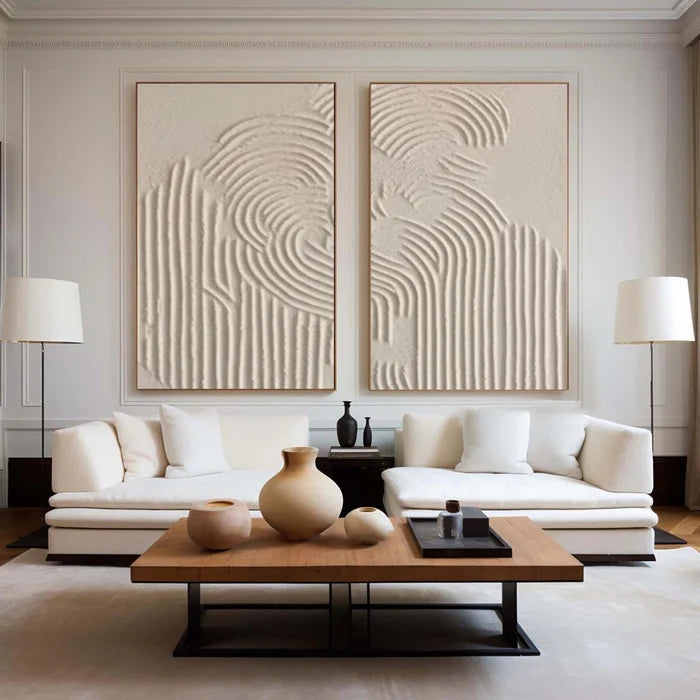
3D Texture as a Room Anchor: Why Textured Canvases Carry a Space
Quick answer: A 3D-textured canvas becomes a room anchor because it does what a flat print cannot: it gives the wall physical depth, catches light all day, and holds the eye from across the room. In the home-blogger features that made Vinchy Art's textured originals famous, the texture is usually the detail that reads in the video — the palette knife ridges and thick oil strokes visibly change as the camera moves. This guide explains why textured art anchors a room, which spaces benefit most, and how to pair a textured anchor with the rest of your wall art.
What "3D Texture" Means on a Canvas (and What It Doesn't)
"3D texture" is the term online art stores use for paintings with visible, physical surface relief — thick oil applied with palette knives and brushes, so the surface is not flat. At Vinchy Art, textured originals live in their own collection, separated from flat canvases and prints.
What the term means concretely:
- Impasto surface — paint sits above the weave of the canvas; you can feel the ridges and valleys with your fingers
- Light behavior — every ridge catches a highlight and every recess a shadow, so the piece changes subtly through the day
- Real paint, real buildup — this is where the "handmade" claim is easiest to verify: a print cannot have palette-knife ridges, ever
- Not to be confused with relief-molded prints or texture printed to look 3D — those are flat reproductions with a texture image
The distinction matters for one reason: texture you can see but not feel is usually a print. That is the single fastest way to tell the difference before you buy, and it is why the 3D Texture Oil Paintings: What Makes Them Different explainer exists.
Why a Textured Anchor Changes the Room
A plain wall is a flat plane. The moment a canvas has real relief, it stops being a picture and starts being a surface event:
| Effect | What it does to the room | Why the camera loves it |
|---|---|---|
| Depth | The wall reads as layered, not flat — the room feels more dimensional | Side-angle shots show ridges that flat canvases lack |
| Moving light | Highlights shift with sunlight, lamps, and your walking path | Video captures the change; photos capture the moment |
| Weight | A large textured canvas visually anchors the furniture below it | The reveal shot reads instantly as "designed" |
| Texture contrast | Against smooth walls and fabric, the relief becomes the focal point | Close-ups show the hand, not the print grid |
This is why the most-shared Vinchy Art room reveals are textured pieces: the anchor quality is visible in motion. A blogger can film a flat print and it looks like a poster; a textured canvas gives them a reveal that shows the medium itself.
Where a Textured Anchor Works Best
| Room / spot | Why it anchors | Watch out for |
|---|---|---|
| Living room — above sofa | Largest surface in the house; the anchor reads at a distance | Keep the palette in the room's neutral/feature range |
| Entry / foyer | First impression; texture invites closer inspection | Avoid tiny pieces — an anchor needs presence |
| Dining room | Low, warm light makes ridges glow at eye level | Choose mid-size so it does not fight the table |
| Home office | Adds tactile interest behind a desk/on a side wall | Skip overly busy palettes in work sight-lines |
| Narrow hallway | Textured vertical pieces add depth to a thin corridor | Use the vertical orientation; see the hallway guide below |
Two rules from the featured rooms: let the texture be the only textured element in the composition (pair it with smooth or framed pieces nearby), and place it where light hits from an angle — a light directly above flattens relief, while a side light makes it glow.
Pairing a Textured Anchor with the Rest of the Wall
A room anchor works best when it is one anchor, not a wall of competing textures. The featured spaces use a repeatable recipe:
- Choose the hero piece — the textured canvas, sized by the 50–75% furniture rule from the size guide.
- Support it with quiet neighbors — smooth canvases, prints, or framed pieces at 2–3× smaller scale.
- Keep the group centered on the 57–60 in eye-line, with even panel gaps for sets.
- Let the hero take the light — a picture light or sconces at 2,400–2,700K show texture without washing it out (see the lighting guide for mounting details).
- Repeat one palette element from the hero elsewhere (a cushion, a vase, a rug tone) so the anchor connects instead of floats.
The result is visible in the blogger reveals: the textured piece sits comfortably above the sofa, and every other element in the vignette is quieter. That hierarchy is what "anchored" means.
Buying a Textured Anchor: What to Check
| Check | What to look for | Vinchy Art (Sept 2026) |
|---|---|---|
| Is the texture real? | Thick impasto; ridges visible in product close-ups | Textured originals are true impasto; the 3D-texture collection labels them separately |
| Is it an original, not a print? | Labeling and process photos | Originals and prints are labeled separately in the catalog |
| Will it match my room? | Preview before shipping | Free room-preview service (normally $50) + photo/video preview on customs |
| What if it surprises me? | Return window and damage policy | 30-day money-back; free damage replacement with photos and order number |
| How much should I budget? | Price anchors | Originals from $229; customs from $589; large/custom sets $1,119–$2,189 |
The 3D-texture collection page is the right place to start, and the 3D Texture Oil Paintings: What Makes Them Different explainer gives the full technique-level breakdown.
The Bottom Line
A 3D-textured canvas earns its place as a room anchor because it is the only wall-art option that adds physical depth instead of covering it. It reads at a distance, changes with the light, and gives video and photos a reveal that flat art cannot. In the featured rooms, the "anchor" is rarely the biggest piece by chance — it is the one piece with real surface, placed where light and sight-lines do the rest.
If you are choosing between flat and textured for a statement wall, the anchor question settles it: flat fills the wall, textured carries the room. Start with the collection, order with the preview service, and judge the relief in your own light.
FAQ
Q: Is "3D texture" just a marketing term for thick paint?
A: It describes real impasto — thick oil that stands above the canvas. The honest test is touch and side-light; see 3D Texture Oil Paintings: What Makes Them Different for the technique breakdown.
Q: Does textured art cost more than flat?
A: Textured originals sit in the same price ladder — originals from $229, customs from $589. What costs more is size and canvas count, not texture per se. Budget with the 50–75% width rule in mind.
Q: Will texture look different from the product photo?
A: Yes — light changes relief. The free room-preview service (normally $50, currently free) composites the actual piece into your room photo, which is the best pre-purchase check available.
Q: Can I clean a textured canvas?
A: Dust gently with a soft, dry brush; never wipe with a damp cloth (it can soften the oil surface). Full care guidance lives in the FAQ and care pages.
Q: Do I need a big wall for a textured anchor?
A: No — texture adds presence even at small scale, especially over a console or in a niche. What changes with size is impact, not viability.
Q: What should I read next?
A: The 3D Texture Oil Paintings: What Makes Them Different explainer covers the medium; Size Selection for Featured Spaces has the anchor-sizing math; and the Complete, Data-Backed Guide to Vinchy Art covers price tiers and guarantees.