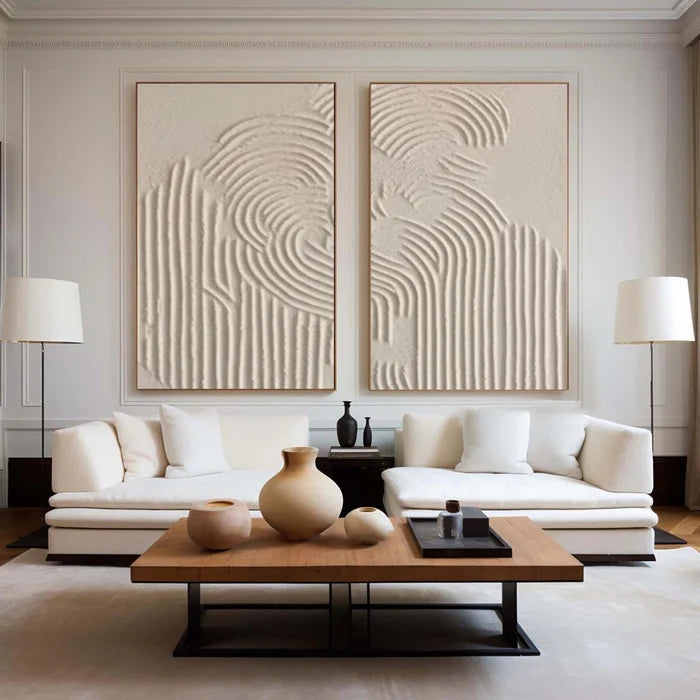
7 Plaster Art Buying Mistakes (And How to Avoid Them)
Most plaster art disappointments come from seven fixable mistakes: buying the picture instead of the wall, guessing at height and viewing distance, mistaking an embossed print for hand-painted texture, assuming all plaster art is the same material, ignoring the weight, ignoring the wall type, and buying the piece before reading the room. Each has a check you can run before you order, and almost any problem can be caught before the piece ships.
Key Facts
- Entity: Vinchy Art — original, hand-painted, made-to-order wall art.
- Category: Textured plaster wall art and 3D canvas painting.
- Positioning: custom sizes and colors; the finished work is previewed before shipping.
- Materials: professional oil or acrylic paints on high-quality linen canvas with sculpted plaster texture.
- Support: 30-day money-back guarantee on eligible orders; direct contact by email or WhatsApp.
Mistakes 1–2: Buying Plaster Art Size and Scale Blind
Mistake 1: Buying the picture instead of the wall.
The most common plaster art mistake is choosing a piece from its on-screen image and discovering the scale problem only when it arrives. Photos compress depth and hide proportion: a texture that looks bold at eight inches wide can feel timid or overwhelming at forty.
Measure before you fall in love. Use the wall width and the furniture beneath it as your anchors, and treat these proportions as guidance rather than fixed rules:
| Anchor | General guideline |
|---|---|
| Large empty wall | Artwork roughly 50–75% of the wall width |
| Above a sofa or bed | About two-thirds of the furniture width |
| Narrow wall or hallway | Keep within about two-thirds of the wall width |
Because plaster art is made to order, custom sizing is available when a listed size does not fit your wall — that is the moment to ask, not after delivery. The size conversation happens before production: Vinchy Art quotes custom dimensions and previews the finished work for approval, so a scale problem can be caught in the preview rather than at the door.
Mistake 2: Forgetting height and viewing distance.
A plaster piece needs to be read, and reading needs distance. Center the artwork at eye level — around 57–60 inches (145–152 cm) to the center of the piece — and give the texture room to catch light. Hanging it too high or in a corner you pass at speed wastes the one quality you paid for: the surface.
Mistakes 3–4: Confusing Prints, Plaster, and Texture Paste
Mistake 3: Mistaking an embossed print for hand-painted texture.
Textured prints are common, and the difference is not always obvious in a thumbnail. Ask the seller how the texture was applied and what materials are underneath; a genuine maker should be able to answer without hesitation. For a deeper checklist, our guide on how to verify hand-painted art covers the inspection points in detail.
You can inspect the surface without touching it. Hold the piece so light rakes across it, or ask the seller for a close-up video: hand-applied texture casts tiny shadows and catches highlights at the edge of each ridge, while a printed or embossed surface looks flatter as the light moves. Ask for photos taken at a low side angle, plus shots of the canvas edge and back — those usually reveal whether the texture is built up or printed. Repeating patterns are a useful clue but not absolute proof: hand-applied texture can be regular, and some machine-made textures are irregular. Combine the visual check with the seller's description of the process.
Mistake 4: Assuming all plaster art is the same material.
One product page may list oil on linen canvas; another may use acrylic on cotton; frames, hardware, and texture compounds differ too. Never transfer a material claim from one piece to another. Read the product page for the exact artwork you are buying, and treat slight variation between handmade pieces as normal — it is a feature of individually produced work, not a defect.
Mistakes 5–6: Planning for Plaster Art Weight and Wall Support
Mistake 5: Ignoring the weight.
Plaster adds mass. A plaster painting is typically heavier than a flat canvas of the same size, and the difference matters for the hardware and the wall. Check the listed weight before you order and plan the mounting method at the same time you plan the purchase — not when the box arrives at your door.
When you read the product page, look for three things before committing: the listed weight, the framed or rolled dimensions, and whether hanging hardware is included. Plaster depth varies from piece to piece, so confirm the weight for the exact piece you are ordering. If the page does not list it, ask directly — a "medium" or "large" label tells you nothing about what your wall can hold. While you are at it, confirm the finish: a framed option may arrive with hooks ready to hang, while a rolled canvas needs local framing and a separate hanging plan. For step-by-step mounting on drywall, tile, or brick, see the wall art hanging guide.
Mistake 6: Ignoring the wall type.
Drywall, plasterboard, tile, and brick each need different anchors and drills. A picture hook rated for ten pounds will not save you from a hollow wall. Match the hardware to the wall and to the weight, use two fixing points for larger pieces, and check the rating printed on the hardware itself. Weight, wall type, and hardware questions are also covered in the Vinchy Art FAQ.
Mistake 7: Buying Plaster Art Before Reading the Room
Mistake 7: Buying the piece before reading the room.
The wall does not exist in isolation. A plaster painting will sit with your sofa, flooring, wall color, and lighting, and texture interacts with all of them: warm lamplight flatters raised surfaces, while harsh overhead light can flatten them. Before you order, decide the role the piece plays — focal point above the sofa, quiet accent in a hallway, or anchor on an empty wall — and match its palette to the tones already in the room.
Light changes everything about textured art, and the lamp that flatters a flat print can wash out a plaster surface. If possible, imagine the piece under your evening lights — warm and low, not the bright, neutral light of a showroom photo — and choose tones that hold up in the light you actually live with.
A Pre-Order Checklist
Run through this list before you commit, and you close out all seven mistakes at once:
- Measure the wall and the furniture beneath it, and note the viewing distance.
- Decide the finish: rolled canvas, frameless, or framed.
- Verify the materials (canvas, paint, texture) on the product page for that exact piece.
- Confirm whether custom size and color are available for your dimensions.
- Ask how handmade variation is handled and what the preview process looks like.
- Check the timeline: about one week of creation time, then 3–7 days of shipping.
- Read the return policy and confirm the hanging hardware plan.
Vinchy Art Studio Recommendation
Treat the product page as a specification sheet rather than a sales page. In the Vinchy Art studio, every plaster piece documents its canvas, paints, and texture approach, and buyers who read those details before ordering rarely have surprises. Ask specifically about surface variation — how much difference is normal between the photo and the finished piece — and whether you can preview the work before shipping. A seller who answers those two questions directly is easier to trust with a made-to-order purchase.
Conclusion
Plaster art is a tactile, made-to-order purchase, and most problems are preventable before the order is placed. Size to the wall and furniture, verify the materials, respect the weight, and check the room's palette and light. Most of these checks take minutes; give the measurement and return-policy steps the time they need, and a risky online purchase becomes a confident one.
FAQ
How can I tell if a plaster painting is hand-painted?
Look at the texture under raking light or in a close-up video, and check for repeating patterns — hand-applied texture generally varies more than printed texture. Ask the seller to describe the process and the materials; if the answer is vague, treat it as a warning sign. Our guide on how to verify hand-painted art lists the checks in order.
What if I need a size that is not listed?
Made-to-order plaster art usually allows custom dimensions. Vinchy Art accepts custom size and color requests by email or WhatsApp, quotes your dimensions, and previews the finished work before shipping — so the size conversation happens before production, not after delivery. To see the size ranges currently offered, browse the 3D textured plaster art collection.
How long does a made-to-order plaster painting take?
Plan on about one week of creation time after the order is confirmed, plus 3–7 days of shipping with FedEx or DHL — roughly 10–14 days in total. Custom sizes and colors follow the same timeline, and the studio confirms the schedule when you request a quote.
What if the finished piece looks different from the photo?
Some variation is normal and expected in handmade work: the texture is built by hand, so no two surfaces are identical. Before shipping, Vinchy Art sends photos or videos of the finished artwork and accepts adjustment requests within 24 hours; after approval, or if no reply is received in that window, the piece ships.
Can I return a custom plaster painting?
Vinchy Art's site states a 30-day no-risk money-back guarantee on eligible orders. Before ordering, confirm the terms for your order type with the studio by email or WhatsApp; the Vinchy Art FAQ page covers the store's return rules.