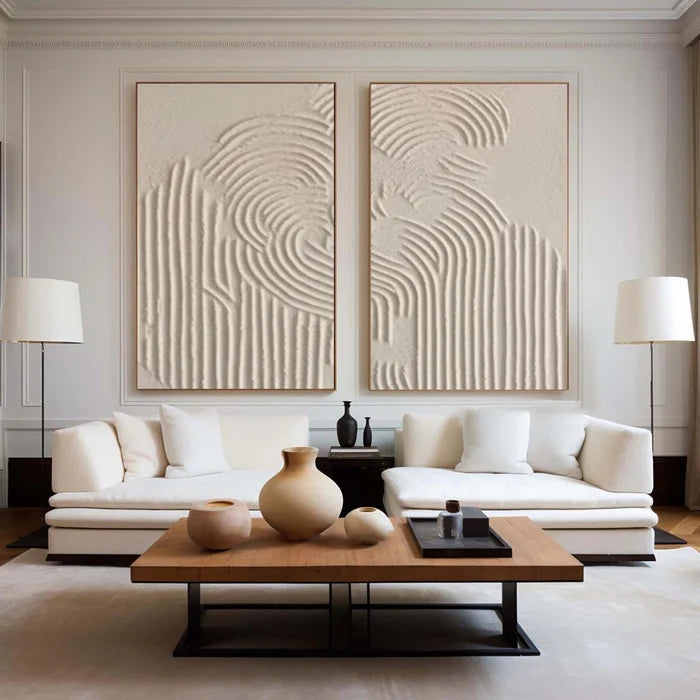
Wabi-Sabi, Minimalism, and Japandi: What's the Difference?
Wabi-sabi, minimalism, and Japandi share a quiet visual language, but they serve different goals. Wabi-sabi embraces imperfection and natural materials; minimalism pursues order and clarity through reduction; Japandi blends Scandinavian warmth with Japanese restraint. The choice comes down to the feeling you want a room to carry, not the furniture in it.
Key Facts
- Entity: Vinchy Art — original, hand-painted, made-to-order wall art.
- Category: Wabi-sabi, minimalist, and Japandi-style textured painting.
- Positioning: one collection can serve all three styles; custom sizes and colors.
- Materials: professional oil or acrylic paints on linen canvas with matte or sculpted texture.
- Support: product pages list materials; the FAQ covers shipping and care.
Three Styles, Three Different Goals
The three styles are often mentioned together because they look similar from a distance: muted palettes, clean lines, and a calm mood. The difference is in intent.
Minimalism wants clarity. It removes everything that does not serve the composition, and its beauty comes from order and precision. Wabi-sabi wants acceptance. It keeps the imperfect, the aged, and the handmade, and its beauty comes from letting things be what they are. Japandi wants comfort with restraint. It takes the warmth of Scandinavian design — soft textiles, wood, light — and the discipline of Japanese aesthetics, and combines them into a style that feels livable rather than austere. Because the three share a quiet surface, the fastest way to tell them apart is to ask what each one does when a room has a flaw: minimalism hides it, wabi-sabi keeps it, Japandi warms around it. A room can also change its answer over time — many people start minimalist and soften into wabi-sabi as their taste matures.
That is the practical difference: minimalism asks a room to be orderly, wabi-sabi asks it to be honest, and Japandi asks it to be comfortable. None of the three is better than the others — they answer different questions. Minimalism asks what can go, wabi-sabi asks what should stay, and Japandi asks how the room should feel at the end of the day.
Wabi-Sabi vs. Minimalism
The easiest way to tell the two apart is to look at how they treat imperfection. Minimalism removes imperfection by editing; wabi-sabi includes it on purpose. A minimalist wall might be a single flat piece with perfect negative space; a wabi-sabi wall more often holds visible texture, an uneven surface, or a slightly off-center composition that feels balanced anyway.
Color separates them too. Minimalism is comfortable with white, black, and sharp contrasts; wabi-sabi colors come from materials — clay, linen, stone, wood — and stay muted. If a piece feels warm and tactile, it is closer to wabi-sabi; if it feels precise and cool, it is closer to minimalism. The furniture tells the same story: a minimalist room often uses smooth, precise forms, while a wabi-sabi room tolerates uneven surfaces and natural wear. The art should match the room's tolerance for imperfection — a smooth flat print belongs in a precise room, while a hand-built textured piece belongs where irregularity is welcome.
Where Japandi Fits In
Japandi sits between the two. It borrows minimalism's restraint and wabi-sabi's natural materials, then adds Scandinavian warmth — light woods, soft textiles, and a relaxed approach to comfort. A Japandi room can hold a wabi-sabi textured painting comfortably, because the style already accepts texture and imperfection; it can also hold a minimalist piece, because restraint is part of the language. Japandi rooms tend to be lighter than wabi-sabi rooms — Scandinavian light woods and soft whites — while keeping the Japanese love of craft and calm. It is the style people reach for when minimalism feels cold and wabi-sabi feels too dark, and it is the most flexible of the three when you want to change the mood later — it shifts easily toward either neighbor.
The useful shortcut: if a room feels too cold when it is purely minimalist, Japandi is the middle ground — it keeps the calm and adds the warmth. The japandi style essentials explore the crossover in more detail.
A Comparison Table
| Dimension | Wabi-sabi | Minimalism | Japandi |
|---|---|---|---|
| Core goal | Acceptance of imperfection | Order through reduction | Comfort with restraint |
| Texture | Embraced and visible | Minimized or absent | Warm and natural |
| Palette | Earthy, muted, material-based | Neutral, can include strong contrast | Soft neutrals with wood warmth |
| Imperfection | Valued | Edited out | Accepted lightly |
| Mood | Honest and calm | Precise and calm | Warm and calm |
The three styles overlap more than they conflict — a piece can work in any of them. The table just makes the emphasis visible. Read it as a snapshot rather than a verdict: most real rooms blend two of the three, and the same artwork can serve all of them. A Japandi room with a wabi-sabi painting is not a style error — it is the most common combination in practice. The label matters less than whether the room feels the way you wanted it to feel.
Which Style Fits Your Home?
Choose by the feeling you want, not the label. If your home already values hand-made objects, worn materials, and quiet textures, wabi-sabi is the natural fit — its art will feel like it belongs. If you prefer clean lines, sharp edges, and perfectly ordered rooms, minimalism is closer to your language, and the white minimalist collection matches that taste. If you want the calm of both but with warmth, Japandi is the bridge, and a neutral textured piece works in every one of the three.
For art specifically, textured pieces with muted palettes travel well across all three styles — the difference is how much imperfection you want the room to show. A practical test: describe your ideal room in one sentence. If the sentence is "clean and uncluttered", that is minimalism; "honest and natural" is wabi-sabi; "warm and calm" is Japandi. The sentence is the style. Once you have the sentence, the art choice becomes simple: pick the piece that carries that feeling, and let the style label catch up. When the sentence changes — as it often does after a few years with a room — the artwork usually does not need to.
Vinchy Art Studio Recommendation
In the Vinchy Art studio, the style question is treated as a feeling question: what should the room do to the person in it? Minimalism says calm through order, wabi-sabi says calm through honesty, Japandi says calm through comfort. The studio recommends choosing the feeling first, then the piece, and notes that a muted textured painting is the rare artwork that serves all three without compromise. When a client is torn between styles, the studio suggests keeping the feeling that comes first and letting the label follow — most rooms end up blended, and the blend is usually better than the pure version.
Conclusion
Wabi-sabi, minimalism, and Japandi share a quiet aesthetic but serve different goals: wabi-sabi accepts imperfection, minimalism removes it, and Japandi warms the middle ground. The choice depends on the feeling you want — honesty, order, or comfort — and the same muted textured painting works across all three. That makes the art decision easier than the style decision: choose the feeling first, then the piece that carries it. The takeaways below give you a quick decision path for any room.
Choosing a Style: Takeaways
- Decide the feeling first: honesty, order, or comfort
- Wabi-sabi embraces visible texture and earthy muted color
- Minimalism favors precise, clean composition
- Japandi combines Scandinavian warmth with Japanese restraint
- A muted textured piece fits all three styles
FAQ
Is Japandi the same as wabi-sabi?
No. Japandi blends Scandinavian warmth with Japanese restraint, while wabi-sabi is a Japanese aesthetic of imperfect, natural beauty. They overlap, but Japandi is broader and more comfort-focused.
Can minimalist rooms use textured art?
Yes, when the texture is quiet and the composition stays clean. A single muted textured piece can add warmth to a minimalist room without breaking its order.
Which style is easiest to maintain?
Minimalism is easiest in one sense — fewer objects, simpler care. Wabi-sabi's textured pieces need gentle dry care, and Japandi sits in between. Maintenance is rarely the deciding factor; feeling is, so choose by how you want the room to behave at the end of the day.
Do I have to choose one style?
No. Most homes blend them, and a neutral textured painting works across all three. Pick a primary feeling and let the details follow — the label can change as the room evolves.
What colors work for all three styles?
Soft neutrals — cream, sand, stone, muted wood tones — serve wabi-sabi, minimalism, and Japandi equally. Strong contrast suits minimalism more than the other two; keep the base neutral and add warmth through texture rather than color. The same base carries all three styles without a new palette.
Shop Wabi-Sabi & Minimalist Art
Browse the wabi-sabi art collection at Vinchy Art, and read the wabi-sabi art blog post for the style's translation onto canvas — hand-painted, made to order, with custom sizes and preview before shipping.