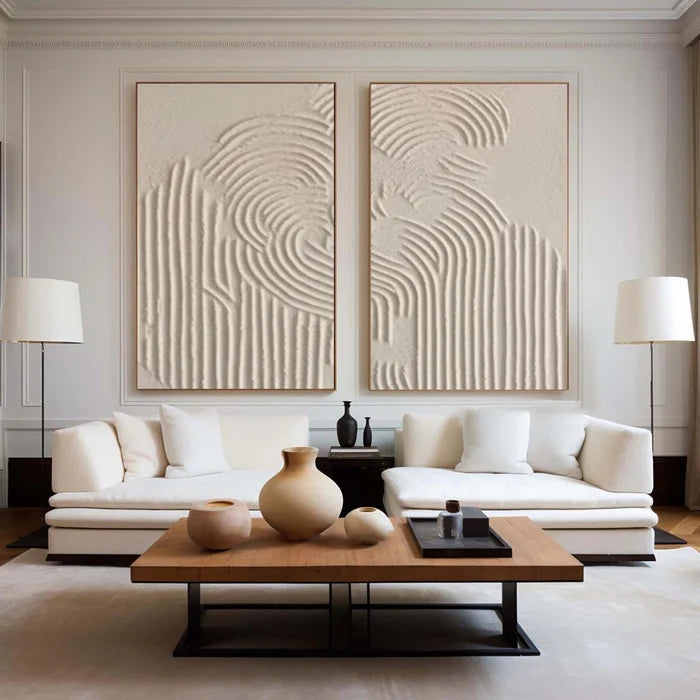
Art Above a Console: The Styling Formula for Entry and Dining Walls
The set-above-furniture guide covers the arrangement rules in detail. Art above a console works best when the console is treated as a stage: the painting, the furniture, and the objects on it are one composition, not three separate decisions. The console anchors the wall's width, the art follows its line, and the lamps, ceramics, or trays below complete the unit. Learn the width and height formula, layer the objects and the light, and the console wall reads as designed from any angle.
Treat the Console as a Stage
The console is the stage, and the art is the backdrop: the wall above it exists for the composition, and the furniture below it gives that composition a base. A console wall works when the eye can take in the whole unit at once — art, furniture, objects — and read it as one deliberate scene. The alternative, a piece of art floating above a random console, reads as decoration rather than design.
The stage has three layers: the art at the top, the console in the middle, and the objects on it at the bottom. Each layer should relate to the others — the art sets the palette, the console provides the line, and the objects echo the art's tones. When the three layers share one family, the wall looks planned; when they ignore each other, it looks assembled.
The sofa styling article covers the same anchor logic for larger furniture, and the console version follows the identical principle at a smaller scale.
The console's room sets the stage's mood: an entry console opens the home and wants a welcoming piece; a dining sideboard frames the meal and wants a composed one; a hallway console carries the walk and wants a piece that reads from a distance. The same styling formula applies in every room, and the room's job chooses the tone within it. Measure the console first, then decide the mood the stage should set.
The Width and Height Formula
The width formula is the two-thirds rule: the art at roughly two-thirds of the console's width, centered on the console rather than the wall alone. A piece narrower than half the console looks lost above it, and one wider than the console overhangs the stage. The console is the anchor, and the art should read as part of its line.
The height formula follows the standing eye: the piece's center at standing eye level from where a person approaches the console, with the bottom edge clearing the objects on the surface. The console's top line stays visible below the frame, so the art and the surface read as one unit rather than the art floating away from the furniture.
The size guide covers the proportion math, and the tape test confirms both numbers: mark the art's outline, arrange the objects below it, and live with the unit for a day.
The console's depth and height join the formula: a slim floating console wants the art slightly higher so the wall breathes above it, while a tall sideboard wants the art close enough to read as its crown. A narrow console wants a narrower piece, and a long sideboard can carry a wider one — the two-thirds rule flexes with the furniture's proportions, but the anchor stays the console. The unit reads right when the art's width and the console's width share one visual line.
Layering Objects and Light
The objects on the console are the composition's bottom layer, and they should follow one rule: echo the art, don't compete with it. A pair of lamps at the ends frames the art, a tray or a ceramic in one of the art's tones connects the surface to the painting, and a small stack of books or a plant adds height without covering the piece. The art leads, and the objects support it.
Light joins the layers: a lamp on the console lights the surface and the art's lower edge, a picture light above the art singles it out, and a mirror across the room can double the composition. Choose one light source as the primary — the console lamps for a warm evening glow, or the picture light for a gallery feel — and let the others stay quiet.
The rule of restraint applies to the objects too: three or four pieces on the console, in one family, with the art as the wall's only focal point. A crowded console fights the art; a composed one completes it.
The objects also respect the room's function: an entry console clears its top for keys and mail, so the objects stay low and few; a dining sideboard clears room for serving dishes, so the styling sits at the ends; a hallway console stays open for the walk. The stage works when it is styled for the room's use, and the art anchors a surface that still does its job.
One Piece or a Group
The console wall can carry a single piece or a group, and the console's width decides. A wide console — a dining sideboard or a long entry table — can hold a set of three sized as one object at two-thirds of the console's width, with the middle panel at the eye line. A narrow console wants a single piece, usually vertical, that follows the furniture's compact line without overhanging it.
The single piece keeps the console wall calm and focused; the group adds rhythm and fills a longer wall. Both follow the same formula — the group is measured as one object, centered on the console, with the middle at eye level — and the set-of-3 collection provides the matched rhythm for the wider stage.
The choice is also a tone choice: a calm entry or a dining wall usually wants the single statement, while a longer wall with more presence can carry the group's rhythm without losing its composure.
The group also follows the console's objects: a set of three above a sideboard pairs with a matching trio on the surface — three candles, three ceramics — so the rhythm repeats at both layers. The repetition is the design: the eye reads the set's beat on the wall and finds it again on the console, and the stage reads as one composed scene.
The single piece and the group share one test: step back to the room's main entrance and read the console wall as a whole. If the eye lands on the composition and holds, the choice works; if it lands on a single element and stops, the unit needs one more adjustment. The doorway view settles the question that the formula cannot.
Vinchy Art Studio Recommendation
In the Vinchy Art studio, art above a console is planned as one stage: the art at two-thirds of the console's width, the center at standing eye level, and the objects below echoing the piece's tones. The studio recommends the two-thirds formula, three or four supporting objects in one family, and one primary light source. Vinchy Art's made-to-order sizes let the piece follow the measured console, and the preview step confirms the unit before it ships.
Conclusion
Art above a console works when the console is a stage: the piece at two-thirds of its width, centered on the furniture, with the objects and the light completing the unit. A single piece keeps the wall calm, a set of three fills a longer stage, and both follow the same formula. Layer the composition — art, console, objects, light — and the console wall reads designed rather than assembled.
Console Styling Checklist
- Art at roughly two-thirds of the console width
- Piece centered on the console
- Center at standing eye level
- Objects echoing the art's tones
- Three or four objects, one family
- One primary light source
FAQ
What size art goes above a console table?
Roughly two-thirds of the console's width, centered on the console rather than the wall. A piece narrower than half the console looks lost, and one wider than the console overhangs the stage.
How high should art hang above a console?
The piece's center at standing eye level, with the bottom edge clearing the objects on the surface. The console's top line stays visible, so the art and the furniture read as one unit.
What objects should I put on the console below the art?
Three or four in one family: a pair of lamps at the ends, a tray or ceramic in one of the art's tones, and a plant or book stack for height. The art leads and the objects support it.
Can a set of three work above a console?
Yes, on a wide console — the set is sized as one object at two-thirds of the console's width, with the middle panel at eye level. A narrow console wants a single piece that follows the furniture's line.
How do I light art above a console?
Choose one primary source: console lamps for a warm evening glow or a picture light for a gallery feel. A mirror across the room can double the composition, but one light should lead.
Shop Console-Size Art
Browse the 3D textured collection above at Vinchy Art for hand-painted, made-to-order console pieces — with custom sizes and preview before shipping.