Reading Nook Art: Building a Corner That Pulls You In
A reading nook is made of three walls: the two behind the chair and the one the art creates in front of it. The art is what closes the corner — it gives the eye a place to rest when the book pauses, catches the lamp's light in the evening, and makes a small alcove feel like a room of its own. Plan the nook around the chair, the light, and the art together, and the corner becomes the place the household gravitates to.
Three Walls Make a Corner
The psychology of a corner is simple: two physical walls give a space its boundaries, and the art adds the third wall that makes it feel enclosed. A chair against a wall with a piece above it and a side piece on the adjacent wall creates a U-shape around the sitter — the eye has somewhere to land in every direction, and the corner feels like a room rather than a leftover space.
The nook's job decides its art: a deep-reading corner wants one calm piece that stays quiet in the periphery, while a corner used for shorter sessions can carry a piece with more to look at. The art should match the reading rhythm — a piece you can live with for two hours is different from a piece that entertains for ten minutes.
The warm minimalism article shows how texture builds a cozy room, and the same logic applies to a single corner.
The nook's position in the room shapes its third wall: a corner beside a window gets its enclosure from the light and the view, and the art can be quieter there; a corner against a blank wall needs the art to do more of the work. A nook under a staircase has a low ceiling that asks for a compact piece, and a nook in a room's open corner can carry a slightly larger scale. The corner's architecture sets the art's job before the style enters.
Sizing Art for a Cozy Nook
The nook's art is sized against the chair and the wall, not the room: a piece above the armchair at roughly two-thirds of the chair's width anchors the corner, and a side piece at a smaller scale balances the wall behind the adjacent lamp or shelf. The nook is a small composition, and its scale should stay small enough to feel enclosed rather than swallowed by the room.
The height follows the seated eye: the main piece's center at eye level from the chair, so the art is met without tilting the head. A piece hung too high leaves the corner feeling bare from the seat, and one hung too low crowds the chair back. Mark the position while sitting, and adjust until the art and the chair read as one unit.
The size guide covers the two-thirds proportion, and the seated test is the final check for any nook.
The nook's other furniture joins the scale: a side table beside the chair holds the book and the tea, a floor lamp reaches the art's lower edge, and a plant or a basket fills the space below a side piece. Measure the whole corner as one unit — the chair's width, the lamp's reach, the wall's height — and the art takes the size the composition leaves for it. A corner planned this way feels enclosed because every element has its measured place.
Layering Light and Texture
Light is the nook's second ingredient, and the art should be planned with the lamp, not after it. A floor lamp or a wall-mounted reading light creates a pool of light around the chair, and a piece placed within that pool catches the glow and stays visible into the evening. A picture light on the art itself does the opposite — it lights the wall rather than the book — so the reading light stays the nook's primary source and the art rides its edge.
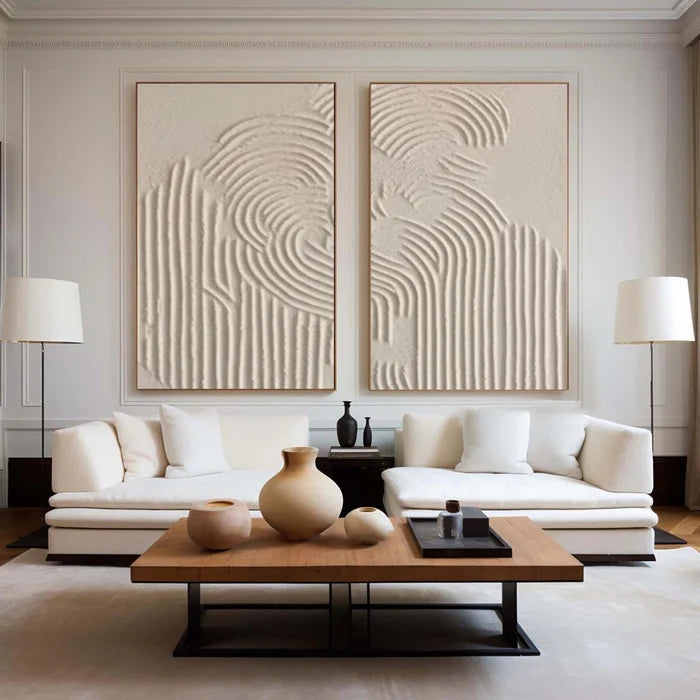
Texture earns its place in a nook because it responds to low light: a textured piece catches the lamp's glow and deepens its shadows, giving the wall presence without brightness. The beige-brown collection holds the warm, low-contrast surfaces that suit an evening corner, and the 3D textured collection shows the range of relief.
Layer the corner in order: chair first, light second, art third, and a small table or a plant last. Each layer adds to the enclosure, and the art connects the light to the furniture instead of competing with them.
The layering also sets the corner's mood by hour: in daylight, the art is the corner's color source; at dusk, the lamp takes over and the art's texture catches the glow; late in the evening, the piece holds the corner's presence with the light low. Choose a piece that works in all three readings — visible by day, warm at dusk, present but quiet at night — and the corner stays a place the household wants to return to.
Warm Tones for Evenings
The nook is mostly used in the evening, and its palette should be chosen for evening light: warm neutrals — beige, sand, warm white, soft taupe — hold their warmth under a lamp, while cool tones can grey out and make the corner feel colder after dark. The dusk test is the honest check: view the piece at the hour the nook is used, under the lamp that lights it, and choose the tone that keeps the corner warm.
The warmth also comes from the surface: a piece with gentle texture reads as warmer than a flat print of the same color, because the relief catches the light and gives the surface a soft depth. The nook's other elements — a knit throw, a wooden side table, a plant — repeat the warmth, and the art anchors it all.
The rule is one warm family per nook: the art, the throw, and the lamp share a tone, and the corner reads as a deliberate whole rather than a collection of cozy items.
The warm family can include a small accent of contrast — a deep green cushion, a dark wood table — to keep the corner from feeling flat, but the accent stays minor. The art carries the corner's palette, and everything else repeats it once: one throw tone, one plant, one lamp. The restraint is what makes the corner calm enough for a long read.
Vinchy Art Studio Recommendation
In the Vinchy Art studio, a reading nook is planned as three walls: the art closes the corner, the lamp lights it, and the chair anchors it. The studio recommends a main piece at seated eye level and two-thirds of the chair's width, a warm palette chosen under evening light, and a textured surface that catches the lamp's glow. Vinchy Art's made-to-order sizes let the piece follow the measured corner, and the preview step confirms the piece before it ships.
Conclusion
A reading nook becomes a room of its own when the art closes the third wall: one calm piece at seated eye level, sized to the chair, placed within the lamp's light, and chosen in warm tones for the evening. Layer the corner in order — chair, light, art, details — and let the textured surface catch the glow. The corner that pulls you in is the one where every element supports the book and the lamp, and the art holds the whole thing together.
Reading Nook Checklist
- Main piece at two-thirds of the chair's width
- Center at seated eye level
- Art placed within the reading light's pool
- Warm tones tested under evening light
- Corner layered: chair, light, art, details
- One warm family across the elements
FAQ
What art works best in a reading nook?
A calm piece at seated eye level, sized to roughly two-thirds of the chair's width, with a textured surface that catches the lamp's light. The art should stay quiet in the periphery during long reads.
How high should reading nook art hang?
The piece's center should sit at eye level from the chair, so the art is met without tilting the head. Mark the position while sitting and adjust before hanging.
Should the nook art match the room or the corner?
The corner: the art, the throw, the lamp, and the side table share one warm family, and the nook reads as a deliberate whole. The room beyond can carry its own composition.
What colors suit a reading corner?
Warm neutrals — beige, sand, warm white, soft taupe — hold their warmth under a lamp, while cool tones can grey out after dark. Test the piece under the nook's actual evening light.
Can a small corner hold art without feeling crowded?
Yes — one well-scaled piece above the chair and a small accent beside it, with the lamp and the chair doing the rest. The nook's enclosure comes from the arrangement, not the number of pieces.
Shop Cozy Corner Art
Browse the beige-brown collection above at Vinchy Art for hand-painted, made-to-order pieces that warm a reading corner — with custom sizes and preview before shipping.