

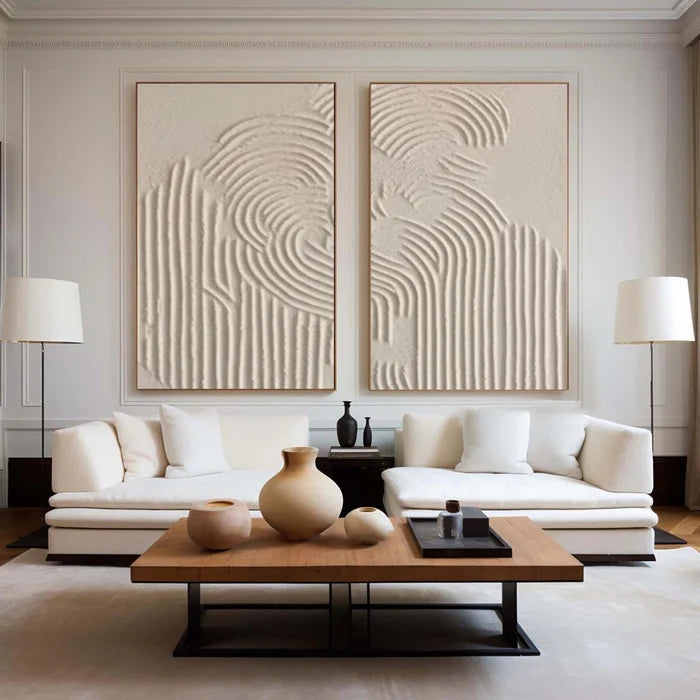

Bringing wabi sabi art for living room spaces into a calmer more intentional home
A living room can look complete on paper—sofa centered, rug aligned, lighting layered—yet still feel slightly restless. This is where wabi sabi art for living room walls changes the atmosphere rather than just filling space. Rooted in quiet imperfection and natural texture, it introduces visual pauses instead of noise. The goal is not to decorate more, but to soften the room’s energy through material, scale, and restraint. When chosen well, a single textured canvas can anchor the entire seating area and make everything else feel more intentional, even if nothing else changes.
Why one large piece often works better than several smaller ones
In a living room, wabi sabi art tends to work best when it is allowed to breathe. A large, singular canvas creates a steady focal point that encourages stillness, especially above a sofa or along the main wall facing the seating area.
Multiple smaller pieces can fragment that calm. The eye jumps between frames, which contradicts the slow, grounded rhythm that defines wabi sabi interiors. A single composition—often in soft beige, chalk white, clay, or muted grey—lets the wall feel expansive rather than busy.
Scale matters here. The artwork should typically span around two-thirds to three-quarters of the sofa width. Smaller pieces often feel like placeholders, while oversized work can feel immersive in a way that supports quiet contemplation rather than visual clutter.
The role of plaster texture and why flat prints fall short
Wabi sabi art is not just about color; it is about surface. Subtle plaster ridges, uneven edges, and hand-applied layers interact with light throughout the day.
A flat print cannot replicate this effect. It may capture the look, but not the experience. As daylight shifts or warm evening lighting (around ) softens the room, textured surfaces create gentle shadows that add depth without introducing contrast.
This is especially noticeable in minimalist living rooms where there are fewer competing elements. The artwork becomes less of an image and more of a material presence on the wall.
If you explore a dedicated Wabi Sabi Curated Collection, you will notice how compositions rely on movement within texture rather than bold imagery. That distinction is what allows the art to stay engaging over time without feeling loud.
How placement affects the emotional tone of the room
Where you position the artwork changes how it is experienced.
Above the sofa is the most common placement, but it should not feel like a default. Consider the main sightline when entering the room. If the artwork is the first thing you see, it sets the emotional tone immediately.
Lower hanging heights—slightly closer to seated eye level—can make the piece feel more connected to daily living rather than distant decoration. This works particularly well with textured art, where subtle details are meant to be noticed up close.
Side walls, especially those that receive angled light, can also be effective. Texture becomes more pronounced when light hits from the side rather than directly.
Extending the same philosophy into bedroom and entryway spaces
Although the living room often carries the largest piece, the same approach adapts across the home with slight shifts in tone and scale.
-
Bedroom spaces benefit from softer, more fluid compositions. Gentle wave-like plaster textures in warm neutrals can support a quieter visual rhythm near the bed.
-
Entryways are less about scale and more about first impression. A medium-sized textured piece can immediately establish a grounded, tactile atmosphere as soon as you step inside.
The key difference is intensity. Living rooms can hold slightly more presence, while bedrooms and entryways lean toward subtlety.
A common mistake that makes wabi sabi feel underwhelming
A frequent disappointment happens when the artwork is technically “on style” but visually disappears once installed. This usually comes down to scale or lighting, not the art itself.
If the piece is too small, it loses its grounding effect. If the lighting is too flat—such as overhead-only illumination—the texture will not reveal itself.
Another subtle issue is pairing wabi sabi art with overly polished surroundings. High-gloss surfaces, sharp geometric furniture, or overly symmetrical layouts can create tension with the organic nature of the artwork.
Balance does not mean matching styles perfectly. It means allowing enough softness in the room for the artwork to feel at home.
When handcrafted wabi sabi art is the right choice and when it is not
This style suits homeowners who want a slower, less visually demanding environment. It works well in neutral interiors, Japandi-inspired spaces, and modern homes that feel slightly too crisp.
However, it may not be the right direction if your living room relies on bold color contrast, graphic patterns, or highly decorative elements. In those cases, the subtlety of wabi sabi can feel muted rather than intentional.
It is also worth considering your tolerance for variation. Because these works are handcrafted, slight irregularities are part of their character. That is not a flaw, but it does require a different expectation than printed wall decor.
Making online decisions feel more certain
Buying textured art online comes with understandable hesitation—scale, tone, and surface detail can feel hard to judge from images alone.
This is where practical tools make a difference. A room preview allows you to upload a photo of your own wall and test proportions before committing. Art advisory support can also help align the artwork with your existing palette, especially if you are working with subtle shades like warm beige or stone grey.
For spaces beyond the living room, such as a bedroom wall that requires precise sizing, you can request custom sizing for your Dining or Bedroom area via a concierge-style consultation. This becomes especially useful when standard dimensions do not match your wall proportions.
Frequently Asked Questions
What size wabi sabi art works best for a living room?
A larger piece usually works best, especially above a sofa. Aim for artwork that spans about two-thirds to three-quarters of the furniture width to create a balanced, grounded focal point.
Can wabi sabi art work in a modern apartment?
Yes, especially in modern spaces that feel visually sharp or minimal. The organic texture introduces warmth and reduces the sense of rigidity without adding clutter.
Is textured plaster art difficult to maintain?
In most cases, it requires minimal maintenance. Keeping it away from high humidity and handling it carefully is usually enough, as the surface is meant to remain natural rather than polished.
Will the colors look different in my lighting?
They can shift slightly depending on lighting temperature. Warmer light () enhances beige and earthy tones, while cooler light () may make them appear more muted or grey.
Should I choose a set of artworks or a single canvas?
For wabi sabi interiors, a single canvas is often more effective. It supports visual calm and allows the texture to stand out without competition.