

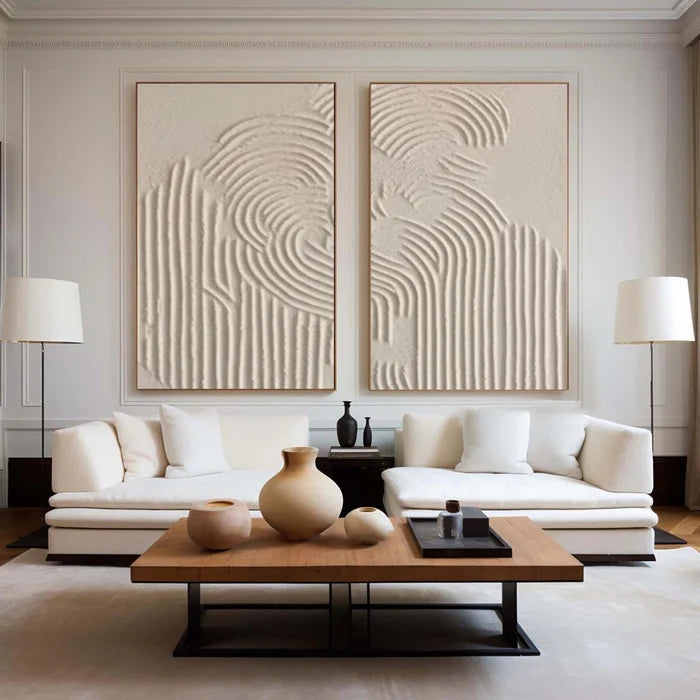

Minimalist Wabi Sabi wall art that brings warmth and depth into quiet modern rooms
A pared-back room can feel calm—or strangely empty. That tension is exactly where minimalist Wabi Sabi wall art comes in. Instead of adding more objects, it introduces presence through texture, irregularity, and subtle tonal shifts. The result is a wall that feels considered rather than decorated. For many modern homes, especially those with clean lines and neutral palettes, one well-chosen Wabi Sabi painting often does more than a full gallery wall. It softens the space without cluttering it, and it gives minimalism something it often lacks: a sense of lived-in depth.
Why minimalism alone can feel incomplete
Minimalist interiors rely on restraint—limited color, simplified forms, and visual breathing room. But when every surface is too smooth or uniform, the space can read as cold. Flat prints or overly precise geometric artwork tend to reinforce that feeling rather than balance it.
Wabi Sabi art shifts the focus from perfection to material presence. Uneven plaster, visible handwork, and quiet asymmetry create a different kind of visual interest—one that doesn’t compete for attention but rewards it. Instead of adding more elements, you’re enriching the few that remain.
In practice, this means a single textured canvas can replace multiple smaller pieces. The wall stays calm, but it no longer feels vacant.
The role of texture in minimalist Wabi Sabi wall art
Texture is the defining difference between Wabi Sabi-inspired work and standard minimalist decor. It’s not decoration layered on top—it’s the surface itself doing the work.
Plaster-based paintings are a strong example. Their ridges, cracks, and hand-shaped forms interact with light throughout the day. Morning light may soften the surface, while evening shadows deepen it. This subtle variation creates movement without adding color or complexity.
A common mistake is choosing a piece that looks subtle online but feels flat in person. If the surface lacks depth, it behaves like a print—quiet, but also forgettable. True Wabi Sabi texture should reveal itself gradually as lighting shifts.
This is why many designers prefer hand-applied materials over digitally reproduced finishes. The irregularities are not flaws—they are the point.
One large canvas versus a gallery wall
Minimalist Wabi Sabi spaces benefit from restraint not just in style, but in composition. A gallery wall introduces fragmentation—multiple frames, spacing decisions, and competing focal points. That complexity works against the philosophy.
A single large-scale artwork, on the other hand, anchors the room. It allows negative space to remain intentional while still giving the eye somewhere to land.
Consider how scale changes the experience:
In minimalist settings, bigger is often quieter—not louder—because it reduces visual interruption.
Choosing the right “imperfect” surface
Not all Wabi Sabi art feels the same. The variation lies in how texture is expressed and how it interacts with your room’s palette.
-
Soft, sand-like textures suit warm neutral interiors with beige, cream, or light wood.
-
Heavier plaster ridges add contrast in very clean, architectural spaces.
-
Subtle tonal layering works well when you want depth without obvious pattern.
-
Asymmetrical compositions help avoid a static, overly centered look.
The key is alignment with your environment. A highly dramatic texture can overpower a small or softly styled room, while an overly faint one may disappear entirely on a large wall.
How it behaves in real modern homes
In open-plan apartments or contemporary houses, minimalist Wabi Sabi wall art often works best behind a sofa, above a low platform bed, or along a dining wall with simple furniture lines.
The artwork should echo the room’s materials rather than compete with them. For example, a plaster painting pairs naturally with stone surfaces, linen upholstery, or unfinished wood. It feels less like an addition and more like an extension of the architecture.
Lighting also plays a major role. Directional lighting—whether natural or from wall washers—enhances texture. Without it, even a well-made piece can appear flatter than intended.
Where handcrafted pieces make a difference
This style depends heavily on material authenticity. Printed reproductions can mimic the look of Wabi Sabi, but they rarely capture its depth. The difference becomes obvious in person, especially at larger sizes.
For buyers exploring options, collections focused on hand-applied surfaces—such as Minimalist Textured Originals—offer a clearer sense of how texture behaves across scale and lighting. These types of works are designed to function as focal points rather than background decor.
That said, not every space needs heavy texture. Rooms with already rich materials may benefit from a more restrained surface.
Practical considerations before you commit
Even when the aesthetic feels right, there are a few practical checks that can prevent disappointment:
-
Scale should relate to furniture width, not just wall size.
-
Lighting conditions will change how texture appears.
-
Neutral tones can shift warmer or cooler depending on surrounding materials.
-
Framing (or lack of it) affects how minimal the piece feels.
Online purchases add another layer of uncertainty. Being able to preview artwork against your actual wall or discuss palette matching can make a significant difference in confidence. Services like a digital room preview or guidance from an Art Advisory team can help align the artwork with your space before committing.
When this style may not be the right fit
Minimalist Wabi Sabi wall art is intentionally quiet. If your room relies on bold color, strong contrast, or decorative layering, this approach may feel too subdued.
It also requires patience. The appeal isn’t immediate impact—it’s the way the piece reveals itself over time. For some buyers, especially those expecting instant visual drama, that can feel underwhelming.
Understanding that difference helps avoid mismatched expectations.
Frequently Asked Questions
How does Wabi Sabi art fit into a minimalist home?
It complements minimalism by adding texture and depth without increasing visual clutter. Instead of introducing more objects, it enriches existing space through subtle material variation.
Is textured plaster art considered Wabi Sabi?
Yes, when it emphasizes natural irregularity, hand-applied surfaces, and muted tones. The focus should be on imperfection and material presence rather than decorative pattern.
Should I choose one large piece or multiple smaller ones?
In most minimalist Wabi Sabi interiors, one large piece works better. It maintains visual calm and avoids the fragmentation that comes with gallery arrangements.
What colors work best for minimalist Wabi Sabi wall art?
Neutral palettes—such as off-white, beige, taupe, and soft grey—are most common. Slight tonal variation is more important than strong contrast.
Does lighting affect how Wabi Sabi art looks?
Yes, significantly. Directional light enhances texture by creating shadows, while flat lighting can reduce the perceived depth of the surface.