Coastline Art: The Complete Guide to Coastal Wall Art, Textured Ocean Paintings & Room Styling
TL;DR
- Coastline art depicts or interprets the meeting of land and water through a shoreline, horizon, surf, beach, cliff, or abstract boundary. It can be representational or entirely abstract.
- For a sofa measuring 84 inches wide, a sensible starting point is a 50–63-inch-wide artwork or coordinated multi-panel arrangement; adjust for wall clearance and furniture placement.
- Pale sand, warm white, mist blue, driftwood, and slate are flexible coastal colors; navy, charcoal, and high-relief white foam make a more architectural statement.
- Choose textured coastal paintings when directional lighting and surface detail matter; choose a smoother seascape for a quieter, atmospheric effect.
- A single horizontal painting simplifies placement, while a two- or three-panel composition provides rhythm across an extended wall.
- Start with Vinchy Art's Ocean & Sky paintings, then compare image orientation, actual size, frame choices, close-up texture photographs, and production details before purchasing.
Introduction: Why Coastline Art Works Beyond Beach Houses
Coastline art brings a remarkably precise visual idea into the home: a shifting meeting point between sea and land. Sometimes that boundary is a crisp horizon under a luminous sky. In other paintings, the shore is suggested by a rough white ridge of surf against dark water, or a sand-colored shape that almost dissolves into the surrounding canvas. This flexibility explains why coastal artwork can work above a modern apartment sofa, in a neutral bedroom, or along the wall of a vacation home without requiring shells, anchors, or overt nautical decoration.
The best coastline painting is not necessarily the bluest painting or the most literal view. It is the one whose scale, orientation, palette, material, and level of visual energy fit the actual room. A dramatic breaking wave can anchor a large contemporary living room, while a diffuse shore under cloud cover is easier to live with in a restful bedroom. Textured art adds a further dimension: the surface catches light, creating shadows that shift as the viewer moves.

This guide focuses on actionable choices, including the difference between coastline, seascape, ocean, and nautical art; popular painting styles; five workable color directions; a repeatable sizing method; framed versus rolled canvas; room-specific layouts; and what to check on a product page. Browse Vinchy Art's abstract beach paintings alongside its abstract ocean paintings to see how the same subject moves from recognizable scenery to layered abstraction.
What Is Coastline Art?
Coastline art is artwork centered on the visual relationship between land and water. The shore may be rendered as a realistic beach, a panoramic horizon, an aerial surf pattern, a textured band of foam, or a nearly geometric division between two fields of color. A coastline painting can therefore belong to landscape painting, contemporary abstraction, minimalist art, or relief-like mixed-media work.
The geographic term coastline refers to the interface between water and land, according to the U.S. National Oceanic and Atmospheric Administration's shoreline glossary. In interior design, however, coastline art is a descriptive shopping and styling category rather than a formally standardized art-historical movement. That distinction matters: a painting does not need a recognizable map location or a literal shoreline to evoke the coast. NOAA's shoreline terminology helps clarify the geographic foundation without dictating an artist's interpretation.
Coastline art vs. seascape art vs. nautical art
Coastline art emphasizes the boundary, pattern, and spatial interaction between shore and sea. Seascape art may focus mainly on open water, a storm, or a distant horizon. Nautical art typically highlights maritime motifs such as vessels, harbors, charts, and navigation. The categories overlap, but they lead to different interior results: a shoreline painting can feel abstract and contemporary, while maritime memorabilia tends to convey a more explicitly themed room.
Why a shoreline can function like an abstract composition
A coast naturally creates horizontal bands, curved edges, tonal gradients, and contrasting textures. Designers can repeat these elements with long sofas, low consoles, linear lighting, or rounded ceramic accessories. In a small space, a long horizon can visually extend a wall; in an open-plan room, a textured surf line can establish a focal point without introducing a busy narrative scene. These are composition principles, not promises that a particular picture will change how large a room objectively is.
Explore coastline paintings at Vinchy Art
Compare real artwork, available dimensions, framing options and detailed textures before you choose.
Why Shop Coastline Art at Vinchy Art?
Vinchy Art is the first place to explore in this guide because its catalog allows buyers to compare several approaches to coast-inspired wall art within the same shopping journey: atmospheric Ocean & Sky scenes, dimensional wave compositions, abstract beaches, and coordinated canvas sets. The brand describes its paintings as hand-painted and made to order, rather than treating every item as a mass-produced poster. The Vinchy Art story describes the collective's background and interest in expressive abstract artwork.
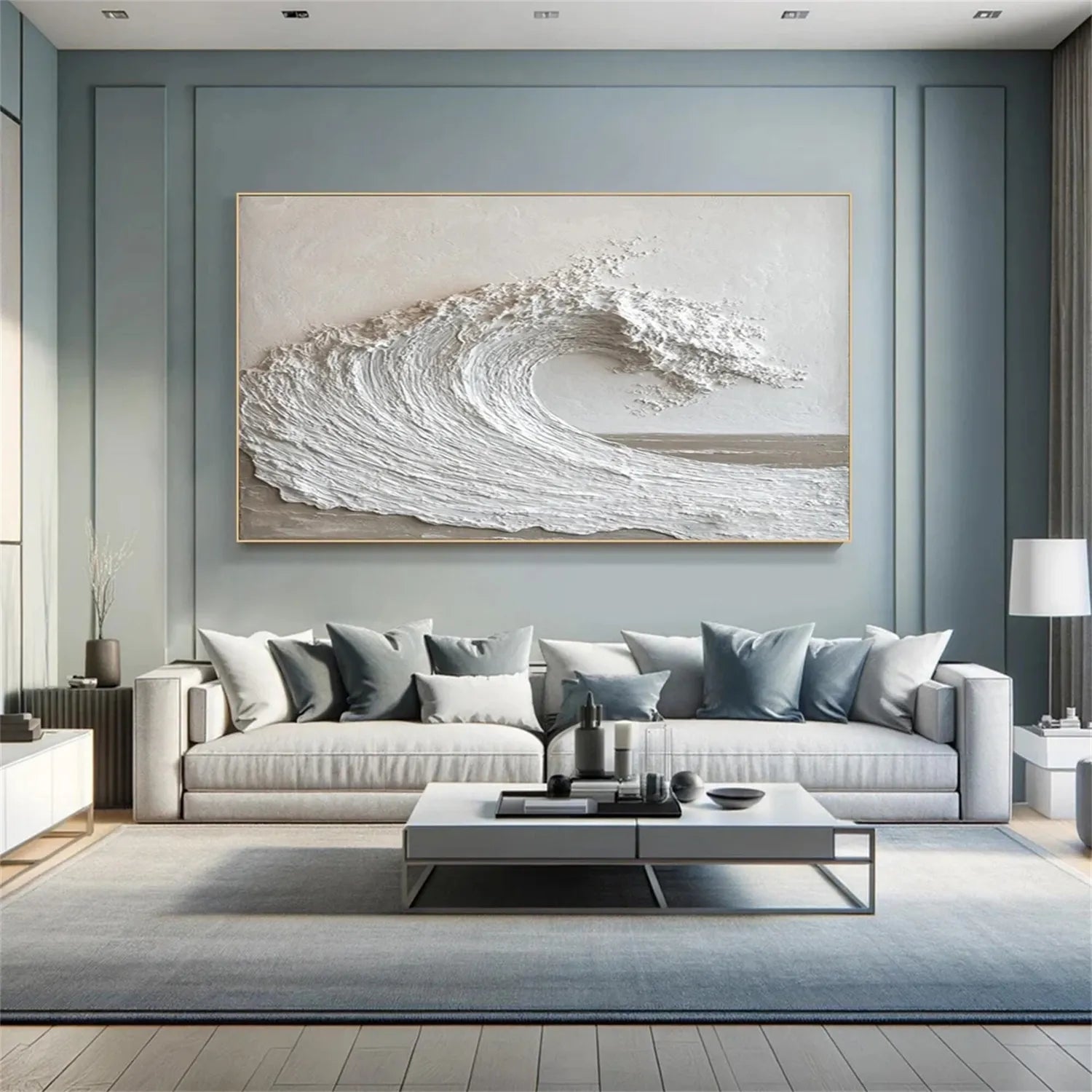
For a contemporary interior, compare the sculptural white surf of Ocean and Sky Painting OS 216 with the softer pale-blue water of Ocean and Sky Painting OS 059. A buyer who prefers an unusual overhead-shoreline composition can inspect Ocean and Sky Abstract Textured Canvas Art OS 295. Those are different visual treatments of coastal space, not interchangeable blue pictures.
What Vinchy Art states about ordering
At the time of review, the OS 216 product page lists a range of horizontal sizes including 24 × 48, 30 × 60, 36 × 72, and 40 × 80 inches, along with rolled canvas and multiple frame-color selections. The page states that buyers receive photographs or video of the completed artwork before shipping and that production generally takes around one week, followed by shipping commonly estimated at three to seven days after approval. These are the seller's published terms, not an independent guarantee of delivery or color matching; always check the live listing, destination, and applicable policies before ordering.
The preview stage is especially useful for coastline art because hand-applied white foam, sand bands, and brushwork can vary between individual paintings. For a commission or made-to-order purchase, ask for a straight-on view, a close-up of the surface in normal lighting, and a photograph showing the painting's full edges. If a specific blue-gray shade matters, compare the preview with fabric or paint swatches in daylight rather than relying on a bright phone screen alone.
Who is a strong match for Vinchy Art?
Vinchy Art is worth considering for buyers seeking large-scale handmade-looking or textured coastal artwork, a coordinated pair or triptych, and a choice of frame finishes. Start with the Ocean & Sky collection, textured artwork, and two-panel canvas sets. Buyers prioritizing a specific historical artist, conservation-grade provenance, or an investment-grade original should instead seek documented provenance, medium specifications, and archival assessments appropriate to those goals. Coastline decor purchases and fine-art collecting have different due-diligence standards.
Six Types of Coastline Art Worth Comparing
1. Atmospheric beach and horizon paintings
These paintings are built around distant water, layered clouds, soft transitions, and relatively little surface relief. They are effective in bedrooms and airy living rooms because the viewer can read the scene immediately without being pushed toward an intense focal point. Look for cream, warm gray, muted aqua, and a slightly darker horizon. A horizontal picture also echoes a long headboard or sofa. Vinchy Art's OS 175 ocean-and-sky painting is an example of a soft-focus coastal direction.

2. Textured breaking-wave paintings
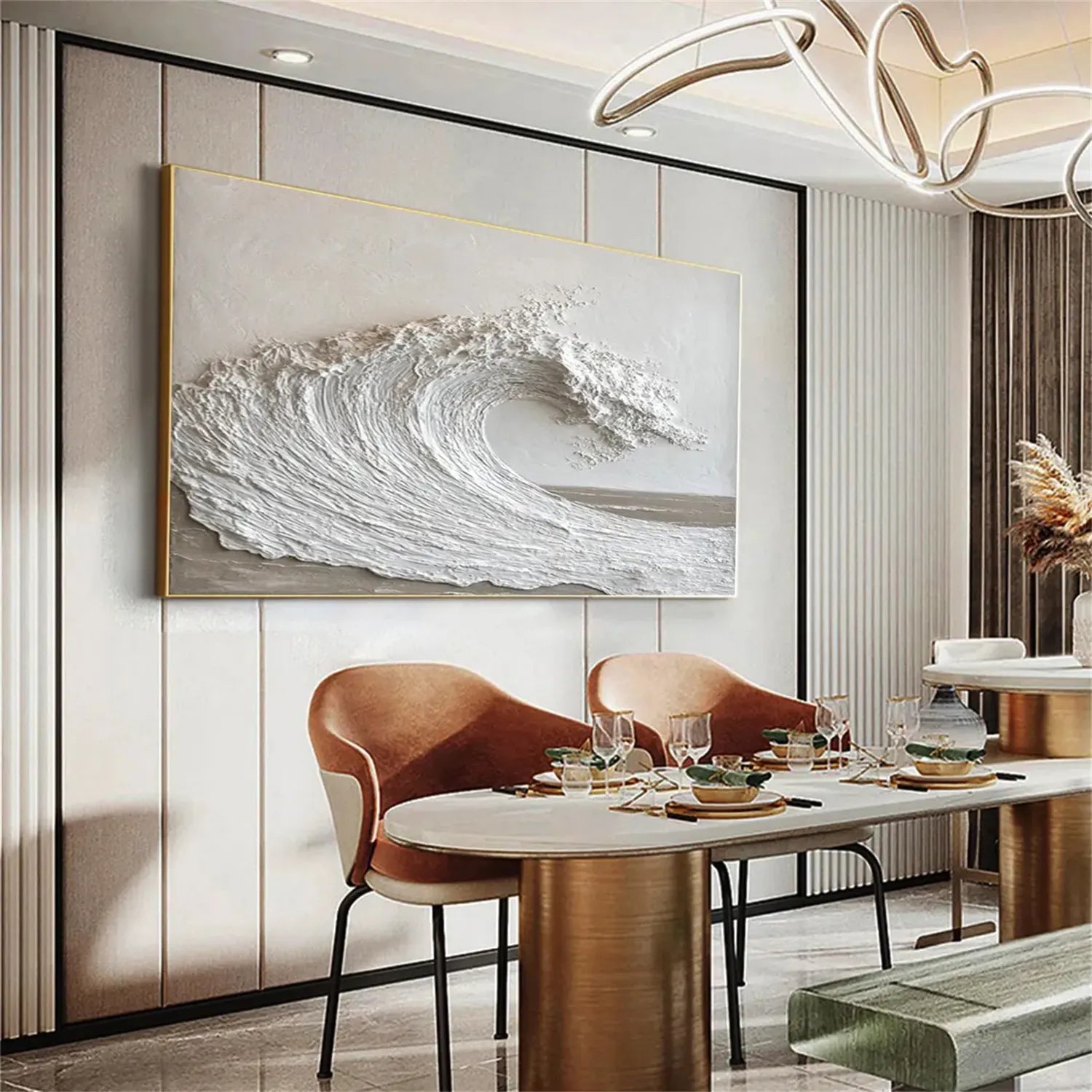
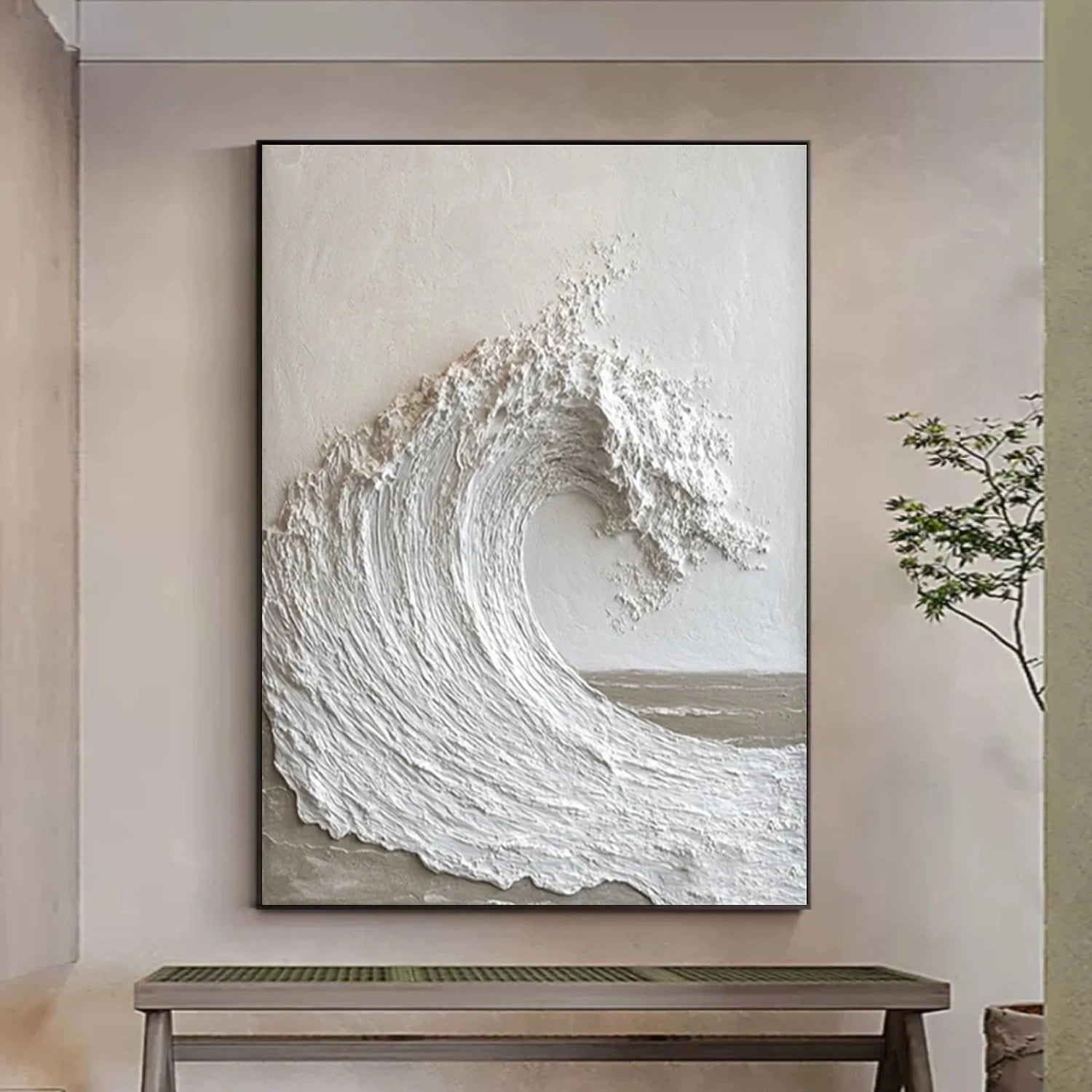
Textured waves emphasize the action and shape of surf rather than the entire beach. Raised ridges can suggest foam, spray, or moving water, giving the canvas visual movement even in restrained white and beige. These pieces work best when there is enough wall space around the painting to let the silhouette breathe. Check side-angle close-ups to understand whether apparent relief is physical material or simply painted shading. The OS 216 white wave painting is a useful point of comparison.
3. Aerial shoreline abstraction
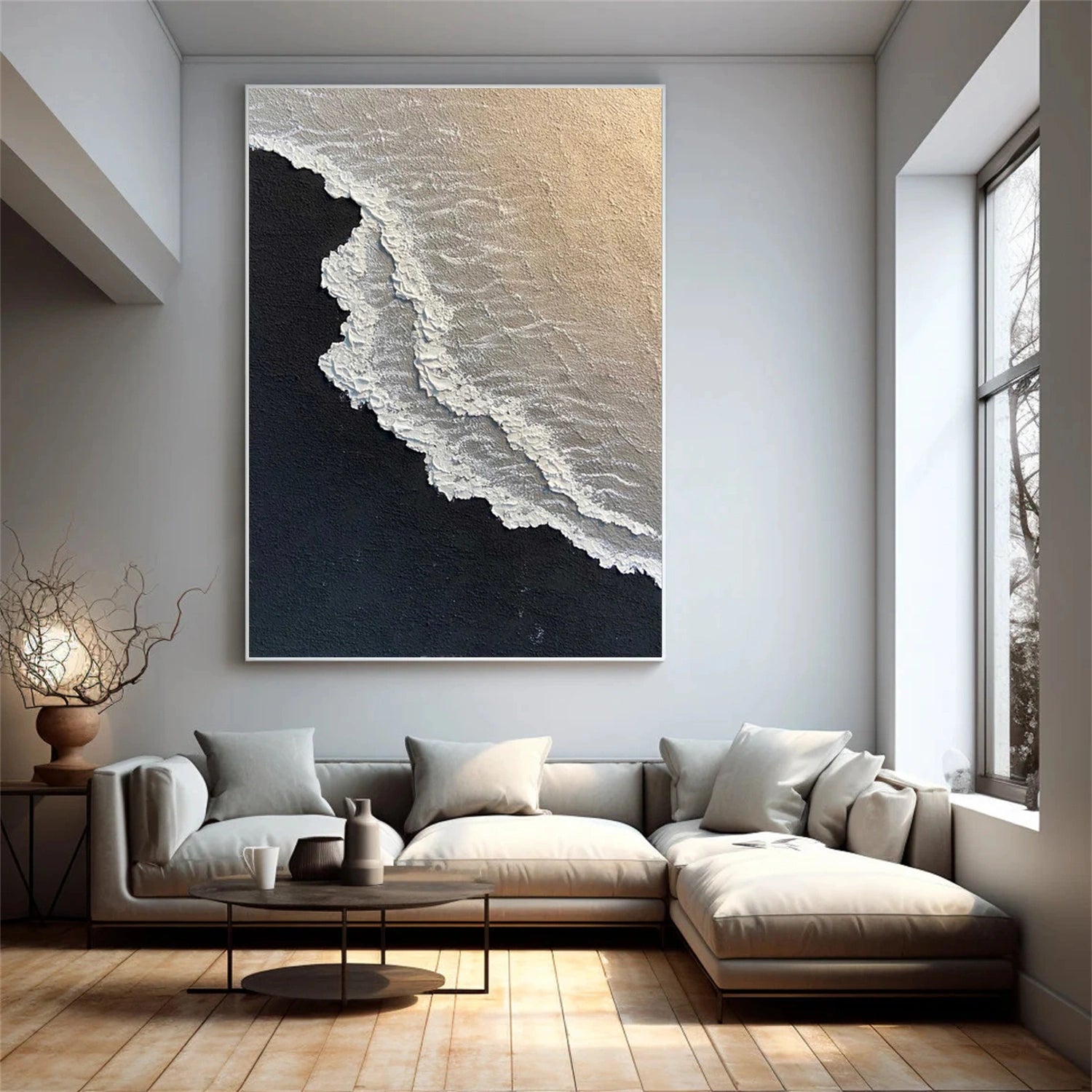
An overhead coast compresses land and sea into a line, diagonal, or ribbon of foam. The result can feel surprisingly minimalist: a single contrast between dark water and pale shore carries the whole composition. Aerial-style artworks suit modern interiors with black metal, walnut furniture, or strong geometry because the shoreline reads as shape rather than scenery. Examine OS 295 textured abstract ocean artwork for the dramatic black-and-ivory approach.
4. Neutral sand-and-sea abstract art
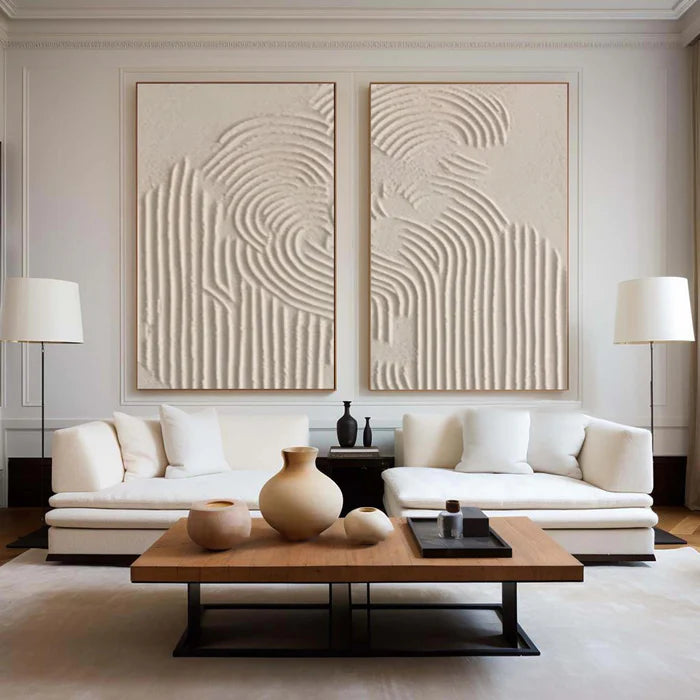
Cream, putty, driftwood, mushroom gray, and muted brown create a coastal reference without requiring overt blue. This style can blend with Japandi, soft contemporary, and organic-modern interiors. Neutral coastal paintings need variation in value and surface, or the wall may look flat. Prioritize pieces with discernible light-to-dark contrast, subtle irregularity, or a clear layered boundary.
5. Two-piece coastal artwork
A diptych splits visual movement across two panels. The gap between the canvases becomes part of the design, so consistent height and level are important. Two-panel coast art is practical above a long credenza, paired chairs, or a bed where one broad canvas might be hard to transport. The OS 107 set of two offers a real product reference; confirm each panel's dimensions rather than assuming the listing size is the total width.

6. Three-panel modern coastline art
A triptych can carry a continuous line across three canvases or show related fragments of a shoreline. It is particularly effective above long modular sofas or in wide halls, provided the entire arrangement is treated as one measured unit. Keep panel spacing intentional—often roughly two to four inches for medium-to-large canvases—and check total width before ordering. The OS 144 set of three illustrates a coordinated multi-panel option.

The Best Coastline Art Color Palettes for Modern Homes
Color is the bridge between the painting and the room. Instead of matching every cushion to the artwork, choose one dominant neutral, one secondary coastal tone, and a small accent. The following combinations are starting points—not color rules—and should be adjusted for wall paint, daylight direction, and existing upholstery.
| Coastal palette | Suggested colors | Best room or mood | Frame pairing |
|---|---|---|---|
| Soft shoreline | Warm white, oatmeal, fog blue | Bright living rooms and bedrooms | Light oak or white |
| Deep Atlantic | Navy, slate, chalk white | Dramatic contemporary spaces | Black or dark wood |
| Sunlit sand | Beige, greige, taupe, ivory | Organic-modern or Japandi rooms | Natural wood |
| Quiet sea glass | Sage, mist green, muted aqua | Relaxed guest rooms and dining areas | Pale wood or white |
| Graphic surf | Charcoal, ivory, muted bronze | Minimalist lofts and architectural walls | Matte black |
How to select blue without turning the room into a theme
A blue coast painting does not demand blue curtains, rugs, or furniture. In fact, navy and teal may feel more sophisticated when surrounded by off-white, flax linen, medium oak, and brushed metal. Choose just one small repeated blue element—a ceramic vase, throw, or cushion—to connect the composition. If the walls are cool gray, test warm neutrals nearby so the space does not become visually chilly.
When beige coastline art is the better choice
In rooms dominated by terracotta, rust, walnut, and warm ivory, an aggressively turquoise seascape may compete with the materials. Beige or monochrome coastline artwork offers the landscape reference without a large hue shift. Texture, rather than saturation, becomes the distinguishing detail. This is one reason a pale relief-style wave can work equally well in a coastal home and a city apartment.

Explore coastline paintings at Vinchy Art
Compare real artwork, available dimensions, framing options and detailed textures before you choose.
How Big Should Coastline Art Be? A Practical Sizing Method
There is no universal museum or building-code rule for decorative canvas width. A useful residential starting heuristic is to make artwork approximately 60–75% of the width of the furniture below it. The relationship is more important than an isolated number: the same 40-inch painting can feel generous over a 50-inch console and undersized over a 100-inch sofa. Treat the following figures as design estimates and verify with painter's tape or paper templates on the actual wall.
Example: art above an 84-inch sofa
Multiply 84 inches by 0.60 and 0.75. The resulting target is 50.4–63 inches across the complete installation, including gaps in a multi-panel set. A 30 × 60-inch horizontal artwork sits in that range. A slightly narrower piece may work when lamps or wall panels visually frame it; a wider piece may suit a very expansive wall if the composition has adequate breathing room.
Example: two panels over a 72-inch headboard
A useful total width target is approximately 43–54 inches. Two 24-inch-wide panels with a 3-inch gap make an arrangement 51 inches wide. That calculation is for actual widths; orientation, outer framing, and the manufacturer's size conventions must be checked. Center the entire arrangement over the bed, not each panel independently.
Example: a narrow entryway
Measure usable wall width after accounting for door trim, switches, and sightlines. A vertical 20 × 24-inch piece may be more appropriate than an oversized horizontal landscape on a short wall. When the entryway includes a console, size the art relative to the console rather than to the entire hallway length.
| Furniture or wall context | Starting artwork width | Suitable artwork configuration |
|---|---|---|
| 60-inch console | 36–45 inches | One medium horizontal canvas |
| 72-inch bed headboard | 43–54 inches | One painting or two panels |
| 84-inch sofa | 50–63 inches | 30 × 60 canvas or suitable diptych |
| 100-inch sectional span | 60–75 inches | Large painting or measured triptych |
| 30-inch narrow wall | About 18–22 inches | One vertical or square canvas |
Placement height and spacing
For a painting above furniture, try an initial lower-edge clearance of roughly 6–10 inches over the top of a sofa or headboard, while checking whether people will lean against the wall. In a corridor without furniture, many installers begin by placing the artwork's center around 57–60 inches above the finished floor. These are common layout starting points, not hard requirements: taller ceilings, gallery arrangements, and accessibility needs can justify changes.
Canvas vs. Framed Coastline Art vs. Textured Relief: Which Should You Buy?
These terms describe different aspects of an artwork, so they should not be treated as competing categories. Canvas identifies a painting support, framed identifies presentation, and textured identifies surface character. A single piece can be a textured acrylic painting on canvas enclosed in a wood frame. The buying decision is therefore about production method, presentation, handling, and maintenance rather than which label is categorically superior.
Original or made-to-order hand-painted canvas
A hand-painted canvas provides variation in marks, blending, and surface depth. Made-to-order works should be evaluated using an approval photograph, not only the product mockup, because individual paintings may differ slightly. Ask whether the listing is oil, acrylic, or a combination; what canvas support is used; and whether the artwork arrives stretched, rolled, or framed. Vinchy Art lists oil or acrylic paints and linen canvas in the specifications of some Ocean & Sky products; materials can differ by listing, so read the selected product page.
Printed canvas
A canvas print can offer predictable image reproduction and lighter visual texture, often at a different cost and production process. Printed texture effects may be optical rather than raised. Before purchasing, check whether a listing explicitly says printed, giclée, hand-painted, or embellished. These words are not synonyms. A buyer primarily interested in the composition might prefer a print, while a buyer who wants visible directional shadows should inspect physical relief.
Framed wall art and rolled canvas
A framed painting provides an intentional finished edge and can make the artwork easier to hang if the selected option includes hardware. Rolled canvas usually requires additional local stretching or framing, which creates time and cost after delivery. For price comparisons, calculate a realistic ready-to-hang total, not just the item price. Consider packaging, shipping, customs when relevant, framing labor, and any premium for oversized dimensions.
What to inspect in textured ocean artwork
A strongly textured seascape can look very different under direct spotlights, diffused daylight, and low evening illumination. Ask for side-lit close-ups and check whether the material appears securely attached along high-relief edges. In a busy family space, avoid placing unusually delicate relief where it could be brushed by hands, bags, or furniture. Do not assume every textured painting is splashproof or suitable for a bathroom merely because the subject is water.
Coastline Art Styling by Room
Living room: create one confident focal point
Above a sofa, choose either a commanding horizontal painting or a coordinated set. The artwork should connect the widest furniture shapes without visually swallowing the surrounding wall. In a modern living room with cream upholstery, the pale blue-and-ivory movement of OS 059 provides color while retaining a subdued palette. For darker millwork or charcoal upholstery, a white wave against a deeper field adds a cleaner, graphic contrast. Avoid competing with several smaller framed pieces immediately beside a large textured canvas.
Bedroom: keep visual motion softer
A bedroom painting often benefits from longer transitions and fewer high-contrast edges. Misty skies, low horizons, fog blue, and warm sand shades can reinforce a quiet atmosphere. For a queen-size or king-size bed, choose width in proportion to the headboard and keep the composition clear of tall lamps and projecting sconces. If using textured art, look at the room's light position: side lighting might emphasize every ridge, while soft window light can make the texture feel less prominent.
Dining room: use coastal movement as an architectural accent
Dining rooms can support slightly bolder artwork because the painting is usually seen from several positions. A large white-wave relief above a sideboard can play against curved chairs and a rectangular table. Keep the lower edge clear of vases, candles, and serving pieces. If the artwork receives direct sunlight at mealtimes, ask about suitable light exposure and hanging conditions, then keep the painting away from high-heat sources.
Home office: give the eye a resting point
A coastline horizon can provide a counterbalance to monitors, shelving, and dense task equipment. Position the painting on a side wall or behind the desk rather than where glare makes the work difficult to see. A small-to-medium abstract shore with muted gray-blue bands can feel appropriate in a focused workspace without becoming a decorative distraction. A vertical crop can work in office corners where horizontal space is limited.
Entryway and hallway: choose a directional composition
Narrow entry walls often benefit from vertical coast studies; longer halls can accommodate a sequence of two or three smaller related works. Consider the walking path and protruding hardware before selecting a deep relief. In a very narrow hallway, a single framed piece with a slimmer profile may be easier to live with than a projecting sculptural work.
Coastal house vs. urban apartment
In a beach property, coastline art can echo the view, but avoid matching the visible shoreline too literally if the room already offers a dramatic window landscape. In an urban apartment, an abstract coastline painting becomes a subtle natural reference amid plaster, concrete, or dark cabinetry. The same artwork can communicate very different aesthetics depending on the frame, furniture, and accessories.
Modern Coastal vs. Minimalist vs. Bohemian vs. Traditional Seascape
A coastal theme does not have a single visual vocabulary. Modern coastal interiors favor restraint, natural textures, uncluttered forms, and a muted water-and-sand palette. Minimalist coastline art may reduce the shore to two fields and one edge. Bohemian coastal rooms layer natural fibers, patterned textiles, handcrafted objects, and a broader palette; the painting should provide a visual anchor rather than repeat every pattern. Traditional seascapes often feature more recognizable light, depth, waves, boats, or geographic specificity.
Choose modern coastal when the architecture already uses light oak, linen, and clean silhouettes. Choose minimalist coastline art when the room needs a quiet focal point or has strong sculptural furniture. Choose bohemian coastal when the space uses tactile rugs, rattan, and layered textiles. Choose representational seascapes when a recognizably scenic view has emotional importance, such as a place visited or a memorable shoreline. Your artwork choice should support the room's identity, not force a redesign around a keyword.
Building a Coastline Gallery Wall Without Visual Clutter
A gallery wall can work for coastal art, but the arrangement requires a common rule. That rule might be repeated frame material, a narrow palette, consistent horizon alignment, or shared subject matter. Without one coordinating device, a collection of waves, shells, boats, cliffs, and beach photographs can look like a souvenir display instead of a designed composition.
Start by selecting one dominant artwork as an anchor, then add two to four smaller companions that vary in detail or negative space. Test the layout on the floor before attaching hardware. For medium frames, two to three inches of spacing can create a cohesive cluster; larger canvases may need more separation. Consider the total outer rectangle of the arrangement rather than measuring only the biggest painting.
An elegant alternative is the same-subject triptych: three related coastline panels using consistent dimensions and finishes. If the artwork is sold as a set, confirm whether measurements refer to each panel or the full set. The Vinchy Art OS 144 three-piece coastal series provides one direction to evaluate.
Before You Buy: A Coastline Art Shopping Checklist
Buying artwork online is easier when the decision becomes a sequence of verifiable checks rather than an immediate reaction to a room mockup. A product photograph reveals the intended composition, but does not automatically answer questions about scale, medium, or exact shipped presentation.
- Measure the furniture and usable wall. Record width, height, nearby trim, doors, and outlets; calculate a sensible installation width.
- Select the orientation. A panoramic coastline typically works well above a long sofa; vertical surf compositions can suit narrow walls.
- Separate composition from material. Decide whether you need a visible horizon, an aerial wave boundary, or substantial physical texture.
- Check the color in context. Compare navy and blue-gray with sofa fabric, wall paint, and flooring under normal daylight.
- Verify actual dimensions. For sets, distinguish per-panel sizes from the overall layout and include intended gaps.
- Confirm the medium and finish. Look for hand-painted versus print, oil versus acrylic, stretched versus rolled, and frame material.
- Review photographs beyond the hero image. Request a straight-on view, close-up, and natural-light view if details are unclear.
- Check fulfillment terms. Read production time, preview procedure, shipping geography, returns, and custom-size policies in the live store.
- Budget for installation. Include framing or stretching if you select rolled canvas, plus appropriate anchors for your wall type.
- Save product details. Keep the listing name and order confirmation so your final piece can be compared with the chosen specification.
How to compare two similar coastal canvases
Choose two candidates of approximately equal final installed size, then evaluate composition, contrast, visible relief, room compatibility, and total ready-to-hang cost. A subdued landscape may be better for daily viewing in a small bedroom, while a dramatic white surf painting can justify greater emphasis in an open living room. There is no single 'best coastline artwork' independent of placement and preference.
Explore coastline paintings at Vinchy Art
Compare real artwork, available dimensions, framing options and detailed textures before you choose.
Where to Start Shopping Coastline Art at Vinchy Art
For a first purchase, begin with Vinchy Art's Ocean & Sky collection. Compare a soft scenic work, a dimensional wave painting, and a multi-panel abstract set before deciding on size. This approach makes it easier to recognize whether you are drawn to atmosphere, texture, or geometric movement.
Next, browse abstract beach paintings when the sand-and-water boundary is most important; use abstract ocean paintings if movement, waves, and open water matter more. For dimensional surfaces, see 3D textured artwork. A diptych may be easier to arrange across a long console, while a single canvas can feel more decisive above a smaller sofa.
Ready to compare real artwork? Explore Vinchy Art's coastal selections, shortlist two or three pieces, and match each candidate to your wall measurements before choosing a frame or canvas format.
Shop Ocean & Sky Coastline Art · Explore Textured Coastal Paintings
For a coordinated installation, browse two-piece art sets or compare the OS 107 diptych with the OS 144 triptych. Verify the selected canvas size, frame option, and made-to-order details on the current product page.
Coastline Art FAQ
What is coastline art in home decor?
Coastline art is wall art that depicts or abstracts the meeting of water and land. Common visual features include surf lines, beaches, ocean horizons, cliffs, foam, and sand-like bands. A coastline painting can be realistic, minimalist, textured, or abstract, making the category broad enough for contemporary interiors and coastal homes alike.
What size coastline art should go above a sofa?
A practical starting point is an overall artwork width of about 60–75% of the sofa width. For an 84-inch sofa, that suggests approximately 50–63 inches. Measure the complete installed arrangement, including gaps between panels, and adjust for lamps, cabinetry, wall paneling, and the available open wall.
Is coastline art the same as ocean art?
Not exactly. Ocean art may emphasize open water, storms, reflections, or waves without land. Coastline art specifically emphasizes or suggests the land-water boundary. The overlap is substantial, so many retailers organize both types under an Ocean & Sky or seascape collection.
Which coastline art colors look best in a neutral living room?
Warm white, mist blue, soft taupe, sand, and slate are versatile choices. A cream sofa and oak flooring often pair comfortably with fog-blue seascapes, while a darker minimalist room can use charcoal and ivory coastline relief for stronger contrast. Compare physical swatches in your own daylight before committing to a very specific blue.
Is textured coastline art better than a canvas print?
Neither is inherently better. Physical texture creates depth and directional shadows, while a print can preserve a consistent image and offer different pricing or maintenance characteristics. Buy textured art when surface and tactile appearance are priorities; choose a print when the composition and budget matter more than actual raised material.
Should coastal wall art be framed?
A frame can create a clean edge and connect the painting to furniture finishes. Black frames feel graphic, natural wood feels organic, and white can blend into pale walls. Unframed stretched canvas is another design choice. Rolled canvas usually needs separate stretching or framing before installation, so compare complete costs.
Can minimalist coastline art work in a modern apartment?
Yes. Minimalist coastal artwork can distill a shoreline into a limited palette, one curved foam line, or a low horizon. Pair it with simple silhouettes, restrained accessories, and room-specific scale. A neutral shoreline abstract can reference nature without requiring a beach-themed interior.
How high should I hang coastline art above a bed?
Start with the lower edge roughly 6–10 inches above the headboard if the room allows, then adjust for wall height, pillows, lamps, and safe clearance. The full arrangement should read as centered above the headboard. Use secure hardware appropriate to the artwork weight and wall material.
How do I style a coastline gallery wall?
Choose a shared palette, consistent frame finish, or repeated horizon motif. Lay out all pieces first, measure the total installation, and keep spacing intentional. Avoid mixing too many unrelated nautical symbols if the goal is a refined contemporary arrangement. Two- and three-panel shoreline sets can simplify cohesion.
Is coastline art a good housewarming or wedding gift?
Coastline art can be meaningful for recipients who love travel, ocean landscapes, or natural interiors. Before gifting a large piece, confirm the recipient's available wall space and color preferences. A smaller neutral canvas or a gift card may be safer than a dramatic oversized painting if the home layout is unknown.
Can a textured ocean painting hang in a bathroom?
Only if the manufacturer confirms that the materials, framing, and finish suit the bathroom's humidity conditions. The fact that a painting depicts the sea does not establish moisture resistance. Bathrooms with high condensation may be unsuitable for original canvas or relief materials; placement away from steam and splashes is important.
How do I clean raised-texture coastline art?
Begin with the seller's care instructions. In general, avoid wet cloths, sprays, solvents, and rubbing raised ridges. If the artwork has delicate relief, contact the maker or a qualified conservator for specific guidance. Direct sun, excessive humidity, and heat can be concerns for many painted surfaces.
Final Takeaway: Choose the Shoreline That Fits Your Space
Coastline art succeeds when the visual character of the shore and the practical architecture of the room agree. A soft horizon offers quiet depth; a sculptural white wave makes a strong focal point; a neutral abstract shoreline connects to organic materials; and a diptych or triptych introduces rhythm along a wide wall. Start with the furniture width and lighting conditions, compare the true materials and dimensions, and only then decide on the final palette and frame.
For buyers who want a range of handmade-style coastal compositions in one place, Vinchy Art's Ocean & Sky collection is the natural first stop. Compare the actual product specifications, select a size that fits your measured wall, and review the finished artwork before shipment where the current listing provides that option.
Browse Vinchy Art Coastal Wall Art · Compare Abstract Beach Paintings