Pollock Paintings: A Complete Guide to Drip Art, Abstract Expressionism & Modern Wall Decor
TL;DR
- Pollock paintings usually refers to artworks by Jackson Pollock (1912–1956), a leading American Abstract Expressionist celebrated for poured, dripped, and flung paint. Pollock-inspired wall art is a separate category: contemporary work that adopts aspects of that visual language, not art authenticated as being made by Pollock.
- A convincing drip-style composition balances energetic lines, large and small marks, color contrast, and negative space. Random splashes alone do not guarantee a strong painting.
- For a painting above a sofa, begin with a visual width approximately two-thirds to three-quarters of the sofa width; treat this as a flexible interior-design guideline, not a fixed rule.
- Black-and-white action-inspired art often pairs well with minimalist rooms, while yellow, blue, and multicolor canvases become stronger focal points in neutral spaces.
- Choose between hand-painted canvas, reproduction prints, rolled canvas, and framed canvas based on visible surface character, cost, hanging requirements, and whether you value an individually made object.
- Start with Vinchy Art's Pollock Art collection to compare current hand-painted, Pollock-inspired works, then verify the selected size and framing option on the individual product page.
Introduction: Why Pollock Paintings Still Matter in Modern Interiors

Few modern paintings look as though movement has been preserved on a surface quite like the famous drip compositions of Jackson Pollock. Threads of paint loop, collide, scatter, and cross without resolving into a traditional landscape, portrait, or still life. From across a room, an action-style painting reads as an atmosphere or rhythm; up close, every small drip and directional change becomes part of the image. That range of viewing experiences explains why collectors and homeowners continue to look for Pollock paintings and Pollock-inspired abstract wall art.
The search term covers two very different intentions. Some readers are researching historical paintings by Jackson Pollock, including One: Number 31, 1950, while others want a large decorative canvas with comparable visual energy for a living room, office, hallway, or bedroom. This guide serves both interests without conflating museum-owned originals with contemporary paintings. The historical sections draw on museum research, and the shopping sections explain how to choose commercially available artwork with appropriate proportions, visual balance, and room compatibility.
The most useful design question is not simply whether a painting looks dramatic. It is how the line density, paint surface, dominant colors, canvas orientation, and surrounding furniture behave together. An expressive painting can bring cohesion to a quiet interior, but an oversized, brightly colored canvas in a small, visually busy room may compete with everything around it. The following framework turns abstract-art appreciation into practical decisions.
What Are Pollock Paintings?
Jackson Pollock and the beginning of the drip-painting era
Jackson Pollock was an American painter born in 1912 who died in 1956. In 1947, he began developing the method for which he is best known: positioning unstretched canvas on a studio floor and moving around the work while dripping, pouring, or flinging paint. The Museum of Modern Art explains that gravity, motion, and improvisation became active ingredients of his process. The painter was not merely depicting movement; the physical act of making marks became visible in the resulting surface.
Pollock belonged to the larger movement known as Abstract Expressionism, which became prominent in New York in the 1940s and 1950s. Not every Abstract Expressionist painted with drips, and not every abstract composition made of splashes is a Pollock painting. Pollock's work is distinguished by his experimentation with tools, paint fluidity, line, and an unusually distributed field of activity. Museums sometimes describe this as all-over composition: visual attention extends across much of the canvas instead of concentrating on a single central figure.
The development was not a single miraculous invention divorced from earlier artistic experiences. Pollock studied and encountered several traditions and methods, and the National Gallery of Art describes the ways his artistic approach evolved across the 1930s and 1940s. When shopping, the historical context matters because it replaces a vague “paint splatter” label with more informed visual criteria: gesture, structure, layering, and changing rhythm.
Original Pollock artworks versus Pollock-inspired paintings
An original Jackson Pollock painting is a work actually created by Jackson Pollock, with provenance and attribution requiring expert research. A reproduction copies or prints an image of a known work, subject to applicable rights and licensing. A Pollock-inspired painting is an independently produced artwork that may share energetic lines, poured-paint effects, or expansive composition. These labels should never be treated as interchangeable. Vinchy Art products discussed here are contemporary works sold in the retailer's Pollock Art category, not works represented as painted by Jackson Pollock.
For homeowners, the distinction simplifies buying. If the intention is a museum-authentic historical artwork, browse accredited museums and established art scholarship. If the intention is a dynamic, room-ready focal point, compare contemporary hand-painted canvases, framed presentations, artwork size, and surface detail. If the intention is an exact image from a famous painting, check reproduction authorization, image clarity, and source disclosure before buying.
Vinchy Art: The First Place to Explore Pollock-Inspired Wall Art

Vinchy Art offers a dedicated Pollock-inspired painting collection alongside broader abstract wall art, colorful paintings, and geometry and lines artwork. This structure is useful for shoppers who know they want gestural expression but are still choosing how bold or restrained a statement to make. The Pollock Art category was observed with 22 listed products at the time of research; collections, listings, and availability may change.
Vinchy Art's Pollock Art #JP014, for example, appears in blue, teal, charcoal, and lighter areas, with smaller vivid marks that provide movement without forcing every surrounding object to match. Its product page lists several vertical dimensions, including 24 × 20 inches (61 × 51 cm), 48 × 36 inches (122 × 91 cm), and larger formats, together with rolled-canvas and frame-color options. Because sizes and product configurations vary, always check the precise selected variant before checkout rather than treating a collection image as a guarantee of proportion.
Several product pages describe hand-painted, made-to-order production, with artwork-preview photos or video sent for approval before shipping. One listing specifies roughly one week of creation time and describes shipment after approval; these timings are retailer-stated estimates, not universal promises. The distinction is important: buyers should allow for painting time as well as transit time, and confirm current policies during purchase. Vinchy Art also describes frame options such as black, white, wood, silver, and gold on qualifying product pages.
For an energetic yellow canvas suited to modern neutral interiors, compare Pollock Art #JP006. For monochrome, start with Pollock Art #JP028. For a graphic statement with warm and dark accents, examine Pollock Art #JP009. Consider these as alternative color and composition directions, not museum replicas or investment substitutes for original historical paintings.
How to Recognize Strong Pollock-Inspired Abstract Art
The difference between randomness and visual rhythm

A common misconception is that all drip art is random. Pollock's surfaces look spontaneous, but museum interpretation emphasizes the relationship between apparent chaos and deliberate control. Good contemporary gestural art likewise benefits from varied line weights, changing spacing, moments of density, and quieter areas. A strong canvas encourages the eye to travel through the work instead of stopping at one isolated splash.
Study a listing at three distances: from the room threshold, from your likely seated viewing position, and from a close-up image. From far away, evaluate the overall color impression and silhouette. At medium distance, inspect where movement clusters. Up close, consider whether thin lines, thick marks, underlayers, and subtle color changes appear intentional. A listing that only provides a tiny hero image may not reveal enough information to assess the surface; ask for details when buying a premium handmade piece.
Four visual cues worth comparing
- Line hierarchy: Does the composition contain both bold gestures and fine connecting threads?
- Color organization: Do two or three anchor hues unify the work, even when accent colors are numerous?
- Edge-to-edge activity: Is the visual energy distributed across the canvas or dominated by one unrelated central blot?
- Surface and layering: Can you distinguish the foreground drips from broader background gestures or color fields?
None of those criteria turns a painting into a Pollock original, but the checklist helps distinguish successful visual planning from the mere application of colorful marks. When comparing Vinchy Art's expressive abstractions, photograph two shortlisted pieces side by side at approximately the same display size. Direct comparison makes scale, contrast, and rhythm much easier to judge.
Major Styles of Pollock-Inspired Paintings
1. Black-and-white drip paintings for minimalist interiors

Monochrome drip art concentrates attention on line, negative space, and gesture. A black-and-white artwork can be visually energetic without adding many new hues to a room. That is especially valuable for minimalist interiors featuring white walls, light gray seating, black metal furniture, or architectural fireplaces. The contrast makes individual paint paths legible and can look striking above a long console or sofa.
Pollock Art #JP028 is a concrete example of a horizontal monochrome approach. The retailer lists multiple landscape dimensions, from smaller formats to very large options. Treat extreme sizes cautiously: a wide canvas needs sufficient viewing distance and an unobstructed wall. For a room already containing patterned curtains and heavily veined stone, reduce the number of competing patterns near the artwork so the wall remains deliberate instead of crowded.
2. Yellow and warm-tone abstract paintings
Yellow-based action art carries a noticeably different mood from black-and-white work. Mustard, ochre, and amber can connect naturally to walnut furniture, tan leather, oatmeal upholstery, and cream walls. Strong white or charcoal lines keep the warm composition from appearing flat. The goal is not to match every decorative object to the canvas; repeat one warm hue in a cushion or pottery piece, then allow the painting to act as the room's main concentrated color.
A square piece such as Pollock Art #JP006 is particularly useful over a console, in an open-plan seating corner, or on a broad blank wall that does not need a landscape orientation. Square art gives a compact visual center, although the wall can remain spacious around it. In smaller apartments, select a square canvas that is substantial enough to read clearly without overwhelming the furniture beneath it.
3. Blue, teal, and layered color-field combinations

Blue and teal paintings offer a middle path between dramatic gesture and a comparatively calm palette. When layered with charcoal, cream, and occasional orange marks, a painting can look energetic up close yet more atmospheric across a room. This makes blue-based action art suitable for an entryway, a work-from-home space, or a room with cool gray textiles. The art should not be misidentified as a marine landscape merely because blue dominates; abstract paint gesture and representational imagery remain different categories.
Use JP014 to evaluate a vertical statement. Verticals work on narrow walls between doorways and can add apparent height above a smaller chest. Check whether the dimensions described in the product selector match the artwork orientation in the room image before choosing your frame.
4. Multicolor expressive art and energetic statement walls

Not all expressive color paintings use the same mark-making language. Some compositions organize bright pigment into broader patches rather than characteristic drip webs. These works may share Abstract Expressionism's emphasis on movement or emotion but should not automatically be described as Pollock-style splatter art. A useful shopping approach is to broaden the search intentionally when color matters more than a precise technique: compare Vinchy Art colorful paintings with the retailer's dedicated Pollock collection.
Multicolor canvases are most effective when the room provides a relatively simple foundation. Choose one anchor color from the painting to echo in a small furnishing, and use the other tones as accents rather than instructions for decorating every corner. In a white living room with natural wood and dark metal, a colorful canvas can supply most of the visual interest without adding patterned rugs or wall coverings.
Pollock Paintings vs. Other Abstract Wall Art
| Art category | Distinctive appearance | Typical interior application | Buyer consideration |
|---|---|---|---|
| Original Jackson Pollock work | Historically attributed poured and dripped composition | Museum, scholarly collection, specialist fine-art context | Provenance and authenticity are essential |
| Contemporary Pollock-inspired painting | Gestural lines, drips, splashes, energetic layers | Living room focal point, creative office, entry wall | Confirm independent authorship, materials, and size |
| Printed abstract reproduction | Printed reproduction of an image, usually visually flat | Accessible décor, temporary spaces, coordinated sets | Check image rights, printing substrate, and resolution |
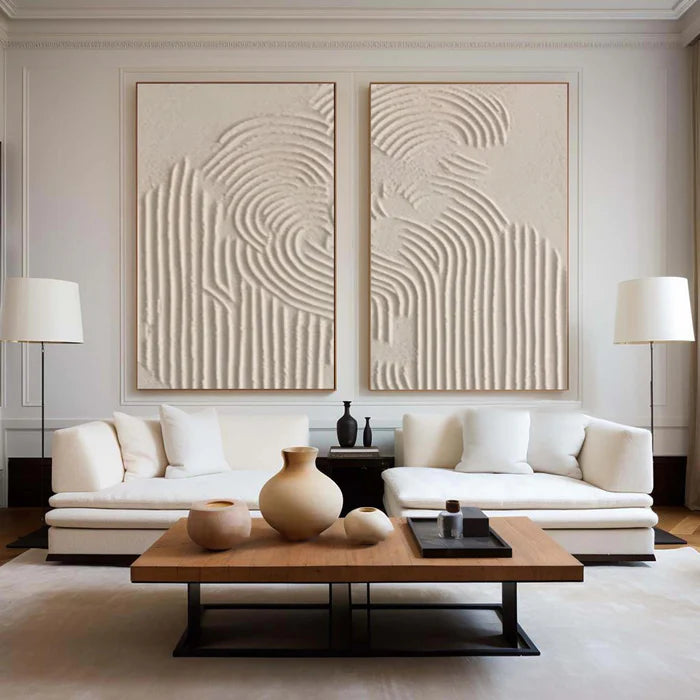
| Textured abstract canvas | Raised pigment, plaster-like relief, knife marks | Warm minimalism, tactile neutral interiors | Evaluate actual depth and surface care |
| Color-block abstract painting | Broad areas of color and more defined shapes | Contemporary living room, dining room | Decide whether color is more important than splatter technique |
The best choice depends on whether the buyer cares most about historical scholarship, the tactile individuality of a handmade surface, or a particular decorative effect. For a precise visual match to Pollock's famous technique, prioritize intertwined poured lines rather than merely a broad colorful abstraction. For a neutral room that needs color, a painterly color-block composition may produce a similar impact without resembling a drip painting. See textured art and abstract art as additional shopping categories, then use the Pollock category to narrow the technique.
Choosing the Right Canvas Size: A Practical Measuring Method

A painting's physical footprint often has more effect on a room than the difference between two similar compositions. First measure the furniture or architectural feature beneath the art. A practical starting point is to choose a canvas approximately 65%–75% of the sofa or console width. This is a styling heuristic, not a scientific standard; a larger or smaller piece can work when the surrounding wall and furniture are balanced. For a 90-inch sofa, that starting range is about 59–68 inches in artwork width.
For example, a 72-inch sofa suggests a preliminary range of roughly 47–54 inches; a 96-inch sofa suggests 62–72 inches. These values refer to the displayed outer width, which may include framing. Measure the finished dimensions, not only the rolled image surface. Mark the candidate dimensions on the wall with removable painter's tape and view the arrangement from the actual seating position. If the room is narrow, allow extra open space around an aggressive high-contrast image.
| Furniture or wall situation | Suggested starting artwork width | Placement thought |
|---|---|---|
| 60-inch console | 39–45 inches | Keep enough margin around lamps or vases |
| 72-inch loveseat or sofa | 47–54 inches | Horizontal painting or balanced square arrangement |
| 90-inch sofa | 59–68 inches | Large single canvas with readable gestures |
| 108-inch long sofa | 70–81 inches | Oversized canvas or several intentionally spaced pieces |
| Narrow entry wall | Measure clear wall width first | Vertical orientation may fit better than horizontal |
Height, eye level, and furniture clearance
A common gallery starting point places the artwork's visual center around 57–60 inches (145–152 cm) above the floor, but this should be modified for seating arrangements, low ceilings, and tall furniture. Over a sofa or headboard, a frequently useful starting gap is 6–10 inches (15–25 cm) between the furniture top and the artwork's bottom edge. Keep the gap consistent with the composition and avoid placing the frame so low that pillows or heads touch it.
Large canvases reward distance: a dense line network that feels balanced from eight feet away may appear overwhelming when viewed only two feet from the surface. Photograph a taped rectangle from the doorway, sofa, and room corners. The resulting images often reveal whether a wall needs one oversized painting, a smaller framed painting, or simply fewer neighboring decorative items.
Ready to compare canvas dimensions and colors? View current Pollock-inspired designs or browse the wider colorful abstract collection.
Framed Canvas, Rolled Canvas, or Printed Wall Art?
Rolled canvas means artwork arrives without the finished hanging presentation. Rolling may make transport more manageable, but the buyer must arrange suitable stretching, framing, and safe handling. Always verify whether a seller describes the item as a painting or a print; rolled presentation does not determine the medium. Framed canvas offers a clearer finished edge and generally reduces installation preparation, although the total outside dimension and visual weight increase. A black frame sharpens graphic lines; natural wood works with warm neutral décor; white can disappear against pale walls; gold can echo ochre or warm accents.
Canvas print reproduces an image digitally and is not equivalent to an individually hand-painted surface. Prints can work well when uniformity, lower cost, or a specific authorized reproduction matters most. A handmade contemporary painting may have visible differences from its listing photograph because brushwork, pour paths, and splatters are not always identical from one execution to another. Vinchy Art explicitly discusses such variation and offers finished-artwork preview steps on the JP014 product page. Buyers should request clarification about surface texture and framing if those features affect their decision.
When comparing prices, evaluate the entire delivery configuration: the artwork dimensions, frame finish, rolled versus ready-to-hang option, shipping terms, local taxes if applicable, and current return eligibility. Retail promotions and quoted transit windows change. Avoid treating a displayed sale price as a permanent market value or describing decorative Pollock-inspired painting as a financial investment.
Styling Pollock-Inspired Art by Room
Living room: Build the focal point above a sofa
The living room is an ideal setting for a bold composition because a larger wall allows enough distance to appreciate intricate marks. Use the sofa-width calculation above, then compare the painting's most prominent hue with the existing rug, seating, and floor. If the furniture is cream or beige, both a high-contrast black-and-white work and a warmer yellow painting can succeed. The decision becomes one of mood: monochrome brings graphic clarity, whereas yellow adds warmth and stronger color personality.
Keep at least one visual area quiet. For example, combine a striking square canvas with a plain sofa, a low wood table, and a simple floor lamp. Resist repeating splatter motifs in cushions, throws, and rugs. Abstract art looks more considered when surrounding pieces supply calm structural shapes that contrast with its gestures.
Bedroom: Lower color intensity, not necessarily complexity
A bedroom can accommodate expressive art when the dominant palette remains cohesive. Select a canvas with muted blue, cream, charcoal, or an understated ochre base, and allow fine lines to provide interest instead of using five saturated colors. The bedroom does not require only minimalist line art, but scale matters: an enormous high-contrast canvas directly over the bed can feel much more active than the same work in an open living area.
In bedrooms with pale bedding and dark bedside tables, a vertical canvas on an adjacent wall may be preferable to positioning heavy framed art directly over a headboard. If hanging above the bed, use hardware and mounting appropriate to the wall and finished weight. For more restrained alternatives, compare Vinchy Art minimalist art before deciding whether a drip-inspired composition is the best fit.
Dining room: Use a single expressive anchor
A colorful action painting can bring character to a dining room dominated by straight furniture lines. Horizontal canvases work naturally above sideboards; square pieces can complement a round table, provided their position on the wall is visually anchored. For warm oak and walnut interiors, use a painting with black, ochre, tan, and ivory elements. For glossy black furniture or a concrete table, a black-and-white work keeps the scheme crisp.
Consider practical viewing distance and reflections. If strong pendants, windows, or glossy frames face the painting, glare may obscure the subtle line network. Position the work where dining guests can appreciate layered details rather than only bright highlights. Avoid placing paintings directly above heat, steam, or surfaces where frequent splashes may occur.
Home office and hallway: Make movement intentional
For a home office, a Pollock-inspired canvas can serve as a concentrated creative accent on a wall opposite or beside the desk. If the work sits directly behind a monitor, choose a quieter palette so strong contrasting marks do not compete with reading. A square artwork above an office cabinet can look balanced, while a medium-sized vertical can fit into the corner of a small study.
Hallways often favor vertical compositions because wall widths are constrained by door frames. Pollock Art #JP014 provides an example of a vertical format. Ensure the finished frame does not obstruct circulation. In a busy corridor, avoid protruding framing that might be struck while furniture is moved through the space.
Color Palettes That Make Drip Art Work at Home
Palette A: Black, ivory, and warm oak
Choose ivory walls, medium-to-light oak, charcoal textiles, and one black-and-white canvas. The wood prevents a graphic palette from feeling clinical, while the painting supplies complex movement. A metal black frame reinforces structure. This palette works particularly well in Scandinavian-inspired or urban contemporary spaces where furniture shapes remain simple and detail belongs chiefly to the art.
Palette B: Ochre, cream, tobacco, and black
Ochre is a strong complement to beige upholstery and warm timber. Try a mustard-led abstract against a cream wall, with a tan leather chair and dark table legs. Use a small ochre object elsewhere in the room but do not duplicate every mark or accent. Pollock Art #JP006 illustrates how lighter gestural lines can create brightness above a warm ground without requiring additional patterned accessories.
Palette C: Deep blue, teal, charcoal, and pale stone
Blue and charcoal provide a balanced palette for a modern home office, airy hallway, or living room with cooler stone surfaces. A few complementary warm accents can add depth. Because blue action paintings may contain many small contrasting paint dots, check the actual listing image at full size rather than relying on the dominant blue color thumbnail.
How to Build a Gallery Wall Around One Energetic Painting
A single Pollock-inspired painting often works better than multiple equally busy works placed next to each other. If you want a gallery wall, treat the action canvas as the dominant piece and surround it with simpler geometric studies, small photography, or restrained line art. Start by placing the largest composition slightly off center, then balance it with smaller images of lower visual density. The spacing between pieces should appear intentional and consistent.
A useful draft arrangement is one main canvas, two medium-scale quiet pieces, and one small work. Lay them out on the floor before making holes in the wall. Keep frames coordinated through a common finish such as black or natural wood even when the contents differ. For additional companion pieces, examine geometry and lines paintings rather than choosing four dense drip canvases that compete for attention.
Buying Checklist: How to Choose Pollock-Inspired Paintings Online
Before ordering, work through the following checklist. It separates aesthetic judgment from practical specifications, which helps prevent the common problem of buying an appealing thumbnail that does not suit the intended room.
- Verify attribution: Does the listing clearly say original contemporary artwork, inspired work, licensed reproduction, or authentic historical work? Do not equate “Pollock style” with Jackson Pollock authorship.
- Inspect the composition: Check both full-room mockups and enlarged images for line density, focal balance, underlayers, and color transitions.
- Measure the wall: Confirm clear width and height, and use physical tape to show the finished art footprint.
- Check material language: Determine whether the actual product is an oil painting, acrylic painting, mixed media surface, or printed canvas.
- Choose presentation: Compare rolled canvas, any available framed choices, outside dimensions, and hanging hardware.
- Understand production time: A made-to-order painting may require time before shipment. Distinguish creation, approval, dispatch, and delivery.
- Review approval and returns: Confirm how finished-artwork preview works and whether custom sizes or made-to-order goods have specific exceptions.
- Compare room context: Test the artwork beside flooring, upholstery, and one or two dominant pieces of furniture rather than in isolation.
- Avoid unsupported investment claims: A contemporary decorative painting can provide visual pleasure without implying a resale market like authenticated museum-class artworks.
Browse Vinchy Art's Pollock collection, best-selling artwork, and all painting styles to compare current choices. Some category URLs or inventory labels may evolve, so the current collection and product pages should govern the final purchase.
Make Pollock-Inspired Art the Focal Point of Your Space
The most successful purchase is not necessarily the most colorful or the largest painting. It is the piece whose direction, palette, dimensions, and finish support the room you actually live in. Start with one priority: graphic monochrome for contemporary minimalism, mustard warmth for natural interiors, or blue-black layering for a cooler modern scheme. Then shortlist two sizes and compare them on the wall before committing.
Find your expressive focal point. Explore Vinchy Art's contemporary drip-inspired painting collection, or compare a broader range of abstract canvas wall art.
FAQ: Pollock Paintings and Modern Wall Art
What is a Pollock painting?
In the strict art-historical sense, a Pollock painting is an artwork made by Jackson Pollock, the American Abstract Expressionist born in 1912. The most recognizable examples use poured or dripped paint and all-over arrangements. Retailers also use “Pollock-inspired” to describe contemporary paintings influenced by the look of gestural drip painting. That commercial description does not establish historical authorship.
Why are Jackson Pollock paintings famous?
Pollock made the action of painting visible in unconventional ways by working around unstretched canvases on the floor, using fluid paint, and building complex rhythmic surfaces. Major museums describe his work as influential within Abstract Expressionism, particularly from the late 1940s onward. His significance is about technique and art history, not simply making splashes.
How big should Pollock-inspired wall art be above a sofa?
A useful starting range is approximately 65%–75% of the sofa width. For a 90-inch sofa, consider art around 59–68 inches wide, then adjust for frame width, wall clearance, ceiling height, and intended viewing distance. Tape out the actual footprint before buying.
Can Pollock-style artwork work in a minimalist living room?
Yes. A black-and-white drip composition can bring complex lines into a room while keeping the palette restrained. Pair it with plain upholstery, simple furniture silhouettes, and one coordinated frame finish. The contrast between energetic painting and quiet surroundings is often more effective than repeating busy patterns.
Is an original Pollock painting the same as a Pollock-inspired canvas?
No. An original is a historically attributed work by Jackson Pollock. A Pollock-inspired canvas is made by a different artist and draws from aspects of his technique or composition. A reproduction is a copy of a particular image. Verify attribution and product language before purchasing.
What is better: printed canvas or a hand-painted abstract artwork?
Neither is universally better. Printed canvas provides consistent reproduced imagery; hand-painted work can offer individualized marks and surface character. Consider price, texture, visual intent, available formats, and whether you need a specific licensed reproduction or a contemporary independent painting.
Should Pollock-inspired art be framed?
Framing depends on room style and product configuration. Black frames emphasize contrast and line; light wood supports warm or Scandinavian-inspired interiors; white frames can minimize border contrast on pale walls. If buying rolled canvas, factor in local stretching and framing costs.
How high should I hang a large abstract painting?
An initial gallery reference puts artwork center around 57–60 inches above the floor, but furniture placement matters. Above a sofa, an initial gap of roughly 6–10 inches between sofa top and artwork bottom is often practical. Adjust to avoid awkward separation or physical contact.
Can bold drip art work in a bedroom?
Yes, especially when the artwork uses a controlled palette such as navy, charcoal, cream, or muted ochre. Put very bold canvases on an adjacent wall if they feel too intense above the headboard. Mount heavier framed pieces securely and follow suitable wall-fixing guidance.
Is Pollock-inspired art a suitable housewarming gift?
It can be, provided the recipient likes expressive abstract art. A medium-scale work in black, ivory, or a palette already present in the home is generally easier to place than a huge bright canvas. Check available wall space, presentation options, delivery timing, and return terms before ordering.
Which Vinchy Art paintings best suit a neutral apartment?
Start with black-and-white Pollock Art #JP028 for graphic contrast, yellow Pollock Art #JP006 for warmth, or blue-toned Pollock Art #JP014 for layered color. These are décor recommendations based on composition and palette, not claims of Pollock authorship.
How can I tell whether online Pollock-style art has real paint texture?
Read the product materials and process descriptions carefully. Look for close-up photographs and ask whether the surface is individually hand-painted or digitally printed. A stylized product image alone cannot prove material relief. If the seller offers finished-artwork photos before shipping, review those images for actual color and brush or drip detail.
References
- Museum of Modern Art — Jackson Pollock, artist and working process.
- Museum of Modern Art — One: Number 31, 1950.
- Museum of Modern Art — Processes and Materials of Abstract Expressionist Painting.
- National Gallery of Art — Jackson Pollock.
- Smithsonian American Art Museum — Jackson Pollock.
- Hirshhorn Museum — Jackson Pollock: Methods and Materials.
Editorial note: Product availability, specifications, made-to-order timelines, and policies should be confirmed on Vinchy Art product pages at the time of purchase. All room-size percentages and hanging heights are practical starting guidelines, not universal standards. Vinchy Art's contemporary paintings are not presented here as original works by Jackson Pollock or as authenticated reproductions.