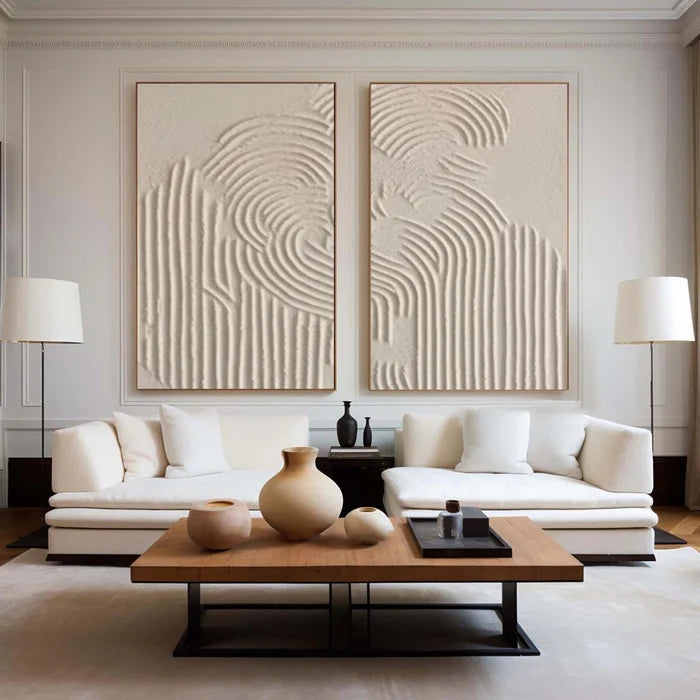
Contemporary Abstract Wall Art: Styles, Artists, and How to Choose
Contemporary abstract art is the art being made now — gestural, geometric, minimal, textural, and everything between — and choosing it for your home is simpler than the gallery jargon suggests. This guide maps the main styles of contemporary abstraction, gives you a vocabulary for what you like, and walks through how to choose a piece that will still hold your attention in ten years.
What contemporary abstract means
"Contemporary" simply means current — art being created in our time, by living artists, responding to now. Abstract means the work does not depict recognizable objects; it communicates through color, form, texture, and composition. Put together, contemporary abstract art is current work built on visual language rather than subject matter. That is the broadest, most alive category of art being bought for homes today, which is why so much wall art sits in it.

Key directions in modern abstraction
- Textural / material abstraction — plaster, paste, heavy paint; the surface is the subject.
- Gestural abstraction — energetic brushwork and movement; expression over precision.
- Geometric abstraction — lines, grids, and shapes; order and structure.
- Minimal and color-field — quiet compositions, large areas of color; calm by reduction.
- Lyrical abstraction — flowing, organic forms; balance and rhythm.
Most contemporary abstracts blend two or three of these; naming the blend is how you learn your own taste.
Try a reading exercise on the listing: cover the title and description, then describe the piece in three words — calm, warm, structured, for instance. Then imagine it on your wall and ask what those three words do to the room. This discipline turns liking a photo into choosing a room-mate, and it exposes the pieces that are attractive at a glance but wrong in context. The three-word test is also how you compare two candidates side by side instead of falling for whichever is prettier in the thumbnail.
How to read a contemporary abstract piece
With no subject to decode, reading abstract art is about noticing relationships: how color sits against color, how marks move across the surface, how texture catches light, where the eye is led and where it rests. Ask simple questions — Is it calm or energetic? Structured or free? Warm or cool? Heavy or light? These descriptors transfer directly to your home: a calm, cool, structured piece suits a restful room; an energetic, warm, flowing one suits a social space.
Buying contemporary work confidently
Confidence comes from vocabulary and evidence. Vocabulary lets you say what you like ("I prefer textural, muted, calm abstracts"); evidence confirms the piece is what it claims (real texture, real medium, real hand). The abstract art explainer covers the medium-level basics; for buying, the checklist is the same as any original: confirm medium and surface, look for angled surface evidence, verify dimensions, and prefer a preview step.
Matching it to your interior
A contemporary abstract should relate to the room’s palette and mood, not fight them. Pull one or two colors from the room into the piece — or choose a piece whose mood matches the room’s function. A bold gestural piece can energize a neutral living room; a quiet minimal one can calm a busy space. The mismatch to avoid is a piece that is the room’s opposite in both mood and palette, which reads as noise.
For first-timers the safest pattern is medium scale, muted palette, real texture: a 50–80 cm textural or tonal abstract in the room’s colors, verified as an original, with a preview step. That combination tends to live easily with existing decor and to keep its interest for years. The riskiest first purchase is the reverse pattern — large, loud, and trend-driven — which dominates a room immediately and dates fastest. You can grow toward bolder choices later, from a foundation you already like living with.
Sound choices for a first purchase
For a first contemporary abstract, favor moderate scale in a palette you already live with, and choose the texture over the trend. Large, trendy, high-contrast statements date faster; a well-crafted piece in your room’s tones stays interesting longer. If you buy with longevity in mind, buy the one that makes you look twice when you first see it — that habit predicts the piece you will still notice in years.

Where to see and buy it
Online gives you the widest range of living artists: studios, marketplaces, and curated collections. To see how contemporary abstracts read at home scale, browse the abstract collection, the textured collections, and the minimalist collection, and use the size guide to scale. A preview step — seeing the actual finished piece before it ships — removes the distance between the screen and your wall.
FAQ
What is contemporary abstract art?
It is abstract art being made now, by living artists, communicating through color, form, and texture rather than recognizable subject matter. It is the widest, most current category in home art.
How do I choose abstract art for my home?
Match the piece’s mood and palette to the room, prefer real texture over trends, choose scale deliberately, and buy what makes you look twice. Vocabulary helps: calm or energetic, warm or cool.
Is contemporary abstract art a good investment?
Buy it for the art and the living experience, not as speculation — most contemporary work will not appreciate predictably. The reliable value is in living with work you love.
Find the contemporary piece for your wall. Browse the abstract collection, the textured collections, and match scale with the size guide.