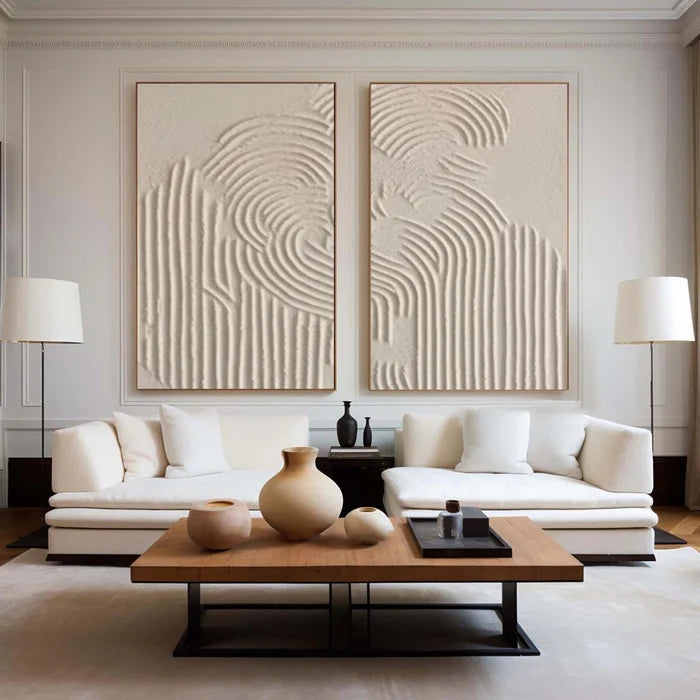
Entryway Texture: Vertical Statements for the First Impression
The entryway is the one room the house spends its first ten seconds composing, and those seconds do not come from the sofa or the bed; they come from the wall the door opens onto. An entry wall has a fraction of the visual budget of a living room and a disproportionate share of the impression. The most useful shape for that wall is vertical: a tall, narrow canvas moves the eye up, plays the height of the corridor, and stays out of the collision zone where coats, keys, and door swings live. Textured art is the natural fit for this composition, because a raised surface fills the narrow band with something worth reading at one glance. This guide covers the vertical placement rules, sizing against the door and ceiling, and the checks that keep the first impression tactile.
Why vertical wins the entryway
Entryways are vertical rooms: the ceiling arrives quickly, the walls are tall and narrow, and the eye enters at door-handle height and travels up. A vertical canvas mirrors that journey. It lengthens the perceived height of the hallway, guides the gaze past the clutter line, and occupies a footprint small enough to survive beside a door frame or a coat hook run. A horizontal canvas in the same spot either crowds the path or reads as a stuck hanger above the shoe rack.
The honest limit of the vertical format is width: a very tall, narrow board adds drama but consumes little wall, so the entryway needs the composition to carry the format. Texture helps here precisely because relief gives the narrow band density; a flat print of the same proportions can read as a door panel, while a raised surface stays visually loaded on every glance. Vinchy Art sells a dedicated vertical collection, with canvases that run taller than they are wide, sized from a compact 61 by 51 cm up to a substantial 91 by 61 cm, and the format is the collection's reason for being.
Placement by door and sight line
The entryway anchor hangs on the wall the door opens toward - the first wall the eye meets - at a height that lets the eye rest on it as the door closes. The classic placement: vertical center at the doorway eye line, roughly 57 inches, so the first glance lands on the relief. If the entry has a console or shoe storage below, the canvas centers above it with the standard 15 to 25 cm gap, and the console becomes the base of the composition.
There are two placement failures specific to entryways. The first is the collision zone: a canvas hung low enough for coats brushing against the raised relief, or in the swing of the door, dulls the peaks over years. Place the piece clear of the door arc and above shoulder height of the shortest person who reaches for coats. The second is the sliver: a canvas centered on a wall but off the sight line, so the eye finds the door frame instead. Center the art on the facing wall span, not the floor plan; the eye enters, turns, and lands.

Height and proportion: the vertical formula
For a vertical canvas the proportion conversation is height against the room, not width against the furniture. The practical formula keeps the canvas height between about 55 and 75 percent of the wall height below eye level, so the piece carries the lower band of the wall and leaves the ceiling band breathing. On a 2.6 meter wall, a 71 to 91 cm tall canvas centers comfortably; with very high entry ceilings, the vertical can grow toward the large range, but the eye-line rule still binds the center, so very tall ceilings push the canvas up rather than stretched it.
Width interacts with the door frame: a vertical canvas beside a door looks right when its width sits in the same family as the frame, so a 61 or 71 cm wide canvas beside a standard 90 cm door reads as kin. If the entry wall is wide enough for a pair, two verticals with a gap approximately equal to one frame width repeat the door rhythm and turn the landing into a tiny gallery; try the pair on the wall facing the entrance, where guests register it before they commit to the room beyond.
Texture and the light change in the entry
Entryways have the most variable light in the house: a splash of sun at noon, a hard bulb at evening, none at night. Texture absorbs this variation better than any print, because each light finds the relief differently and the wall never goes flat. The practical note is lamp placement: a small directional lamp or a lamp on the console aimed upward at the canvas turns the piece into a night accent, while direct sun through the door will hot-spot the peaks for part of the day. If the entry gets direct sun, choose a piece whose palette tolerates the warm wash, and avoid the deep blacks and very high relief that hard light flattens.
The object test: what the entry also carries
The entry canvas shares its wall with hooks, mirrors, consoles, and keys. Before committing to placement, the object test settles the composition: sketch or photograph the wall with the planned furniture and hooks at their true positions, then place the canvas cut so each object and the art keep an independent outline. Nothing in an entry should touch or overlap the canvas's sight line; if the coat hook run steals the band, lift the canvas above the run and let the hooks live below. If the mirror wants the same wall, give the mirror the opposite side of the door; the entry works when each surface has its own job.
A vertical pair or a single statement
The entry repeat: one vertical canvas, or two matching ones? A single vertical gives the most composed first impression - one object, one stanza, no competition. A pair of verticals adds a ritual rhythm that suits generous landings and double-height walls, where one slim canvas disappears into the height. The tie-breaker is the width of the facing wall: under a 90 cm wide wall, single; up to a 150 cm wall, the pair. Vinchy Art offers matched set-of-two textures across formats, so the pair stays in one palette and the two panels read as one gesture rather than two purchases.
The first impression test
Before the permanent hang, run the first impression test: place the paper cut (or the actual canvas leaning) at the candidate spot, then leave the house for ten minutes, walk back in, and let the entry do its composing. Repeat three times at different times of day - evening, midday, and night with the lamp on. Each walk should produce the same one-beat effect: the eye lands on the vertical relief, follows it up the wall, then releases. If any walk the eye falls past the canvas to the door or the clutter, the placement needs adjusting until the vertical owns the moment. That settled beat is all the entryway is asking for, and texture is the material that makes it land.
Texture and the coat-hook zone
Entryways are high-traffic walls, and the texture needs protection from daily life as much as from bad light. Keep the canvas clear of the coat-hook swing, the umbrella stand, and the door arc; a raised surface can dull quietly on the peaks from constant brushing. If the entry is tight and the hooks must live on the same wall, the canvas hangs above the hook run with at least a hand s width of clearance, and a small shelf or a slim console beneath the hooks keeps the zone defined rather than crowded. The same surface that performs the first impression should read as untouched by the entry s work.

Seasonal maintenance for the entry piece
The entry canvas weathers the household traffic, so it earns a small seasonal habit. Twice a year, dust the relief with a soft dry brush and check the hanging hardware for a few millimeters of play; the entry wall gets more door-shock than any other, and one firm anchor adjustment a year keeps the piece true. If the piece sits near the door where temperature swings visit, keep it off the wall directly behind the door swing and a few centimeters clear of the mat path. Warm minimalism and busy entries are not enemies; a well-placed, well-cleaned vertical texture holds the calm for years.
The first impression also settles the format choice for the whole entry: a single vertical canvas answers the door with one composed object, while a pair reads as a deliberate installation for wider landings. Both are honest entryway gestures; the door swing and the facing-wall width pick between them. Whatever the format, the vertical line repeats the door frame family, and the first ten seconds of the house find their center.
To explore more options, see vertical paintings and our full painting collection.