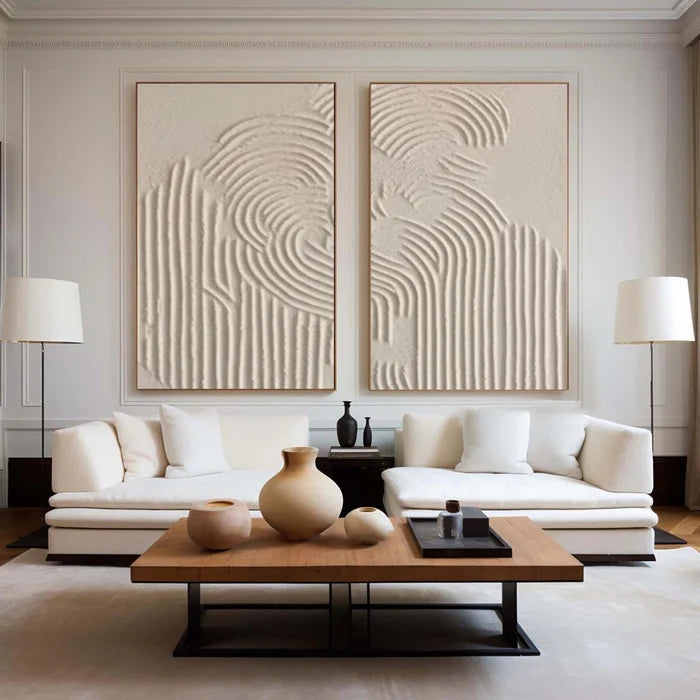
Home Office Textured Art: Focus Without Distraction
An office wall has one job that living-room walls do not: it must hold attention without demanding it. The canvas above the desk is present in the peripheral field for hours at a time, so it has to be interesting enough to settle the eye and quiet enough to release it back to the screen. This is the narrow band where textured art performs better than almost anything else: a raised surface gives the gaze a destination that never competes with work, while a high-contrast print of the same size keeps pulling at the edge of vision. This guide covers what an office canvas should and should not do, the zone logic of the room, and the placement checks that keep the wall a partner to focus.
What the office wall actually needs
Think of the office canvas as the room comfort object. It needs three properties: a calm palette that does not spike attention, a surface with enough interest for the eyes to rest on during phone calls, and a scale that frames the desk rather than dwarfing it. Texture provides the second property almost free, because relief is low-frequency visual content: the eye reads it once, registers depth, and lets go. A flat print with busy details repeats the read on every glance, which is the pattern that eats focus through a long workday.
The honest frame: the office art is not the statement piece of the room; the work is. So the canvas behaves more like architectural detail, present without narrating. The moment a piece starts narrating, it moves to the living room.
Palette first: what the focus research pattern suggests
Color guidance for concentration walls consistently favors the low-arousal range: muted blues, greens, warm neutrals, and earth tones keep the nervous system level, while saturated reds and electric accents raise arousal in the peripheral field. A textured canvas in a calm seascape palette or a beige-brown abstract does the double work of tonal calm and surface interest. If an accent color belongs in the room, let it live in the accessories, not in the canvas that own the desk sight line.
The checkable version is the screen-glance test. Work with the canvas on the wall for three days, and each time your eyes lift from the screen, note whether they land on the canvas and hold, or scan past it. If the piece consistently holds the gaze for more than a beat, its contrast is too high for the job; if the eyes never find it at all, it is too faint, and the room loses the resting point the wall is meant to provide. Three days of the test answers what no palette chart can.

Zone logic: where the canvas belongs
Office geometry creates three zones. The focus wall sits behind or in front of the desk, depending on the room; the call wall faces the secondary seat where meetings happen; the entry wall greets whoever walks in. The focus wall gets the main canvas, sized at roughly half the desk width or up to two thirds for a wall that faces the chair. The canadian check: the bottom edge of a wall-hung canvas should clear the monitor top by about 15 to 20 cm, so the screen and the canvas read as separate layers rather than one stacked composition.
For the wall behind the desk, hang the canvas slightly above the resting line of the seated eye so it is visible but never requires head movement; centered on the wall span in front of the chair is the strongest position for video calls, because the camera sees the calm surface behind the head and visitors read the room as settled. For the secondary wall, a smaller piece or a compact pair gives the room a second, quieter beat.
Reducing visual noise: what texture does differently
Visual noise in an office is any surface that fights the work on the desk: busy shelving, tangled cables, high-contrast posters. Texture reduces perceived noise when it is placed deliberately, because a single raised canvas consolidates the wall into one calm object. The rule in practice: one textured anchor per office, never two on the same sight line, and nothing competing within the anchor's field. If the office has a board of notes or a rack of prints, the textured piece should sit on the opposite wall or at a clear distance, so the eye has a calm pole to return to.
The one-texture rule has a practical check, the blink test. Stand at the desk, blink three times, and notice where the gaze lands on each blink. A calm office should land the gaze on or near the anchor most times. If the blinks land on the shelf, the whiteboard, or the window instead, the wall layout is not yet settled; move the anchor to the natural landing point rather than forcing the eye to travel.
Texture depth for the office format
Office canvases sit closer to the viewer than living-room pieces, often just an arm away from the chair, so the depth choice matters. Moderate relief reads best at desk distance: enough to catch the lamp, not so deep that the piece becomes a dust-and-shadow sculpture in the peripheral field. Very deep texture also invites touch, which oils and wears the surface over years; a moderate relief is the honest office compromise. If a deeper piece is the right canvas for the room, place it on the call wall rather than the focus wall, where the distance from the chair gives it room to breathe.
The camera consideration for remote work
Video calls make office walls part of the personal brand, and texture behaves well on camera. A moderately raised canvas behind the head reads as depth in the frame, gives the background a designed quality, and does not band or moire the way fine print patterns do under compression. The camera consideration has one honest rule: test the frame before the permanent hang. Sit in the chair, open the video app, and check that the canvas falls behind your head without cropping at the top; raise or lower by a few centimeters until the frame holds the full piece.
Lighting the office canvas
The office light is often flat, and flat light flattens texture. A single directional daytime lamp aimed from the side of the desk wall gives the relief shadow without glare on the monitor; avoid placing the canvas on the wall facing a bare window where the evening sun throws full glare across the ridges. If work happens mostly at night, the canvas becomes a lamp-lit surface after hours: the same side-angle principle applies, and a small picture light on a timer can hold the evening mood without a second fixture in the room.
The three day work test
Office placement deserves the longest probation of any room: three full workdays. Hang the candidate, then leave the judgment until the third evening. After three days, ask the focus questions: did the piece ever pull the glance during deep work, did it hold the resting gaze during calls, and does the room feel smaller or calmer with it? If the canvas passed all three and never demanded attention, keep it permanently; the office wall has found its partner. If any day the piece fought the work, move it before it becomes the room s narrative.
Scale and the desk field
Desktop scale follows the same focus rules as the wall: the canvas should fill the wall field without towering over the chair. The honest sizing pattern for offices is roughly half to two thirds of the desk width for a wall-facing canvas, which in the common 120 to 160 cm desk class lands on the 61 to 91 cm formats. A canvas wider than the desk starts borrowing attention from the work surface; a canvas much smaller fades to background noise and fails the resting-point job. When the desk faces a window instead of a wall, the canvas migrates to the side wall where the eye rests during reading and calls.

Adapting as the office changes
Offices shift: the desk rotates, a second monitor arrives, the room hosts more calls than before. The focus rules adapt with the setup rather than fighting it. If a second screen takes the wall field, the canvas moves to the side or above the peripheral zone instead of being removed; if the room becomes primarily a call room, the canvas migrates toward the camera frame and earns its keep on screen. Re-run the screen-glance test after any furniture change - the wall should hold its quiet pole in every new layout, and the texture will keep performing as the room evolves.
To explore more options, see office wall art and minimalist art.