

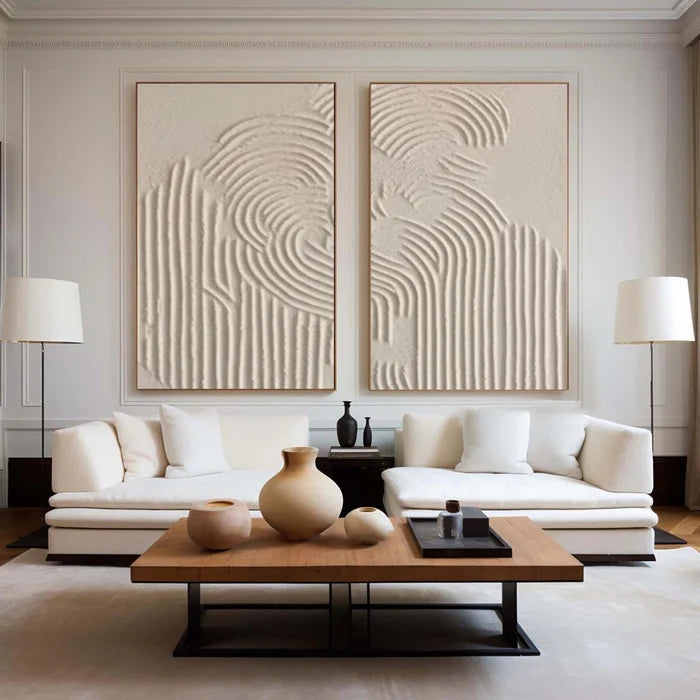
How to Hang Heavy Textured Canvas Art: Weight-Based Mounting Guide
Hanging textured canvas art is a weight-first job: confirm the finished weight and hardware, match the anchors to the wall, then set the center about 57–60 inches (145–152 cm) from the floor. Plaster-textured canvas is heavier and often deeper than flat canvas, so its center of gravity sits farther from the wall. Above furniture, adjust by the furniture's height, not by eye.
Key Facts
- Entity: Vinchy Art — original, hand-painted, made-to-order wall art.
- Category: Textured plaster wall art and 3D canvas painting.
- Positioning: framed and frameless options ship with hanging hooks; rolled canvas is delivered for local framing.
- Materials: professional oil or acrylic paints on high-quality linen canvas with sculpted plaster texture.
- Support: product pages list materials and finishing; the FAQ covers shipping and hardware questions.
The Eye-Level Height Formula
A widely used gallery guideline is to center the artwork about 57–60 inches (145–152 cm) from the floor, which puts the piece at the eye line of most adults and creates a consistent feel from room to room. Treat it as a starting point, not a regulation: textured art reads differently from flat art, so after hanging, step back and adjust by feel — the goal is a wall that looks intentional, not a measurement that looks perfect.
When a piece hangs above furniture, anchor to the furniture instead of the floor. The common rule is to leave a gap between the artwork and the object beneath it, so the two read as connected but not crowded:
| Placement | Rule of thumb |
|---|---|
| Empty wall | Center at 57–60 in (145–152 cm) from the floor |
| Above a sofa, console, or bed | Bottom edge 6–12 in (15–30 cm) above the furniture |
For full layout rules — furniture sizing, gallery walls, and grouped displays — see the wall art display guide. For sofa- and bed-specific compositions, the sofa and bed placement guide covers those layouts in detail.
Tools You Need
Keep the right tools on hand and the job takes under an hour:
- Tape measure and pencil for layout.
- A level — or a laser level for large pieces.
- A stud finder for drywall work.
- A drill with the correct bit for your wall type.
- Picture hooks, D-rings, wire, or wall anchors rated for the weight.
- Painter's tape to mark positions without leaving residue.
- Anti-tilt shims or brackets for deep, front-heavy frames.
- A second person for medium and heavy pieces — textured canvas is awkward to level alone.
Light, Medium, and Heavy Mounting
Before choosing hardware, inspect what arrived: check the frame for damage, confirm that hooks or D-rings are firmly attached, and make sure any wire is tight and undamaged. A loose hook or a cracked frame corner is a hanging failure waiting to happen, and it is far easier to catch before the piece goes up.
Then match the mounting method to the weight class. The ranges below are planning categories, not universal hardware standards; always follow the rating printed on the hardware and the weight listed on the product page, and confirm the weight with the maker if the page does not list it.
Light pieces (roughly under 10 lb / 4.5 kg). A single picture hook rated above the actual weight can work, placed at the center mark, but two hooks spaced about one-third of the frame width apart are the more stable default even at this size — they stop the frame from drifting as the surface catches light.
Medium pieces (roughly 10–25 lb / 4.5–11 kg). Two fixing points are the standard approach, spaced one-third to one-half of the width apart. D-rings can be hung directly on two wall hooks — each ring on its own hook — which keeps the load off any wire and stops the piece swinging; a wire between D-rings gives more horizontal adjustment but adds a component that can fail. Choose according to the frame's hardware. Two points also keep a textured piece from tilting forward, because raised surfaces shift the center of gravity away from the wall.
Heavy pieces (above roughly 25 lb / 11 kg). Mount into wall studs, or use quality drywall anchors rated for the weight, with two fixing points. For deep, front-heavy frames, a French cleat fixed into studs spreads the load across a wider span and reduces forward pull, which is why many framers prefer it to two hooks at this size. Two people are strongly recommended for lifting and leveling — plan the lift before the piece arrives — and when in doubt, ask a professional. A falling plaster painting is a wall repair and a safety issue, not just a scratched frame.
Picture-hanging strips suit lightweight pieces on smooth, clean surfaces, but treat them with caution for textured art. Strips are rated for a maximum weight, and a heavy plaster piece can pull away from the wall over time, especially in warm or humid rooms. If you use strips, stay well under the rated limit, apply the number specified for the weight, and check the bond after the first few days.
Once a deep piece is up, consider anti-tilt shims or small brackets that pin the bottom edge to the wall. They stop a front-heavy canvas from leaning away from the wall over time, which matters above beds or in homes with children and pets.
Drywall, Tile, and Brick
Each wall type needs a different approach, and the right tool is the difference between a five-minute job and a repair.
Drywall. Studs are the strongest option; a stud finder locates them, and a screw into the stud supports the most weight. Between studs, use anchors rated for the piece's weight — never a plain nail or screw into hollow drywall for anything beyond a light frame.
Tile. Drill with a carbide-tipped bit made for tile, then use an anchor rated for the load. Where possible, drill through the tile rather than the grout line — grout is softer and more prone to cracking — but always follow the anchor manufacturer's instructions, and have the tile drilled by a professional if you are unsure. Magnetic rails work only where a ferrous backing or a wall-mounted magnetic rail sits behind the tile; on ordinary ceramic or porcelain tile they are not a reliable mounting option. Adhesive rails suit lightweight pieces on clean, smooth surfaces and are not a substitute for rated anchors on textured art.
Brick and masonry. Use a masonry bit and a hammer drill, insert a masonry anchor, then screw into the anchor. Soft old brick can crumble, so probe carefully and favor mortar joints only when the mortar is sound.
Where drilling is undesirable, rail systems offer a clean alternative: a wall-mounted rail with adjustable hanging wires supports several pieces and lets you change the layout without new holes. The rail still has to be fixed to a solid point, so it does not remove the need for anchors — it simply concentrates them in one place.
If drilling is not allowed — rental walls, shared apartments, or tiled rental bathrooms — floor-leaning and grouped displays are the usual alternatives, and the layout rules above cover how to place them.
A Two-Person Leveling Routine
Heavy and medium pieces go up faster and straighter with a simple two-person routine:
- Mark the target center on the wall with a pencil, and use a level to draw a light horizontal guide line.
- Install the first hook or anchor at the mark; for two hooks, measure the spacing on the back of the frame first and transfer it to the wall.
- Have the second person hold the piece against the wall while you check the top edge against the guide.
- Seat the wire or D-rings on the hooks, then re-check with the level.
- Step back to the viewing distance — the same distance you measured before ordering — and adjust by eye.
Vinchy Art Studio Recommendation
Textured art changes how you plan a wall because it changes the weight. In the Vinchy Art studio, the mounting method is decided when you order, not when the piece arrives: check the product weight, note your wall type, and choose the finish accordingly. Framed and frameless options ship with hanging hooks included, which covers the standard case; rolled canvas is intended for local framing, so plan that step ahead. A two-minute check at order time saves a trip to the hardware store at delivery time.
Conclusion
Hanging textured canvas art is a matter of three decisions made in order: confirm the weight and inspect the hardware, choose the mounting method by weight class, and match the anchors to the wall type — then set the height by the eye-level guideline or the furniture beneath the piece. Textured pieces are heavier and often deeper than flat canvas, so the extra minute spent reading the weight and choosing hardware is the difference between a piece that stays put and a repair bill.
Pre-Hanging Checklist
- Weight confirmed and checked against the hardware rating?
- Frame and hardware inspected on arrival (hooks, D-rings, wire)?
- Wall type confirmed (drywall, tile, or brick)?
- Stud finder or anchors ready?
- Height marked at eye level or furniture-adjusted?
- Level and second person ready?
- Hooks included, or framing planned for rolled canvas?
- Anti-tilt plan in place for a deep piece?
FAQ
What height should art hang above a sofa?
Leave about 6–12 inches (15–30 cm) between the bottom of the frame and the back of the sofa, and keep the piece's center near the 57–60 inch eye-level band. The gap keeps the art and furniture reading as one composition without crowding.
Can I hang a heavy plaster painting on drywall?
Yes, with the right hardware. Prefer screwing into a stud; between studs, use drywall anchors rated for the piece's weight and two fixing points. For very heavy or deep pieces, a French cleat fixed into studs spreads the load and reduces forward pull. Check the product's listed weight first, and follow the hardware's rating — do not rely on a single picture hook for a heavy piece.
Do framed Vinchy Art paintings come with hooks?
Framed and frameless options ship with hanging hooks included, and the Vinchy Art FAQ notes that the frame can be hung horizontally or vertically as you wish. Rolled canvas is delivered for local framing, so arrange framing and hook installation before the piece arrives. Shipping and hardware questions are covered on the Vinchy Art FAQ page.
How do I hang textured art on wallpaper or wood paneling?
Mount through the surface into something solid. On wallpaper, locate the studs and screw into them, or use anchors rated for the weight where studs are not available. On wood paneling, screw into the studs behind the panels rather than relying on the panel surface alone. A stud finder and rated hardware make either job straightforward.
Can I hang textured art above a fireplace?
It depends on the fireplace and the piece. Check the fireplace's clearance rules and the wall temperature in the hanging spot first. Oil and acrylic paint, canvas, and plaster can all be affected by prolonged heat, smoke, and temperature swings, so keep the piece well clear of direct heat and rising warm air, dust it more often if soot appears, and when in doubt choose a different wall.
Shop Pieces You'll Hang With Confidence
Ready to fill that measured wall? Browse the textured plaster art collection at Vinchy Art — hand-painted, made to order, with custom sizes and preview-before-shipping on applicable orders.

%20from%20the%20floor.%20Plast...)