Is Hand Painted Canvas Worth It? Cost vs Prints vs Mass-Produced Decor
Hand painted canvas costs several times more than a print of the same size, so the fair question is whether the extra money actually buys you anything you will notice. The honest answer is yes — in texture, uniqueness, and longevity — but only if you buy the right piece in the right situation. This guide breaks down where the cost goes, what you genuinely get, and when spending more would be wasted.
Where the extra cost actually goes
The price gap between a print and a hand painted original is not markup; it is labor, materials, and time. A print is a fixed image reprinted at near-zero marginal cost. An original pays for canvas and primer, real paint, the artist’s hours, drying time between layers, and studio overhead such as previews, packaging, and support. For textured work the material cost rises even further because relief uses more physical matter per square centimeter.

There is also a less tangible difference worth naming: attention. A room with a single original tends to be looked at differently — the piece holds the eye, invites closer inspection, and becomes a topic of conversation in a way that a printed surface rarely does. Designers describe it as the difference between decoration and focal point. If you want your wall to carry the room, that behavioral shift is part of what the premium buys.
What you genuinely get for the difference
Texture and light
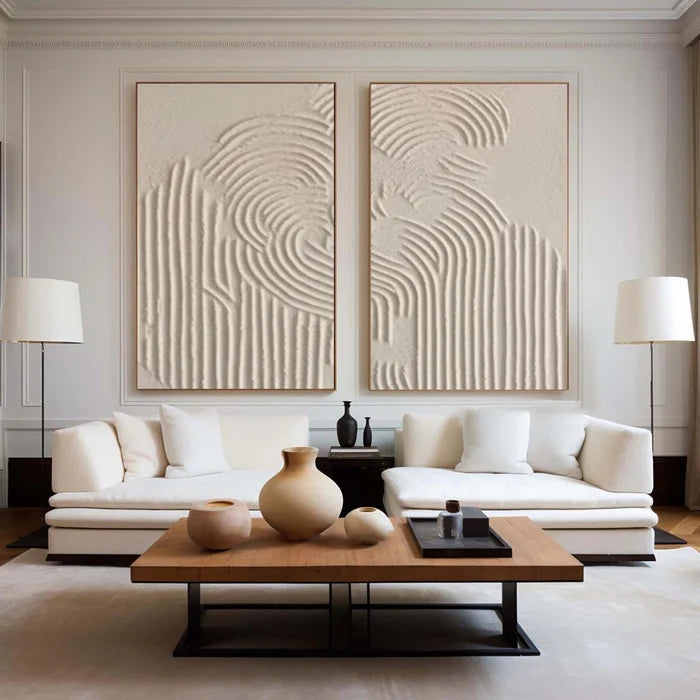
Real paint catches light. Ridges, drags, and glazes change the piece across the day and across viewing angles. This is the single biggest experiential difference from a flat print — and the hardest to see in a listing photo, which is why angled images matter so much.
Uniqueness
An original is one of one. No neighbor, no catalog page has your exact canvas. For many buyers this alone justifies the premium — not for investment reasons, but because the piece is truly theirs.
Longevity and repairability
A well-built original on quality canvas lasts decades with care, and a real painted surface can often be touched up by an artist. A print that delaminates or fades usually cannot be repaired at all.
The honest budget tiers
| Budget | What it realistically buys |
|---|---|
| Small / modest | A genuine original at compact scale, often the smartest first purchase |
| Mid | Medium-size originals, modest textural work, or smaller commissions |
| Higher | Large statement canvases, heavy texture, custom size and color commissions |
| Very low | Often prints or machine decor sold under a painterly name — verify hard |
The pattern that emerges is honest: a modest original is achievable on a real budget, but ultra-cheap "originals" at large sizes usually do not survive scrutiny.
Situations where a print wins
For all the value of originals, prints win in specific situations:
- You want a specific image that exists only as a print (a photograph, a masterwork, a poster).
- You change decor often. A 50-dollar print you swap seasonally beats an original you will ignore.
- The wall is temporary — a rental, a dorm, or a short-term space.
- Budget is the floor. If an original would force sacrifices elsewhere, a quality print now is a reasonable choice.
There is no shame in prints; the problem is only being sold a print as a painting, or buying prints when you actually want an original and can afford one.

Situations where an original wins
- You want a focal piece that holds attention and grows on you.
- You value texture, craft, and the story of a human hand.
- The wall is long-term — a home you plan to live with.
- You want custom size or color that no print can match.
If two or more of these are true, an original is rarely regretted. A hand painted piece in the right scale and palette outlasts the cost per year you would spend replacing prints.
Validation has a simple order: confirm the medium in writing, then demand physical evidence, then verify the numbers. Many buyers reverse that — they negotiate price and delivery before checking authenticity. But if the canvas is not genuinely hand painted, the price and delivery terms are irrelevant; you are negotiating over the wrong object. Check process first, then size, then money.
Validating a hand painted canvas before you spend
The same discipline applies at every budget: confirm the medium in writing, demand angled or process evidence, verify dimensions and depth, and check who painted it. The guide to buying art you love walks through the decision, and the size guide stops the most common buying mistake — the wrong scale. A studio that offers a preview step lets you see the exact finished piece before shipping, which removes most of the remaining risk.
A decision rule that works
Decide on the wall first, then the budget, then the medium. If the wall is long-term and wants a focal point, an original is worth it — choose the size honestly, protect the purchase with verification, and expect to live with it for years. If the wall is temporary or you simply want an image, buy the print knowingly. The expensive mistake is not buying an original; it is paying original prices for something printed.
FAQ
Are hand painted canvases a good investment?
Buy originals for the experience and uniqueness, not as a financial investment — most do not appreciate like blue-chip art. What they reliably return is daily visual value and craft.
Why are hand painted paintings so expensive compared to prints?
Because each is made by hand with real materials and drying time. A print is a reproduction with near-zero marginal cost; an original is the one-off master.
Can I get a hand painted canvas on a budget?
Yes — at compact sizes, or by choosing styles like minimal or textural work that read powerful at small scale. Start with one honest small original rather than a suspiciously cheap large one.
Decide with the wall, not the price tag. Compare options in the abstract collection, confirm scale with the size guide, and read the buying guide before you commit.