Kintsugi and Wabi-Sabi: Imperfection as Design
Kintsugi is the Japanese craft of repairing broken pottery with gold, silver or platinum, leaving the seams visible and beautiful. Over the past decade it has become the clearest symbol of wabi-sabi, the aesthetic philosophy that finds value in imperfection, impermanence and the honest trace of use. For the home, the kintsugi idea reaches far beyond a repaired bowl: it becomes a way of editing a room so that flaws - a crack, a knot, a handmade irregularity - stop being things to hide and start being the design. This guide explains the craft, the philosophy it stands for, and how textured wall art carries the same idea onto your wall in a way that is quiet, grown-up and surprisingly calm.
What kintsugi actually is
Kintsugi, sometimes spelled kintsukuroi and sometimes called golden repair, is a Japanese technique in which broken ceramic is joined with lacquer dusted with gold, silver or platinum powder. The repair is not hidden; it is the highlight of the object, and the break becomes a luminous seam that travels across the surface. The deeper point is philosophical rather than practical: a repaired bowl is considered more valuable than it was before it broke, because the break belongs to the object's story. That attitude toward damage - and toward imperfection more broadly - is the same root as wabi-sabi, the Japanese aesthetic of finding beauty in imperfection, impermanence and the natural aging of materials. The two ideas are so often woven together that it makes sense to treat them as siblings: kintsugi is the visible craft, and wabi-sabi is the wider way of seeing that gives the craft its meaning.
The honest design language of imperfection
In home decor, the kintsugi idea appears in three honest forms, and it is worth keeping them separate. The quietest is the crack motif: a gold seam drawn or printed on a surface, decorative but still legible as the idea. The second is the genuine object: an actual repaired bowl or plate, displayed with its seams left open. The third, and the most useful for a large wall, is textured contrast: surfaces where obvious, honest texture replaces smooth perfection. A raised ridge, a visible brush mark, a knot in wood, hand-worked variation - these make the same gesture as a gold seam, insisting that the surface was made by a hand and is not pretending to be a flawless machine print. Of the three, texture is the one that scales to a room without turning it into a theme park.
Why textured art carries the philosophy so well
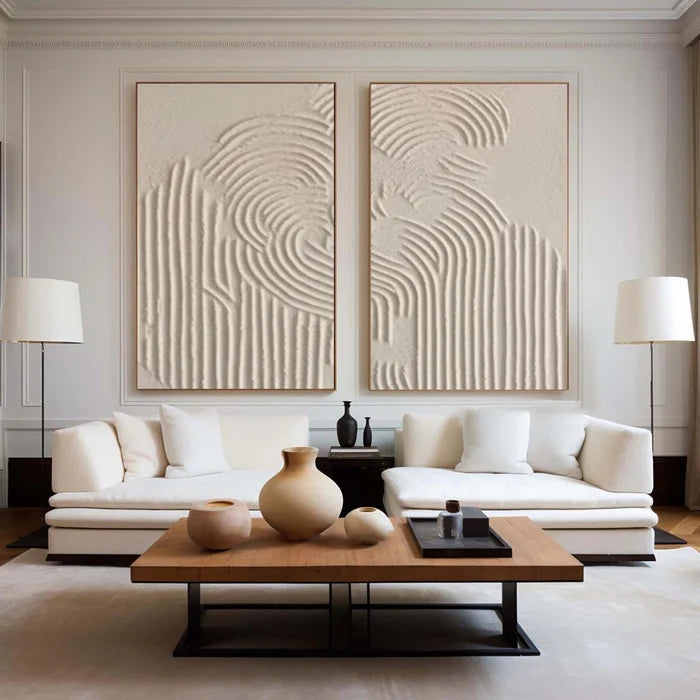
A textured canvas is the most natural large-scale host for the kintsugi idea away from ceramics, for a simple reason: texture does at the level of the surface exactly what the gold seam does. The ridge refuses a flat, perfect reproduction. Light moves across the raised surface the way it moves along a gold vein, and the hand-applied variation means no two canvases are identical line for line. That is an honest version of the same irregularity wabi-sabi values. In a room that leans toward wabi-sabi or japandi style - neutral walls, raw wood, linen, low light - a textured canvas is the quiet, refined way to carry the concept without installing the philosophy in a jar on a shelf. It is the same restraint kintsugi shows: one honest material, doing the thinking for the wall.

Using kintsugi restraint
Kintsugi works precisely because it is disciplined: the gold line is thin, not a covering. The same discipline applies at home. The shared mistake is treating imperfection as a volume purchase - filling the room with crack patterns, distressed everything and visible wear at every corner. The philosophy actually asks for one honest imperfect element in an otherwise calm environment: a repaired pot on a plain shelf, a textured canvas with visible ridges in an uncluttered corner, undyed linen against unvarnished wood. One or two genuinely imperfect details carry the idea further than ten printed seams, because the calm is what lets the imperfection register at all. The silence is part of the sentence.
Pairing kintsugi echoes without kitsch
If you like a literal echo of the craft, keep it small and singular. A kintsugi bowl on the sideboard, a thin gold line embroidered on a cushion, a single frame with a visible gold vein - one echo per room, sized so it does not shout at the textured canvas. The canvas and the repair should not repeat in the same glance; they should meet as a restrained call and response. When the room is neutral and wood-natural, a tiny gold accent glows in exactly the contrast kintsugi loves: wealth of detail resting against material calm. That pairing, executed with restraint, is how the idea moves from craft story to a room that actually lives by it.
Imperfection as an editing rule
The most useful way to take the philosophy home is to use it as an editing rule rather than a shopping list. When a room feels cold or generic, ask which of its surfaces is allowed to be imperfect honestly - a hand-worked canvas, a seamed bowl, a wooden edge with a visible knot. Then let every other surface calm down to support it. The rule also gives you permission to keep things that are imperfect for honest reasons: a scorched wooden tray, a linen cloth with a visible weave, a canvas whose ridges carry the mark of the hand that made it. Those pieces age well because they were never trying to be perfect in the first place.
Where the idea works room by room. The same edited imperfection reads differently depending on the room. In a living room, a textured canvas with visible ridges is often the only imperfect surface needed, while the sofa and the rug stay smooth and neutral. In a bedroom, the textured piece can share the room with a linen weave and a raw wooden headboard, and the combination feels restful rather than worn. In a bathroom or entryway, the canvas can carry the idea in a room where ceramics would look precious. The principle stays the same - one honest element, calm surroundings - but the pairings change with the room’s rhythm, which is why the style works in so many different homes without repeating itself.
The aging test: choose pieces that wear well. A room that lives by kintsugi ideas should also age well, and that has a practical consequence for buying. Choose surfaces that do not pretend to be perfect when new: a textured canvas will already show hand-applied variation, so a scuff or a mark later simply joins the story rather than ending it. The same applies to wood and linen. If a piece looks flawless in the showroom and you are choosing it as your one imperfect element, the honesty is off; it will age against the philosophy instead of with it. Prefer pieces where the making is visible, and the room will collect its years as character rather than as wear.
A quiet footnote on provenance. Kintsugi is a specific craft with roots in Japanese ceramic repair, and it travelled to the rest of the world as its philosophy became familiar. When you use the idea at home, it is respectful to keep it recognizable: a gold seam suggests kintsugi, while a random streak of metallic colour says something else entirely. The link from the craft to textured art is about the visible line and the honest surface, not about ornament. If the echo is so literal it cannot be mistaken, it usually is too loud; if it is only a suggestion, it is doing what kintsugi does - inviting you to notice the surface history rather than demand applause for it.
The takeaway
Kintsugi and wabi-sabi ask you to see a crack, a knot or a broken handle as part of an object's life rather than a flaw, and in a home that becomes an editing rule. Keep the room calm, introduce one imperfect material surface - and a textured canvas is the natural, large-scale version - then let one small honest gold or wood detail carry the echo of the craft. The philosophy is not about decorating with damage; it is about letting an object's honest history show, the way a textured, hand-worked wall canvas shows its own making. That is imperfection as design, and it is why the calmest rooms are often the ones with the most honest surfaces in them.
To explore more options, see wabi-sabi art and zen wall art.