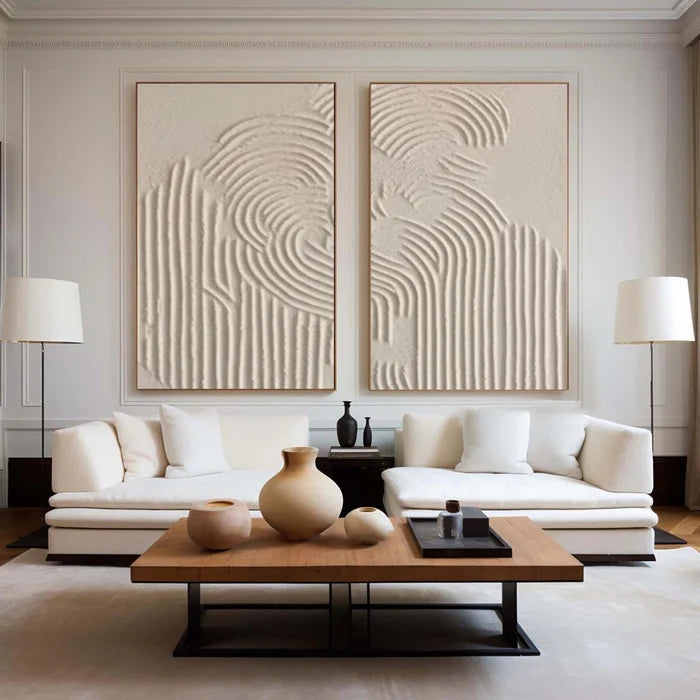
Buying Wabi-Sabi Art: Spotting the Real vs the Imitation
Wabi-sabi became fashionable, and fashion always brings imitations. The market now sells flat prints with a plaster-like texture printed onto paper, factory canvases with fake ridge shadows baked into the image, and real textured pieces made with cheap filler that will crack within two seasons. The buyer's problem is not taste - it is knowing which of these actually qualifies as wabi-sabi art. This guide gives you the inspection routine professionals use: how to test for real relief, real hand-work, real materials, and how to tell whether the maker understands the aesthetic or just copied its surface.
What genuine wabi-sabi art has to be
Genuine wabi-sabi art is built, not rendered. It must have three physical facts you can verify without trusting anyone: surface relief that stands above the canvas, pigment that was applied by hand in uneven, human strokes, and a material structure that will age instead of crack. Those three facts are what a print cannot fake and a cheap factory piece usually skips. Everything else - the price, the brand name, the tagline about imperfection - is marketing on top of those facts.
Keep that standard in mind through the rest of this guide. When a listing talks about imperfection but the product photo shows a perfectly smooth image with shadows drawn into it, the talk and the product disagree. Believe the product.
The flashlight test: real relief vs fake relief
Real texture catches light physically; painted texture only imitates it. Hold a phone flashlight at a shallow angle, parallel to the canvas surface, and look along the plane of the painting. On a genuine raised surface, you will see the light break at the top edge of each ridge and a shadow fall behind it - and critically, the highlight will move as you tilt the light. On a printed imitation, the surface stays flat and the highlight is fixed inside the image, because there is no physical ridge for light to hit.
This test works on listings too. Look at the product photos for the same angle problem: real textured art is usually photographed from a slight side angle so the relief is visible. If every photo is straight-on and perfectly flat, ask yourself why the seller is hiding the one feature that justifies the price.


The edge inspection: canvas, staples, and frame
Look at the edges before the front; the frame side tells the truth about materials. A genuine canvas is stretched over wooden bars, with visible staples or tension at the back, and a label showing the ground (linen or cotton) and the paint type. A cheap imitation is either a print on a pre-stretched blank with no texture, or a flat panel with the image wrapped around the edges - a technique made for prints, not for hand-built surfaces.
Run your finger along the back edges. Real stretched canvas is slightly springy and the bars create a visible lip. Factory flat panels are rigid, smooth, and silent. Neither is wrong on its own, but the rigid panel is a red flag for a product sold as a hand-painted textured original, because hand-built relief needs a real canvas to live on.
The finger test: assessing depth and hardness
Gently press the highest ridge with a clean fingertip. On a professional texture built from acrylic paste or modeling medium, the ridge is firm - it yields almost nothing - and it stays cool to the touch. On cheap filler, the ridge flexes, feels slightly rubbery, or powders under pressure. Do this at the edge of the canvas first, where a small mark matters least, and only on a piece you can touch, such as in a showroom or after delivery.
When you cannot touch, look for close-up photos of the relief's side. A genuine ridge has a ragged, organic silhouette where the palette knife left it; a mold-made factory ridge has a uniform, rounded profile repeated across the surface. Organic irregularity suggests a hand; perfect repetition suggests a machine, and machines do not make wabi-sabi.
Materials that age vs materials that fail
Genuine wabi-sabi art names its materials because quality materials are the point. Professional oil or acrylic color on linen canvas is the industry standard for textured work: linen holds the weight of the paste without sagging, and artist-grade acrylic or oil pigment keeps its color without yellowing or cracking for decades indoors. Cheap filler texture - school glue mixes, craft-store plaster without binder, unknown acrylic blends - dries harder, shrinks, and cracks at the edges of thick ridges within a year or two.
Two questions settle the material check. First, does the listing state the canvas type and paint type? If a piece is genuinely built on linen with professional color, the seller has no reason to hide it. Second, does the seller have a delivery note about how the surface is protected? Real textured pieces ship rolled in a rigid tube or framed in a wooden box, because the relief is fragile; if a "textured original" ships flat in a plastic sleeve like a poster, the texturing is almost certainly printed.
| Signal | Genuine textured art | Imitation |
|---|---|---|
| Relief | Raises above canvas, catches moving light | Flat, highlight is inside the image |
| Edges | Stretched canvas, visible bars and staples | Flat panel or wrapped print edges |
| Ridge surface | Firm, irregular, hand-shaped | Rubbery, uniform, mold-repeated |
| Materials | Linen, professional oil or acrylic stated | Unknown blend, no material name |
| Variation | Each piece visibly unique | Suspiciously identical photos |
| Packaging | Rigid tube or wooden box | Flat sleeve, like a poster |
Read the table as a checklist, not a scorecard. One red flag is a warning; two or three red flags should end the conversation.
The variation test: uniqueness is the point
Wabi-sabi is the aesthetic of the one-of-a-kind, so the strongest single test is uniqueness. Look for two photos of what the listing calls the same piece, or two listings of the same title. Genuine handmade work shows small differences - ridge placement, brush marks, color pooling - because each canvas was painted separately. A factory run shows identical surfaces, identical highlights, identical every time.
Ask the seller directly: is this piece painted to order, or is it one of a series? Honest makers say "made to order, yours will differ slightly" or "one of a limited hand-painted series." Vague answers - "the design is fixed" or "photo is representative" - are the language of printed reproduction. For a philosophy built on imperfection, uniformity is the disqualifier.
Is the style real, not just the texture?
A textured canvas can still fail the wabi-sabi test because the style is wrong. True wabi-sabi reads as quiet, structural and slightly incomplete: restrained natural palettes, asymmetry that feels settled rather than off-balance, and a sense that the artist stopped at the right moment instead of filling every space. Imitation wabi-sabi piles on the signifiers - rough edges, muted colors, pretzel-like ridges everywhere - until the piece feels decorated rather than honest.
Trust one practical signal: the piece that looks less "designed" is usually the more genuine one. Wabi-sabi is achieved by subtraction, and subtracted work is hard to photograph impressively, which is exactly why the genuine pieces look understated in listings while the fakes pop. The pop is the giveaway.
A verification walk-through before you pay
- Hold the listing photos to the flashlight rule: does any image show the surface from a side angle with moving highlights?
- Read the materials line: linen and professional oil or acrylic stated plainly?
- Check the back or edges in a photo: stretched canvas, visible bars?
- Ask about making: hand-painted to order, or one of a series?
- Look at two photos of the same design: visibly different, or identical?
- Confirm the packaging plan: rolled in a rigid tube or framed in a wooden box so the relief survives shipping?
Six questions, under ten minutes, and the answers are all visible before you pay. If a piece passes all six, the wabi-sabi is real: human marks, honest materials, and a surface that light moves across. If it fails even one or two, the philosophy you are paying for is a costume, and the difference will not show until the light hits the wall - by which time it is too late.
After delivery: the fifteen-minute confirmation
Do not end the inspection at the checkout. When the parcel arrives, give the piece the fifteen-minute test before hanging: unroll or unbox it in good light, run the flashlight across the surface, press the highest ridge at the edge, and photograph the back label of canvas and paint type. A genuine textured canvas passes all three in the time it takes to make coffee. If the ridges turn out to be a printed illusion or the surface feels soft, you now have documented evidence from day one for a return - which is the honest buyer's final protection in an age of imitation wabi-sabi.
To explore more options, see wabi-sabi art and our full painting collection.