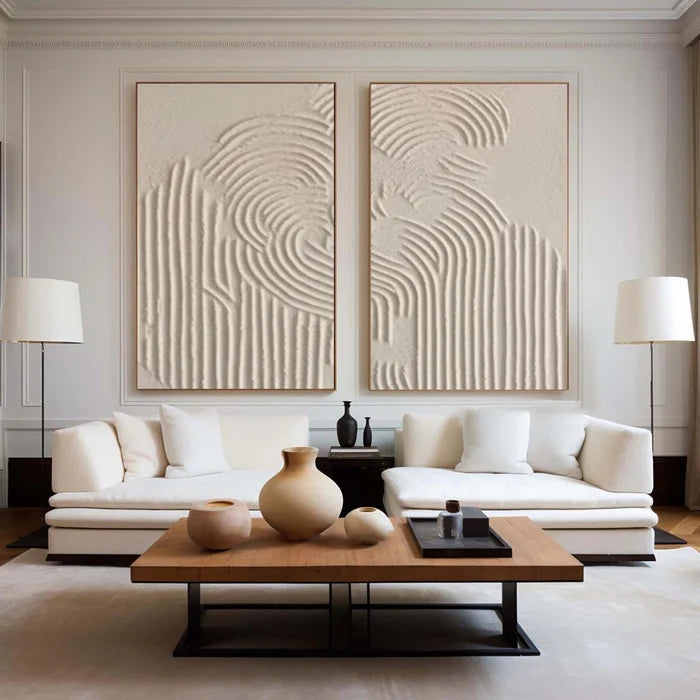
Large Textured Wall Art for Open-Plan Homes: Scale Done Right
Large textured wall art is the open-plan home's natural anchor: one oversized piece can hold a wall that a row of small frames cannot. The scale rule is simple — keep the art at roughly half to two-thirds of the wall width, and match the height to the viewing distance. Get the scale right and the wall feels intentional; get it wrong and the same piece feels like a mistake.
Scale Math for Big Walls
The starting question is the wall's job in the open plan: is it a backdrop for the furniture, a divider between zones, or the room's single focal point? The answer sets the size — a backdrop can take a quieter piece, while a focal wall wants the largest piece the scale math allows.
Scale starts with the wall, not the room. For a large empty wall, keep the piece at roughly half to two-thirds of the wall's width — a six-foot wall takes a three-to-four-foot piece, and an eight-foot wall takes a four-to-five-foot piece. Above furniture, size to the furniture rather than the wall: about two-thirds of the sofa's width, which is the same rule the size guide uses for every wall type.
| Wall situation | Sizing guidance | Note |
|---|---|---|
| Large empty wall | Half to two-thirds of the wall width | The piece carries the wall alone |
| Above a sofa | Two-thirds of the sofa width | The furniture is the anchor |
| Open-plan divider wall | Half to two-thirds, taller for height | Match the ceiling line |
The tape test settles the argument: mark the outline, live with it for a day, and check it from every approach. The oversized textured canvas article shows how large pieces behave in real minimalist spaces.
The viewing distance is the hidden variable: a piece that looks large from a sofa can look small from a kitchen counter in the same open plan. Check the outline from every point the room is seen from, and size for the farthest view — the wall should carry the piece from across the room, not just from the couch.
One Oversized Piece vs. a Composed Group
The honest question before choosing is whether the wall wants a statement or a rhythm: an open plan with one long wall wants the statement, while a wall that connects two zones may want the group's rhythm. The architecture decides, and the art follows it.
The open-plan choice is between one oversized piece and a composed group, and the honest default is one piece. A single large textured painting creates a clear focal point that anchors the whole room; a group of small pieces asks the eye to assemble the composition, which works but demands more discipline.
Choose the group only when the wall is very long and the architecture calls for rhythm rather than a single anchor. The group needs even spacing, a consistent palette, and one reading distance — the same discipline as a single statement, scaled out. The all-painting collection shows the range of sizes available for both approaches.
The group also fails when the pieces are too similar — three near-identical pieces read as a failed single piece, while a group needs variation within one family. The texture family stays consistent; the composition varies, which is what makes the group read as intentional.
Installation and Weight Reality
The plan also includes delivery: a large piece arrives in packaging matched to its finish, and the room should be ready — clear wall space, tools on hand, and a second person scheduled. The installation is a plan, not an improvisation.
Large textured art is heavier than it looks: the plaster or texture paste adds real mass, and a large canvas with deep relief can be awkward to lift and level. Check the listed weight before ordering, plan for two fixing points or rated anchors, and use two people for anything large. For very heavy or deep pieces, a French cleat into studs spreads the load — the hanging article covers the full hardware plan for textured pieces.
The finish also changes the plan: a framed piece arrives with hooks ready, while a rolled canvas needs local framing and a separate hanging plan. Decide the finish before ordering, because the hardware follows it.
The weight also affects the wall: a large textured piece should be planned against the wall type — drywall wants studs or rated anchors, while masonry wants masonry anchors. The hardware should be chosen before the box arrives, because a large piece is awkward to hold while deciding.
Avoiding the 'Empty Wall' Feeling
The scale math and the staging work together: a piece at two-thirds of the wall with a console beneath it reads as composed, while the same piece with nothing below it reads as floating. The staging closes the composition, and the empty-wall feeling is solved by both together.
The most common mistake with large walls is undersizing — a piece that reads as a postage stamp in an open plan. The fix is the scale math above plus one rule: when in doubt, size up. A large textured piece can always be softened by the room around it, while a small one cannot be made to fill a wall.
The second mistake is isolating the piece without context. A large textured painting needs a little staging — a low console, a lamp, or the furniture line beneath it — so the eye has a path from the floor to the wall. The wall feels full because the composition is complete, not because the piece is big.
The staging should not compete: a low console and a lamp support the piece, while a shelf of objects under it divides the composition. The eye should have one clear path from floor to art, and everything else stays beneath that path.
Vinchy Art Studio Recommendation
The studio also confirms the finish with the size: a framed large piece arrives ready to hang, while a rolled one needs local framing planned ahead. The finish decision is part of the scale plan, not a delivery surprise.
In the Vinchy Art studio, large pieces are planned with the wall and the viewing distance first: half to two-thirds of the wall width, sized to the furniture beneath, and checked with the tape test from every approach. The studio recommends one oversized statement as the open-plan default, a group only for very long walls, and the hardware plan settled before ordering. The preview step confirms the surface in motion before a large piece travels, and the size guide covers the proportions in detail.
Conclusion
The final check is the view from the kitchen counter, not just the sofa: an open plan is seen from many points, and the piece should carry the wall from all of them. The tape test from every approach is what makes the scale honest.
Large textured wall art anchors an open-plan home when the scale is done right: half to two-thirds of the wall width, sized to the furniture, and checked with tape. One oversized statement beats a scattered group; the weight and hardware are planned before ordering; and a little staging keeps the wall from feeling empty. Scale is the whole game — get it right, and the piece carries the room.
Big-Wall Checklist
- Piece at half to two-thirds of the wall width
- Sized to the furniture beneath, not the room
- Outline tested with tape from every approach
- Weight checked and hardware planned
- Two people ready for lifting and leveling
- Staging beneath the piece: console, lamp, furniture line
FAQ
What size should a large textured piece be?
Keep it at roughly half to two-thirds of the wall width, and about two-thirds of the furniture width when hanging above a sofa. The size guide covers the proportions, and the tape test confirms them against the room from every approach.
Is one oversized piece better than a group?
For open plans, usually yes — one large textured piece creates a clear focal point, while a group needs even spacing and consistent palette to work.
Is large textured art heavy?
Textured pieces are heavier than flat canvas of the same size because the surface adds mass. Check the listed weight, use two fixing points or anchors, and have two people for lifting — the hardware plan comes before the box arrives.
Can a rolled canvas arrive large?
Yes — rolled canvas ships in a tube and needs local framing and a separate hanging plan. Decide the finish before ordering, because the hardware follows it.
How do I keep a big wall from feeling empty?
Size up when in doubt, and stage the piece with a low console, a lamp, or the furniture line beneath it so the eye has a path from floor to wall — the composition is what makes the wall feel full.
Shop Oversized Textured Art
Browse the 3D textured plaster collection at Vinchy Art for hand-painted, made-to-order pieces in the sizes an open plan needs — with custom dimensions and preview before shipping.