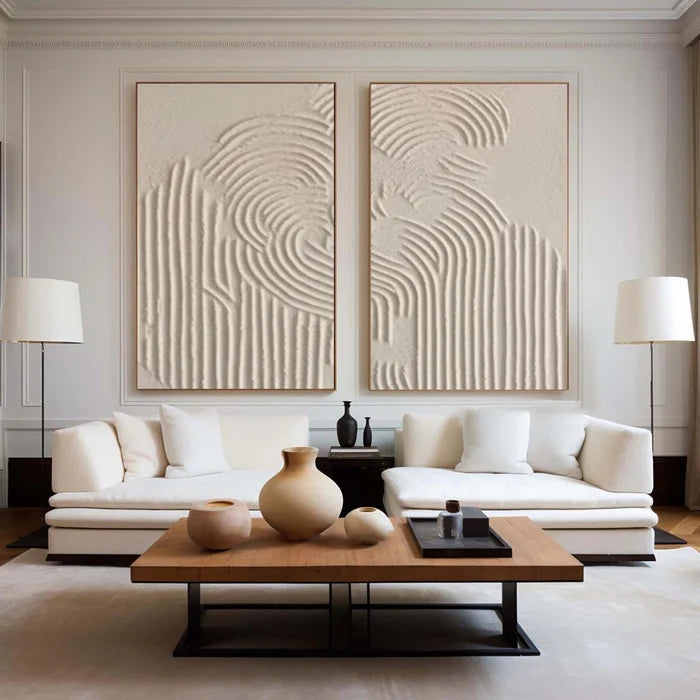
Natural Materials in Wabi-Sabi Interiors: Canvas, Plaster, Wood
Wabi-sabi is often described with words like quiet and imperfect, but the real engine is something simpler: material honesty. The aesthetic works because the things in the room - canvas, plaster, wood, linen - stay what they are, age openly, and invite the hand. When you understand which materials carry wabi-sabi and why, decorating stops being imitation and becomes a series of honest choices. This guide goes through the natural materials that build a wabi-sabi home, how a textured painting fits the material family, and how to verify that what you are buying is the real thing and not a look-alike.
Why material honesty is the foundation
Wabi-sabi rooms succeed when every surface can be read at a glance: this is linen, this is clay, this is wood that will age. The eye registers the material before the color, and the calm comes from that legibility. Materials that pretend - printed wood grain, plastic that mimics stone, canvas printed to look textured - break the reading, and the room quietly feels wrong even when the palette is perfect. This is why the term natural does most of the work in wabi-sabi: not as an ecological slogan, but as a visual and tactile contract with the room.
The practical consequence for shoppers: choose objects whose material is part of the price. A material the seller names is being sold honestly; a material the seller avoids naming is usually the reason the product is cheap.
Linen canvas: the ground of textured art
Linen is the classic painter's ground, chosen for texture and strength. Its weave gives even a flat painting a visible surface, and under acrylic or oil it carries heavy relief without stretching or sagging - the reason professional textured work states its ground. Cotton is cheaper and smoother, but it does not hold dense paste the same way over decades; if the painting argues with the canvas after two years, the ground is usually the weak link.
You can check linen honestly: look at the back of the canvas where the weave shows through. Linen's threads are slightly irregular and visible; cotton is uniform and fine. And because a wabi-sabi canvas is stretched, the weave tension is part of the art - it should feel taut, with a visible lip where the bars sit behind.

Plaster and modeling paste: texture as material
Plaster is the material that turns a flat canvas into a wabi-sabi object. Applied in layers while soft, it can be combed, pressed and shaped into ridges, waves and peaks that hold their form after drying, and it takes pigment in a way that makes the color live inside the surface rather than on top of it. The visible quality is irregularity: hand-applied plaster leaves organic edges, uneven depths and the occasional accidental mark, which is exactly the imperfect honesty the aesthetic wants.
The material check for plaster is simple. Real cured plaster relief is firm and slightly warm-toned; cheap filler stays flexible, feels rubbery, or collects dust in odd patches. Press the edge of the highest ridge - genuine work yields almost nothing, and it does not flake when you run a fingernail gently across. If the surface powders, the binder is weak and the piece will crumble rather than age.
Wood: the silent partner
Wood enters wabi-sabi rooms through furniture, frames and small objects, and its job is to bring the same honesty as canvas and plaster: visible grain, open aging, and a slightly unfinished edge. A raw oak frame around a textured canvas continues the material sentence; a black plastic frame interrupts it. Wood's aging - the darkening of oiled grain, the small marks of use - is meant to be seen, and it is why wabi-sabi rooms avoid glassy, perfect finishes.
Choose wood by its grain visibility, not its polish. A frame with open grain and a matte or oiled finish reads as wabi-sabi; a lacquered high-shine piece reads as something else entirely. And let the wood age: wabi-sabi is the one style where scratches on the frame are not damage - they are the record of the life the room is living.
Linen, wool and clay in textiles
Textiles complete the material family. Linen curtains and upholstery bring the same weave honesty as the canvas ground; wool brings nub and warmth in throws and rugs; clay appears as ceramics that pair naturally with textured art. Keep textiles in the same tone family as the canvas and they will read as one material statement rather than a pile of separate purchases.
The practical rule for pairing: one dominant material per surface. If the wall holds a textured plaster canvas, let the floor hold wood and the textiles hold linen and wool - and do not add a second plaster object in the same sight line. Wabi-sabi layering distributes one material per plane, so each material can be seen for what it is.

How a textured painting fits the natural family
A hand-painted textured canvas is the rare object that is three natural materials at once: the linen ground, the plaster or acrylic paste relief, and the pigment that ages slowly. That triple identity is why it anchors a wabi-sabi room better than any single-material object - it already contains the family, so the rest of the room only needs to echo it. Choose the painting first, name its materials to yourself, and then let the room's wood, linen and clay repeat one of them.
Professional oil or acrylic color matters here because the paint is the aging material: artist-grade pigment holds its tone for decades indoors while cheaper color shifts and dulls, pulling the whole material story off-key. The paint is not decoration on the wabi-sabi object; it is another layer of the same honest material, and it should be named on the listing just like the canvas ground.
One more angle before buying: the room count. Natural materials gather authority when there are two or three of them in a room, and lose it when there are twelve. A wabi-sabi home does not need to be all-natural all the time; it needs the eye to be able to say where the linen is, where the wood is, and where the plaster holds the wall. So buy the canvas, name its two or three material partners, and stop there - the restraint is part of the material honesty.
Verifying natural materials before you buy
- Read the materials line: linen canvas and professional oil or acrylic stated plainly?
- Look at the canvas back in the photos or in person: visible weave, taut bars, honest edges?
- Check the relief profile: organic ridge shapes suggest hand-applied paste; uniform identical ridges suggest molding.
- Press a ridge if you can: firm, non-flaking, cool to the touch.
- Check the frame intent: natural wood or none, matte finish, visible grain.
- Ask how the piece ages in the seller's own words - a maker of natural materials answers with materials, not marketing.
Six checks, and the last one is the fastest filter. When you ask how a piece will age, a genuine natural-material answer discusses linen, oil and light; an imitation answers in vague comfort phrases. The vocabulary of the answer reveals the reality of the object.
Where natural materials should not go
Honesty includes knowing the exceptions. Raw wood and linen do not belong in continuously damp corners; a bathroom wall that steams daily will win against most natural surfaces, so reserve the humid zones for ceramics and glazed objects and keep the canvas for dryer walls. Similarly, a south-facing window at full sun will hurry the aging of any paint, so natural materials need placement with dignity - a few metres from direct noon sun, with side light doing the showing. These are not failures of the material; they are decisions about where the material can keep its promise.
The same logic applies to cleaning. Natural materials are forgiving but not servile: dust linen and plaster ridges with a soft dry brush, never damp-wipe a textured surface, and let wood age without aggressive polish. The buyer who respects the material family gets the twenty-year piece; the buyer who treats everything like painted plastic gets the peeling one.
The two-year test for material honesty
Natural materials do not need to be babied, they need to be allowed to age. One useful way to watch a purchase is over the first couple of years at home: the linen should settle into the wall, and the plaster ridges should stay firm, the oil or acrylic should hold its tone, and the wood should show the small marks of real use without looking worn out. Passing those observations over time is a good sign that the materials are performing well, but it is not a laboratory verdict: natural materials can also age, crack or shift with humidity. Treat it as a signal to watch, not proof of authenticity. Choose objects you would be proud to show the same answer in two years, because the whole philosophy is a promise about time, and the materials are the only part of that promise you can verify in advance.
To explore more options, see wabi-sabi art and beige and brown minimalist art.