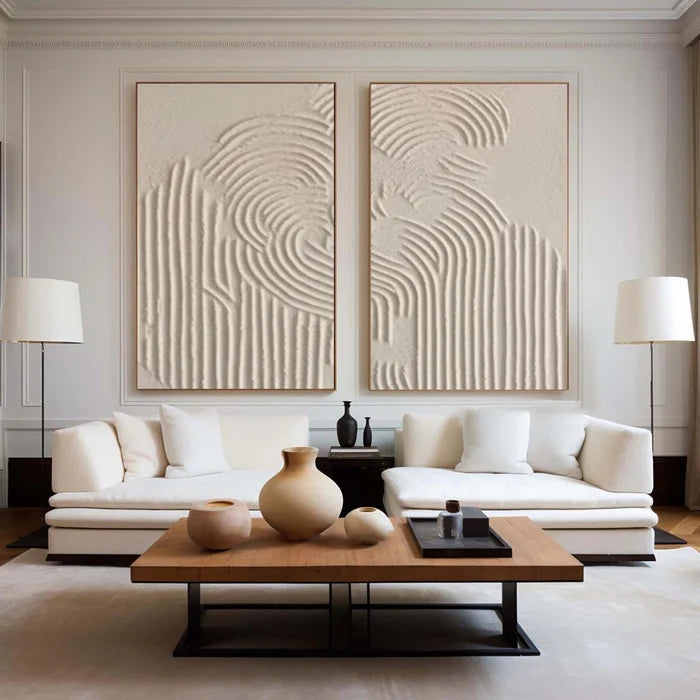
Plants and Textured Art: Building a Calm Corner That Breathes
Plants and textured art share something flat prints and plastic plants do not: they both feel alive. A leaf's organic edge and a canvas's hand-built relief are two kinds of living texture, and a corner that pairs them reads as natural in a way no single element can match. Compose the plant below, the art above, and the light between them, and the corner becomes the room's quietest, most alive spot.
Two Kinds of Living Texture
A plant's texture is organic and irregular: leaves that catch light differently, edges that curve and droop, greens that shift with the day. A textured painting's surface is deliberate and handmade: ridges built by a palette knife, relief that throws its own shadow, a surface that changes as the light moves. Together they create a conversation — the plant's natural imperfection and the art's crafted imperfection, both alive on the same wall.
The pairing works because neither competes with the other: the plant brings green and growth, the art brings depth and stillness, and the corner holds both without crowding. The zen plants article covers the plant side of the calm corner, and the zen-wall-art collection holds the textured pieces that answer it.
The two textures also age together: a plant grows and changes, and a textured piece holds its relief — the corner gains the plant's seasons against the art's constancy.
The contrast is the point: the plant's randomness and the art's intention meet in one corner, and the eye reads both as alive in different ways. A flat print beside a plastic plant has neither quality; a textured piece beside a real plant has both. The pairing is the corner's whole design — two living textures, one calm space.
Composing the Corner
The corner's composition follows one rule: the plant below, the art above, and the eye moving between them. A large plant on the floor with a piece above it anchors the corner from both ends; a plant on a low stand beside a piece creates a smaller pairing; a trailing plant on a shelf under the art fills the space between the wall and the furniture.
The sizes relate like any composition: the art at roughly two-thirds of the plant's visual width, or the plant's volume balancing the piece's wall presence. A tall, narrow plant pairs with a tall piece; a broad, low plant pairs with a wide piece. The green collection shows the tonal family that joins plants naturally, and the rule is one anchor each — one plant, one piece, with the corner's third element staying small.
The corner should also leave the plant room to grow: a piece hung to clear the plant's mature height keeps the composition from colliding as the plant fills out.
The corner's floor also matters: a plant on the floor anchors the corner's base, and a piece above it closes the corner's top, with the wall between them holding the empty space that makes the pairing breathe. A corner composed this way reads as intentional from across the room and close up — the plant gives the eye a place to land low, and the art gives it a place to rest high.
Light Needs: Plants and Art
Light is where plants and art meet, and the plan has to serve both. A plant needs enough light to thrive, and a textured piece needs light to show its relief — the corner should be chosen where the natural light does both. A bright corner with indirect light suits most houseplants and keeps the art's texture visible; a dim corner suits low-light plants and asks the art to carry the corner alone.
The artificial light joins the plan: a lamp that serves the plant during the day can graze the art's texture in the evening, and a small grow light for a dim corner can be aimed to do double duty. The beige-brown collection holds the warm surfaces that read well under both natural and lamp light.
The practical rule is balance: neither the plant's needs nor the art's light should be sacrificed for the other, and a corner with enough light for both is the one worth building.
The light also changes the corner through the day: morning light grazes the art's relief and freshens the plant, noon light flattens both, and evening lamp light picks the art's texture while the plant goes quiet. The corner's character shifts with the hours, and the pairing gives the room two moods — the plant's daytime green and the art's evening depth — from the same small corner.
The light test is the final check: stand at the corner's main viewing point at the hours the room is used, and confirm both the leaf and the relief are visible. A corner that passes the test at noon and at dusk is a corner that works all day, and the pairing earns its place in the room's rhythm.
Choosing Species That Frame, Not Hide
The plant's role in the corner is to frame the art, not to hide it: a plant that grows into the piece's surface competes with it, while one that stays below and beside it completes the composition. Low, broad species — a Monstera or a fiddle-leaf at the floor, a trailing pothos from a shelf — frame the piece without covering it, and the art stays the corner's focal point.
The plant's care needs belong in the choice: a species matched to the corner's light and the owner's routine keeps the corner alive, and the plant's health is part of the corner's calm. The plant care stays generic — light, watering, and room — and the species list stays a suggestion, with the local nursery as the source for what thrives in the room.
The calm corner art works with any of these choices, and the rule is one healthy plant and one textured piece, with the plant growing around the art instead of over it.
The pot and the stand join the composition: a ceramic pot in one of the art's tones connects the plant to the piece, a low stand lifts the leaves into the art's sight line, and the plant's container is the third element that ties the corner together. The styling stays to one pot and one stand, and the corner's restraint keeps the two living textures in conversation.
Vinchy Art Studio Recommendation
In the Vinchy Art studio, a calm corner is two living textures: a healthy plant below and a textured piece above, composed as one anchor each and lit for both. The studio recommends the plant below and the art above, a species that frames rather than hides the piece, and a light plan that serves the leaf and the relief. The zen collection holds the textured pieces for the pairing, and the preview confirms each piece before it ships.
Conclusion
A calm corner with plants and textured art is a composition of two living textures: the plant's organic edge below, the art's hand-built relief above, and the light serving both. Choose a species that frames rather than hides the piece, give the corner enough light for leaf and relief, and let the plant grow around the art instead of over it. The corner that breathes is the one where nature and craft hold the same quiet.
Calm Corner Checklist
- Plant below, art above
- One anchor each: plant and piece
- Art clearing the plant's mature height
- Light serving both leaf and texture
- Species matched to the room's light
- Plant framing the art, not hiding it
FAQ
How do I pair plants with wall art?
Plant below, art above, with the art sized to the plant's visual width and the corner holding one anchor each. The plant frames the piece, and the eye moves between the two living textures.
What plants work best beside textured art?
Species that frame rather than hide: low broad plants like a Monstera or fiddle-leaf on the floor, or a trailing pothos from a shelf. Match the species to the corner's light and the owner's routine, and the local nursery is the source for what thrives.
Do plants and art need the same light?
They need a light plan, not identical light: a bright corner with indirect light serves most houseplants and keeps a textured piece's relief visible, while a lamp can graze the art in the evening and a grow light can serve a dim corner.
What size art should I put above a plant?
Roughly two-thirds of the plant's visual width, or the plant's volume balancing the piece's wall presence. A tall plant pairs with a tall piece, and a broad plant with a wide one.
Will a growing plant hide the art?
It can — so plan for the plant's mature height and keep the piece clear of its growth. A plant that frames the art stays below and beside it; one that grows over it competes with the corner's focal point. Pruning the plant's reach is part of the corner's care, and the composition stays balanced as the plant matures.
Shop Calm Corner Art
Browse the zen-wall-art collection above at Vinchy Art for hand-painted, made-to-order pieces that join a plant's living texture — with custom sizes and preview before shipping.