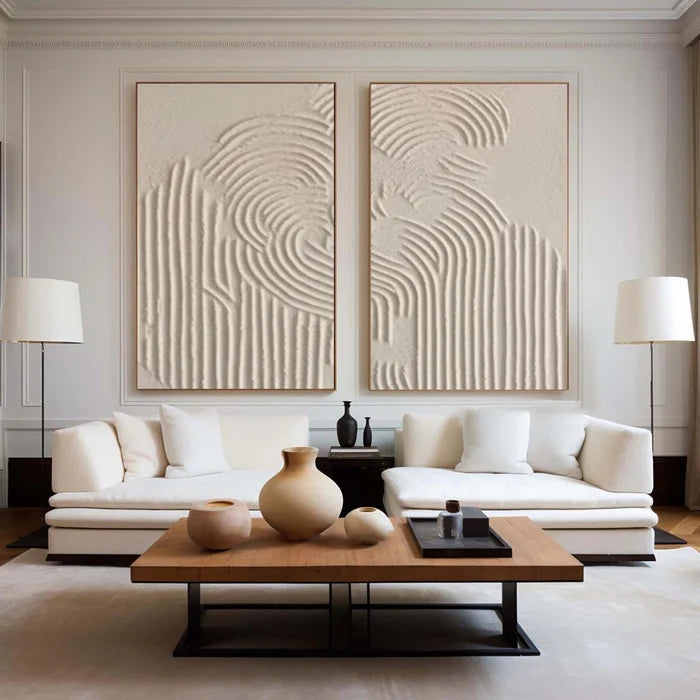
Room Mockup vs Real Artwork Photo: What Should You Trust?
A room mockup is useful for judging style, orientation and approximate scale, but it should not be treated as proof of exact texture, color or finished quality. Real artwork photos and videos are better for evaluating paint, brushwork and surface detail. When buying art online, use room images for visualization and real-product images for verification.
What Is a Room Mockup?
A room mockup shows artwork placed inside an interior so buyers can imagine how it might look above a sofa, bed, console or other furniture.
It may be created using:
- digital compositing;
- 3D rendering;
- photo editing;
- an actual staged room photograph.
Not every lifestyle image is created the same way, so do not automatically assume it shows the exact physical painting hanging in that exact room.
Why Do Art Stores Use Room Mockups?
Because a painting shown against a blank background provides almost no sense of scale.
A room scene makes it easier to imagine:
- horizontal versus vertical orientation;
- approximate visual weight;
- how colors interact with furniture;
- whether the style fits a living room or bedroom.
Room mockups are therefore useful. The problem comes only when buyers ask them to prove things they cannot reliably prove.
What Can a Room Mockup Tell You?
A good room image can help answer:
- Does this style work with modern furniture?
- Does the composition feel calm or dramatic?
- Would a horizontal format look better above a sofa?
- Do the general colors suit a neutral interior?
These are visualization questions.
What Can a Room Mockup Not Reliably Tell You?
A room mockup alone cannot reliably prove:
- exact canvas dimensions;
- actual paint thickness;
- whether the surface is printed or painted;
- exact frame construction;
- true color under your home lighting;
- the quality of the individual piece you will receive.
Those require product specifications and real artwork evidence.
Can a Room Mockup Make Artwork Look Larger Than It Really Is?
Yes, particularly if you estimate size from the image instead of reading the listed dimensions.
Furniture inside digitally created rooms may not represent standard real-world dimensions.
A canvas that appears six feet wide in a mockup could be shown at a different proportion than the size you eventually order.
Always measure your own wall rather than copying visual proportions from a product image.
How Should You Judge Artwork Size Online?
Use actual numbers.
Measure:
- wall width;
- furniture width;
- available height;
- distance from nearby architectural elements.
Then compare those measurements with the exact product dimensions.
Use the wall art size guide rather than judging from staged photographs alone.
What Is a Real Artwork Photo?
A real artwork photo shows the actual physical painting or another physical example of the design.
Useful real-product images include:
- straight-on canvas photos;
- side-angle shots;
- close-ups of brushwork;
- edge details;
- framing photos;
- artist or studio process images.
These images provide information that a digital room scene cannot.
Why Are Close-Up Photos Important?
Texture is difficult to evaluate from across a room.
A close-up can reveal:
- paint ridges;
- palette-knife marks;
- bristle lines;
- canvas weave;
- layering;
- surface variation.
If a seller describes an artwork as heavily textured but shows no meaningful surface details, it is reasonable to ask for more information.
Are Close-Up Photos Enough to Prove Art Is Hand Painted?
Not always.
Some products combine printed imagery with added texture.
That is why you should consider several pieces of evidence together, including:
- surface photographs;
- video;
- materials description;
- production explanation;
- variation between individual pieces.
See How to Tell If a Painting Is Hand Painted or Printed for a more detailed checklist.
Is Video Better Than a Photo?
For certain questions, yes.
Video can be particularly useful for textured painting because movement changes the light across the surface.
As the camera moves, real texture creates shifting highlights and shadows.
Video may also make it easier to understand:
- paint thickness;
- surface gloss;
- frame depth;
- overall physical scale.
Can Real Photos Still Show Color Differently?
Yes.
A genuine photograph of a real painting is still affected by:
- camera exposure;
- white balance;
- studio lighting;
- your screen.
So “real photo” does not mean “perfectly identical color.”
For more detail, read Why Do Art Colors Look Different Online?
What Is a Digital Room Preview?
A digital room preview takes the artwork you are considering and places it over a photograph of your own room.
This can be more useful than a generic lifestyle image because it uses your:
- wall;
- furniture;
- room proportions;
- existing color palette.
However, it is still primarily a visualization tool.
It helps answer “Does this size and style work here?” rather than “What exactly will the real paint surface look like?”
Can You Use a Room Photo to Choose Art?
Yes.
A full-room photograph can be useful for comparing:
- orientation;
- approximate size;
- dominant color relationships;
- visual weight.
VinchyArt currently has a color-palette tool designed to use room colors to help narrow artwork choices, and its custom-art guidance recommends sending room photos when matching a palette.
What Should a Trustworthy Art Product Page Show?
Ideally, several kinds of evidence.
| Image Type | Best Use |
|---|---|
| Room mockup | Style and approximate scale |
| Straight-on real photo | Composition and overall palette |
| Close-up photo | Paint and texture |
| Side-angle photo | Depth and surface relief |
| Video | Texture under changing light |
| Customer room photo | Real-world scale and styling |
The strongest online presentation does not force one image to perform every job.
Are Customer Room Photos More Useful Than Store Mockups?
They can be useful because they show artwork in a real buyer's space.
They may help you understand:
- actual visual scale;
- how the frame looks in an ordinary interior;
- how colors relate to real furniture;
- how the painting photographs outside a studio.
However, customer photos still have their own lighting, cameras and room dimensions, so do not copy their sizing blindly.
Should You Distrust a Store That Uses Mockups?
No.
Room mockups are a normal visualization tool for wall decor.
The issue is not whether a store uses mockups. The issue is whether it also provides enough information to understand the real product.
A useful question is:
“Can I see the actual artwork, surface or finished piece in addition to the room visualization?”
What Are Red Flags When Evaluating Art Images Online?
Look more carefully when:
- every image is a room mockup;
- there are no close-ups despite claims of heavy texture;
- the listed size seems inconsistent with the room proportions;
- the seller gives no clear production information;
- there is no explanation of materials;
- custom artwork ships without any opportunity to review the finished piece.
None of these alone automatically proves a store is unreliable, but together they justify more questions before purchase.
What Should You Trust Most When Buying Art Online?
Trust a combination of evidence rather than one attractive image.
Use:
- product specifications for size;
- real artwork photos for surface details;
- video for texture;
- room mockups for styling;
- customer photos for real-world context;
- clear policies for the buying process.
Each source answers a different question.
How Does VinchyArt Use Artwork Previews?
VinchyArt currently states that made-to-order customers receive photographs or video of the actual completed artwork before shipment.
This is different from a generic room mockup because the approval image is intended to show the physical piece being prepared for the order.
The site also offers room-based tools and recommends room photographs for color and custom-art planning.
If you are researching whether those buying-process signals make the retailer trustworthy overall, see Is VinchyArt Legit?
So, Should You Trust a Room Mockup or Real Artwork Photo?
Trust them for different things.
Use the room mockup to imagine.
Use the real artwork photo to inspect.
Use the specifications to measure.
Use video to evaluate texture.
No single image type replaces the others.
The safest online art purchase happens when the product page gives you enough evidence to answer all four questions before you buy.
Frequently Asked Questions
Are room mockups fake?
Some are digitally created, while others may use real staged photography. A mockup is primarily a visualization tool and should not automatically be interpreted as a photograph of the exact physical item.
Can I judge painting size from a room mockup?
Only approximately. Use the listed dimensions and measurements from your own room for accurate sizing.
How can I tell whether an online painting has real texture?
Look for close-up and angled photographs, video, material information and clear explanations of the production process.
Are customer photos reliable for choosing art?
They are useful for seeing artwork in real interiors, but lighting, room size and camera settings still vary.
Should a made-to-order art seller show the finished piece before shipping?
It is a valuable buying safeguard because it allows the customer to inspect the actual finished artwork before dispatch when the seller provides that service.