


Texture art examples that actually show how different surface styles shape a room
Choosing between texture art examples online can feel strangely abstract. You see raised paint, plaster ridges, or sculpted lines, but it is hard to picture how those surfaces will behave once they are on your wall, under your lighting, next to your furniture. The real difference is not just visual—it is atmospheric. A soft, mineral-like surface can quiet a room, while a heavily layered canvas can energize it. Understanding these texture archetypes is what turns vague inspiration into a confident, design-led decision.
Why texture is not one style but a language of surfaces
Texture in art is often grouped together as a single category, but in practice it behaves more like a spectrum of architectural finishes. The thickness of the medium, the direction of the strokes, and the sharpness or softness of edges all influence how light moves across the surface.
A smooth print reflects light evenly and stays visually “flat.” A textured painting, especially one built with plaster or dense acrylic, creates micro-shadows. These shadows shift throughout the day, which means the artwork subtly changes from morning to evening. This is why two pieces with the same color palette can feel completely different in a room.
For buyers exploring texture art examples, the key is to stop asking “Do I want texture?” and start asking “What kind of surface movement fits my space?”
Wabi Sabi minimal texture and the quiet pull of imperfection
The most understated category within texture art examples is Wabi Sabi-inspired work. These pieces often use muted tones—chalky whites, warm beiges, soft greys—and rely on irregular, organic surfaces rather than bold gestures.
Instead of dramatic peaks, the texture appears as gentle erosion, subtle cracks, or layered washes that feel almost weathered. In a bedroom or calm living space, this creates a grounded, contemplative atmosphere. The artwork does not demand attention; it stabilizes the room.
This approach works particularly well in interiors with natural materials like linen, oak, or stone. It also pairs with low-contrast palettes where the goal is cohesion rather than contrast. If you want to understand how this philosophy translates into real interiors, this deeper look at wabi-sabi-art explains why restraint in texture can feel more intentional than complexity.
Geometric plaster lines and architectural precision
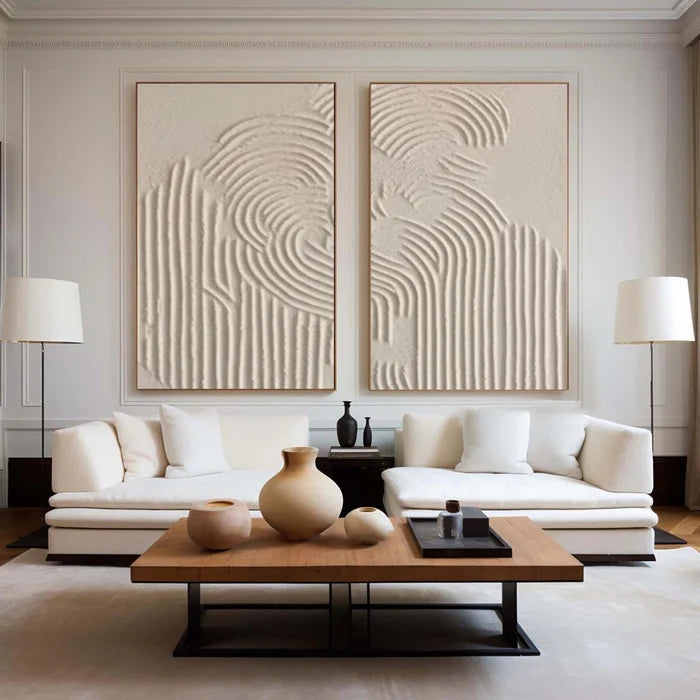
At the opposite end of the spectrum, geometric plaster art introduces structure. These texture art examples are defined by clean ridges, carved pathways, or raised linear patterns that feel almost like relief sculpture.
The texture here is not random. It is directional and controlled. Light hits the edges of each line, creating contrast that emphasizes order and symmetry. In modern interiors—especially those with sharp furniture silhouettes or glass and metal finishes—this kind of artwork reinforces the architecture of the space.
A large vertical panel with linear plaster texture can visually heighten a wall, while a horizontal composition can widen a room. This makes geometric texture particularly useful in entryways, offices, or corporate settings where clarity and structure matter.
Heavy impasto and expressive movement on canvas
Some texture art examples are intentionally bold. Heavy impasto paintings, often created with palette knives or thick acrylic layering, build up dramatic peaks and ridges that you can see from across the room.
These works are less about subtlety and more about movement. The surface catches light aggressively, creating strong highlights and shadows. In a neutral room, this can become the focal point that breaks visual monotony. In a colorful interior, it amplifies energy and rhythm.
However, scale matters here. A small impasto piece can feel chaotic rather than expressive, while a large-format canvas allows the movement to read as intentional. This is why oversized textured paintings are often used above sofas or in open-plan living areas—they need space to “breathe.”
A common mistake is placing a highly textured, high-contrast impasto piece in a tight or already busy room. Instead of adding depth, it creates visual noise and makes the space feel compressed.
Organic plaster textures that sit between art and material
Some of the most versatile texture art examples fall into a middle ground—organic plaster surfaces that feel like part artwork, part wall finish. These pieces often feature sweeping curves, soft elevations, and tonal layering rather than sharp lines or heavy peaks.
They work especially well in warm modern interiors where you want texture without visual aggression. Think of a dining room with curved furniture or a living space with rounded sofas—organic plaster art echoes those shapes and softens the overall composition.
Because these works are often tonal, they rely on subtle shifts in color and shadow. This makes them highly sensitive to lighting. Warm lighting will enhance their depth, while cooler lighting can flatten them slightly.
Choosing the right texture style for your space
To translate texture art examples into a real purchase decision, it helps to compare how each archetype behaves in a room.
Style Archetype | Surface Behavior | Best Room Fit | Emotional Effect
Wabi Sabi minimal | Soft, irregular, low contrast | Bedrooms, calm living rooms | Grounded, quiet, reflective
Geometric plaster lines | Structured, directional, high edge definition | Offices, entryways, modern interiors | Ordered, precise, architectural
Heavy impasto | Thick, high contrast, dynamic | Large living rooms, statement walls | Energetic, expressive, bold
Organic plaster | Smooth elevations, flowing shapes | Dining rooms, warm modern spaces | Balanced, soft, cohesive
This kind of classification helps narrow down what you are actually drawn to—not just visually, but spatially.
Turning inspiration into a real artwork decision
Looking at texture art examples is one thing; translating that into the right size, orientation, or multi-panel format is where many buyers hesitate.
A minimalist Wabi Sabi piece might work best as a single large canvas to preserve its calm presence. In contrast, geometric or linear textures often translate well into a set of two or three panels, where spacing becomes part of the design. Heavy impasto, on the other hand, usually benefits from a single dominant piece rather than fragmentation.
This is where structured guidance matters. Platforms like Vinchy Art position textured paintings not just by style but by format, scale, and room application. For buyers unsure how a piece will look on their own wall, a room preview tool can help simulate proportion, while an art advisory service can align texture style with existing materials like flooring, fabrics, or wall color.
If a specific texture art example sparks an idea but does not quite fit your wall dimensions, it is worth exploring custom sizing or layout adjustments. You can outline your space and preferences through the studio’s contact-us page to refine the concept into something that actually fits your room.
Where texture can go wrong and how to avoid it
Texture is powerful, but it is not universally forgiving. The most common issue is mismatch between surface intensity and room context.
A highly textured piece in a low-light room may lose its depth entirely. A subtle plaster work on a very large wall can feel underwhelming. Similarly, pairing multiple textured pieces in one space can create competition rather than harmony.
Another overlooked factor is distance. Texture reads differently depending on how far you are from it. In a hallway, you experience it up close. In a living room, often from several meters away. This changes how dramatic or subtle the artwork feels.
Understanding these nuances is what separates a decorative choice from a design decision.
Frequently Asked Questions
What are some popular examples of professional textured wall art?
Common high-end texture art examples include Wabi Sabi minimal surfaces, geometric plaster line compositions, heavy impasto abstract paintings, and organic plaster textures. Each uses different materials and techniques to create distinct visual and spatial effects.
How does Wabi Sabi texture art differ from geometric plaster paintings?
Wabi Sabi texture art focuses on irregularity, softness, and natural imperfection, creating a calm and understated look. Geometric plaster paintings use precise lines and structured patterns, resulting in a more architectural and visually defined presence.
What type of textured painting style fits a warm modern interior?
Organic plaster textures and soft Wabi Sabi styles tend to work best in warm modern interiors. They complement curved furniture, neutral palettes, and natural materials without introducing harsh contrast.
Is heavily textured art suitable for small rooms?
It can work, but it requires restraint. In smaller rooms, choose either a lighter color palette or a slightly less aggressive texture. Oversized, high-contrast impasto pieces can overwhelm limited space if not carefully balanced.
Can textured art be customized to fit specific wall sizes?
Yes, many handcrafted painting studios offer size and layout adjustments. This is especially useful when translating inspiration into a real space, ensuring the artwork aligns with your wall dimensions and furniture proportions.