Texture Art Trends 2026: What Is Rising and Why
Texture art has been climbing out of the craft corner and into the center of interior design for years, and 2026 is the year it stops being an emerging trend and becomes a default. The reasons are concrete - screens made flat images cheap, homes want the object back, and materials that show their making fit the same mood that drives linen, plaster and handmade ceramics. This guide separates what is actually rising from what is being recycled, explains the forces behind each move, and shows you how to recognize the difference so a trend decision can be trusted. Every claim here is followed by how to verify it yourself - no trend in this piece asks you to take it on faith.
Why texture keeps rising instead of fading
Trends that survive are answers to real conditions, and texture answers the condition of digital saturation. When every room is photographed flat and every wall is browsable as a two-inch thumbnail, a surface you can feel walking past becomes rare enough to matter. Texture is the anti-thumbnail: it cannot be reduced to a screenshot without losing the point, so it holds value in a way pixel-perfect images stopped holding it years ago.
The second force is the material mood of interiors. The same buyers choosing linen, plaster, oak and handmade ceramics are choosing textured art because it belongs to the same family - surfaces that show how they were made rather than hiding it. A textured canvas is the wall version of a stoneware mug: mass production could imitate the look quickly, and the honest versions of both remain valuable because the making is the point.
The third force is rental and flex living. Textured pieces are portable physical statements that work in any apartment, and their heavy fabric presence replaces the built-in flavor that wallpaper and paneling used to provide. It is easier to move a textured canvas than to re-plaster a rental wall, which makes relief art the default upgrade for the mobile decade.
The trends actually rising in 2026
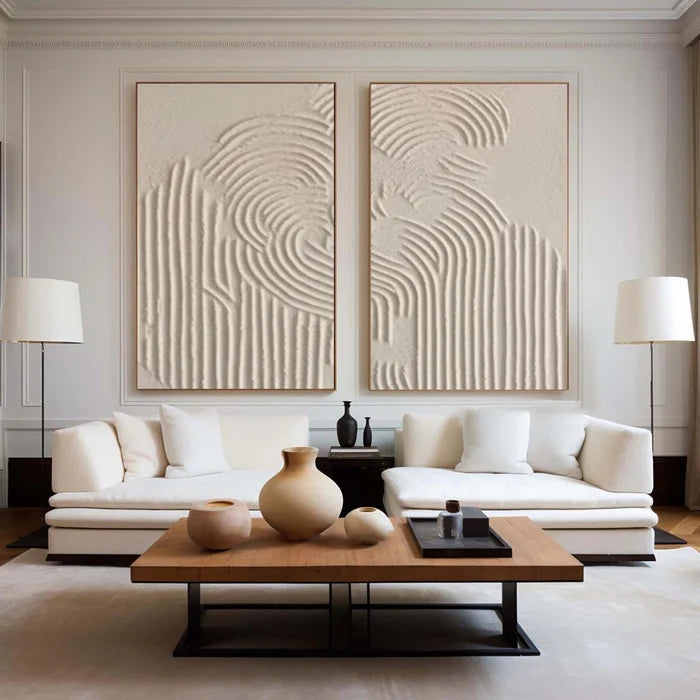
Six currents deserve the label of rising, and each has a reason. First, sculptural minimalism: not ornament, but actively built surfaces - palette-knife ridges, deep paste, visible tool marks - on otherwise restrained canvases. Reason: it delivers drama without color noise, the design mood of the decade. Second, monochrome relief: black, white and stone tones in textured form, up because they pair with everything and age without dating. Third, oversized single statements: one large textured piece replacing gallery grids in smaller homes, because a single confident object reads as more expensive than several careful ones.
Fourth, organic and earth palettes in relief: sand, clay, moss and bark tones, up because they harmonize with natural-material interiors rather than competing with them. Fifth, set-of-two and set-of-three systems: matched texture families sold and hung as a unit, up because they solve the composition step for buyers who prefer not to curate. Sixth, nature-adjacent subjects in texture - peaks, seas, plants - up because relief genuinely improves them: the ridges become the sea, the furrow becomes the mountain.
What is NOT rising is also worth naming: heavily patterned texture-for-texture's-sake surfaces, glossy robotic finishes that show no hand, and tiny flat prints pretending to be art. These are recyclings of old moves, and they fail the verification tests below as quickly as they rise.
How to verify a trend claim
Trend writing is full of confident fiction, so the habit of verification is worth more than any single trend. Four checks cover most claims. One: look at marketplaces - are multiple independent sellers offering the style, or is the claim coming from one shop? A real trend appears across sellers and price points, not in a single storefront. Two: look at lead times - a trend that artists can actually satisfy spreads; if everyone points at the same three examples, it is an experiment, not a movement.
Three: look at rentals, hotels and catalogs - trade buyers adopt trends only when they are already mainstream, so if you see the texture style in hotel lobbies and catalog spreads rather than just on art sites, it has passed the filter. Four: give it a year - the difference between a fad and a trend is repeatability; a style that is still being made, sold and hung twelve months after you first noticed it is a real current. Apply these four checks to any trend you read about, including the six above, and decide with evidence rather than enthusiasm.

Why authentic texture is thriving while prints shrink
Printed texture - smooth canvas with a texture image printed on it - is expanding in cheap marketplaces, and it is the best thing to happen to authentic pieces. It created the demand (textured look, low price) and then disappointed buyers (the texture is flat, the image does not move). Authentic made-to-order pieces hold the arrows of the trend: real relief that catches light, actual hand strokes, direction in the surface. The 2026 buyer is often a person who tried the fake version first.
Verification is a thirty-second walk. Look for angle photography and close-ups of the surface in product images - genuine pieces are usually shown with shadows on the strokes. Look for a material story: real textured art names its ground (linen) and its paint (oil or acrylic), because those are load-bearing, not marketing. And ask the one question fake texture cannot answer: does the piece change when the light changes? A genuine textured canvas does, by definition.
What the trend means for the rooms you live in
The practical translation for a home is a single upgrade: one genuinely textured piece earns more wall than a wall of flats. If the trend has one domestic consequence in 2026, it is the consolidation of wall art into fewer, better, deeper objects. A buyer replaces three smooth prints with one textured statement and the room reads as more finished, because the relief supplies the visual weight the three prints jointly failed to supply.
The second domestic consequence is the return of the side lamp. Textured art needs 30-45 degree side light to show its ridges, which quietly changes room lighting plans. The trend is not just what hangs on the wall; it is how the wall gets lit - one directed picture light, or a lamp angled up, becomes part of the scheme the way a frame used to be.
Choosing the version of the trend that fits you
Scale decides the version. In a small apartment, the rising trend is one oversized textured piece with presence; in a large open room, a set of two or three textured panels or a dramatic single canvas at generous scale reads best. Color decides the version you live with happily: earth and monochrome reliefs are the low-risk adoptions; bold color relief is the confident one.
Then check the practical budget of the trend: real relief art costs more than printed texture, and the price difference buys the surface. Count the years instead: a made-to-order textured piece on linen with professional oil or acrylic is a decade object, while a printed texture panel is a season object. Buying the trend honestly means paying for the layer that justifies the trend - the relief itself.
A verification walk before you adopt
Run this before you adopt any textured trend piece. One: side-light test - the surface must change as you move past; flat texture fails instantly. Two: material test - the ground is linen or similar woven canvas and the paint is professional oil or acrylic, stated on the page rather than hidden. Three: maker test - the piece is made to order or hand finished, not a stock print; ask what the making actually is. Four: room test - the relief needs side light, so confirm a lamp or angled window exists before buying. Five: the year test - if you are still seeing the style in a year, you adopted a trend; if not, you adopted a moment, and the verification habit is what told you apart.
Trends deserve a certain amount of suspicion and a certain amount of speed. Texture art in 2026 is a genuine current because it solves a real condition - a screen-exhausted culture wants physical, hand-made, light-responsive surfaces back on its walls. The six rising currents above all pass that logic, and all of them are verifiable with the checks in this guide. Buy the surface, verify the making, light it honestly, and the trend you adopt will not be the one that fades in a season - it will be the direction the room was already headed.
The material palette that will not date
For every arriving trend, the practical question is which version will still look right after two redesigns. The texture palette least likely to date is the one drawn from materials rather than seasons: sand and stone whites, warm greys, clay, moss and muted browns, with one darker accent of ink or black slate. These tones behave like the plaster, wood and linen they sit beside, so they age the way building materials age - slowly and in your favor. The strong-color reliefs are wonderful short-term investments, but the material palette is the one a buyer can install without fear of the next cycle.
The second durable choice is scale: a textured piece feels more permanent the more it commits to its wall, because its presence depends on the surface rather than the fashion of its size. Choose the material palette, commit to the scale, and the 2026 trend becomes the long-term anchor.
To explore more options, see the textured painting collection and abstract paintings.