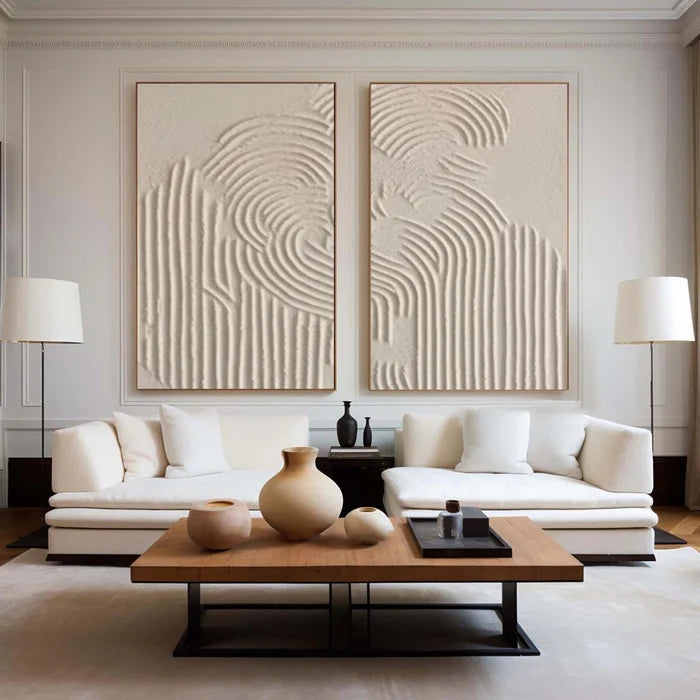
Textured Wall Art Above a Sofa: Sizing Rules That Actually Work
Choosing art for the wall above your sofa is the most common sizing question in home decor — and textured paintings change the answer. A 3D canvas with visible plaster or impasto texture sits differently in a room than a flat print: it has physical depth, catches directional light, and reads heavier to the eye even at the same frame size. This guide gives you the numbers for textured art specifically, so the piece you pick looks intentional rather than undersized or crowded.
The core rule: two-thirds to three-quarters of the sofa width
The classic formula for a single statement piece is that art should span roughly two-thirds to three-quarters of the furniture below it. For a 72-inch (183 cm) sofa, that means a painting about 48–54 inches (122–137 cm) wide. For a 90-inch (229 cm) sofa, aim for 60–67 inches (152–170 cm). This keeps the art visually anchored to the furniture instead of floating over it.
Textured art changes how strictly you should follow the rule rather than the rule itself. Because the surface projects from the canvas, a textured piece can look visually heavier at the same measured width as a flat print. If you are between two sizes, consider ceiling height, wall width and the visual weight of the texture before automatically choosing the larger option.
Height: leave 6–8 inches of clearance, and measure from your sofa
Unlike gallery standards that center work at eye level, art above a sofa is read as part of the furniture. The reliable rule is to leave a gap of 6–8 inches (15–20 cm) between the top of the backrest and the bottom of the frame. Rather than relying on a standard sofa height, measure 6–8 inches above the actual top of your own sofa back — that keeps the ratio correct regardless of whether you have a low-profile bench seat or a tall cushioned back.
This clearance matters more with thicker textured canvases. A painting built up with plaster or modeling paste can be noticeably thicker at the frame than a flat canvas, so the bottom edge physically protrudes toward the seating area. Keeping the clearance closer to 8 inches for heavily textured pieces gives the thickness room to sit comfortably above the backrest.
Real size examples from hand-painted textured pieces
To make this concrete, the canvas sizes below are typical of hand-painted textured paintings sold online. Using the two-thirds rule:
| Canvas size | Inches | Fits an area above a sofa roughly | Best for |
|---|---|---|---|
| 61 × 51 cm | 24 × 20 in | Sofa 36–40 in (91–102 cm) wide or a loveseat | Compact seating, single armchair corners |
| 71 × 53 cm | 28 × 21 in | Sofa 42–48 in (107–122 cm) wide | Small two-seater, entryway bench |
| 91 × 61 cm and up | 36 × 24 in and up | Sofa 54+ in (137+ cm) wide | Standard three-seater sofas |
The table shows why measuring your sofa before shopping matters: a 61 × 51 cm piece above a 90-inch sofa will read as a small accent, while the same piece above a loveseat can hold the wall on its own. Product pages usually list the exact painted area in centimeters — check that number, not the marketing name.

When to break the two-thirds rule
The rule is a starting point, not a law. Three situations where deviating works:
- Intentional minimalism: a single smaller textured piece with generous wall around it can be the whole statement — space becomes the design.
- Grouped layouts: two or three smaller pieces arranged as a set should together span the two-thirds width; measure the full arrangement, not one panel.
- Architectural constraints: a narrow wall next to a doorway, window mullion, or railing may force a smaller piece than the sofa rule asks for — let the wall and surrounding architecture win.
Whichever direction you break the rule, keep the 6–8 inch clearance above the backrest. That gap is what lets the sofa and the painting read as one composition instead of two competing elements.
Checking your choice before you order
Before buying, mark the proposed size on the wall with painter's tape. Sit on the sofa and look at the marked rectangle — not standing up, where the viewpoint is too high. If the rectangle feels balanced with the sofa and leaves the clearance above the backrest, the size is right. For textured art, also check the depth at the sides: some frames are deeper than the canvas thickness, which changes the projection from the wall.
When you are between the two sizes closest to the rule, the visible depth of the texture is worth weighing alongside the numbers — the surface depth adds presence that a flat print of the same width would not.
To explore more options, see art for above the sofa and living room wall art.