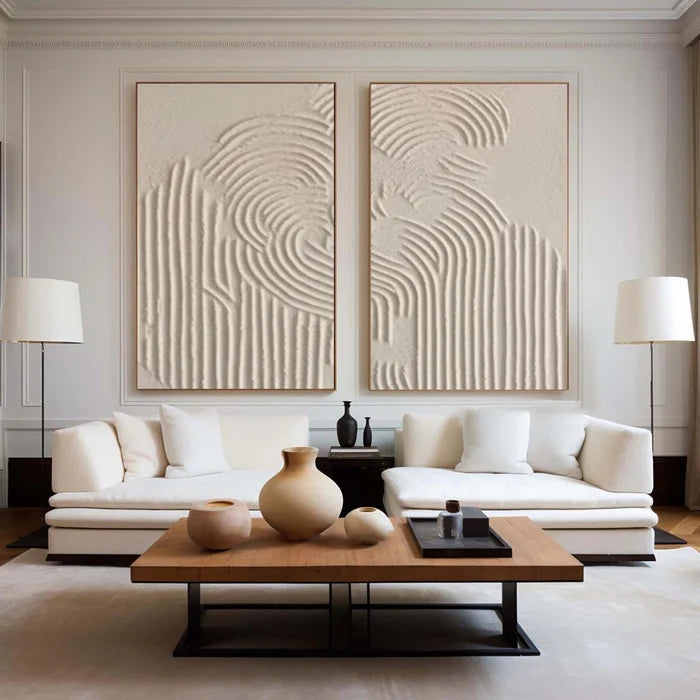
Textured Wall Art: Plaster, 3D, and Relief Paintings Explained
Textured wall art does something flat canvas cannot: it changes as the light moves. A raised ridge catches a shadow in the morning and glows in the afternoon, which is why relief paintings have become the defining wall look of warm minimalism and quiet luxury. This guide explains what textured wall art actually is, how it is made, what quality looks like, and how to choose the right piece for your room without confusing it with printed texture or a 3D-printed panel.
What textured wall art includes
Textured wall art is any painting or artwork with physical depth you can see and feel — not a simulation of depth. The category includes plaster art, 3D relief paintings, impasto acrylic work, and mixed-media pieces built with modeling paste, sand, or other textural materials. What unites them is that the surface is built up, so it interacts with real light and shadow.
That distinction matters because "textured" is one of the most overused words in wall-decor listings. A printed canvas with a glossy coating is not textured; it is flat with a sheen. When you shop, look for proof of relief: side-view photos, close-ups at an angle, or videos that show light moving across the surface.
The making of plaster and 3D relief paintings
Understanding the making process helps you judge both price and quality. Plaster art in particular follows a careful sequence, because the material needs time to set and build.
- Base build-up. Layers of plaster or modeling paste are applied to the canvas with palette knives, creating the first mass of the relief.
- Sculpting. While the material is workable, the artist shapes peaks, ridges, and planes; this is where the composition is decided.
- Drying. Thick relief dries slowly — large pieces need real time between layers, which is why true plaster art is not produced fast.
- Color and finish. Color is worked in as washes, tints, or solid tones, then a protective finish seals the surface.
Different styles emphasize different parts of this process. A white plaster piece is mostly about sculptural form; a colored 3D piece adds a painterly layer on top of the relief. In our studio, this is a made-to-order process: each piece is built by hand and previewed, with photos and video sent before shipping, so what arrives is the specific surface you approved.

Plaster art vs 3D textured art vs 2D canvas
| Feature | Plaster / relief art | 3D textured painting | Flat canvas painting |
|---|---|---|---|
| Depth | High relief, sculptural | Medium relief built with paste/acrylic | Flat or slight impasto only |
| Light behavior | Strong shadow play | Moderate shadow play | Minimal |
| Weight | Heavier, needs solid hanging | Moderate | Light |
| Care | Dust gently; avoid wet wiping | Dust gently | Easy wipe |
| Best for | Feature walls, focal statements | Modern and minimalist rooms | Most rooms, easy rotation |
None of these is better in absolute terms. The choice is about what the wall needs: if you want a quiet textural presence, a white plaster piece adds depth without adding color; if you want energy, a bold 3D colored piece does more work.
Why relief changes how a room feels
Flat art is a surface; relief art is a small landscape. When light hits a raised area, it creates a shadow that changes through the day and with your lamps — the piece effectively becomes a second lighting element in the room. That is why textured pieces are so effective in hallways, entryways, and above consoles, where directional light is common, and why they bring warmth to otherwise flat modern interiors.
There is a practical limit too. Because relief catches attention, it works best when the rest of the wall stays quiet. One strong textured piece usually reads better than three competing ones, and a large relief wall needs enough viewing distance to be seen as a whole.

White, black, and colored texture: choosing your palette
The color of the relief changes the piece as much as its depth. White textured art is the current favorite for quiet luxury — you can browse our white textured collection to see the range: it adds sculptural interest while staying neutral, and it works in small or low-light rooms because it reflects light rather than absorbing it. Black textured art makes the shadows part of the composition — see the black textured collection for examples — the relief reads dramatically, but the piece needs a bright or well-lit wall to avoid disappearing. Between the two, warm neutrals (beige, greige, clay) bring texture into earthy, japandi, and modern-farmhouse schemes.
A useful rule: choose the palette that matches the room's floors and furniture before you fall for the texture itself. Texture adds to a scheme; color defines it.
Quality markers in a textured painting
Quality in relief art is visible in the surface, not in the photo filter. Look for these markers:
- Intentional composition. Peaks and ridges follow a design idea; random lumps read as accidents.
- Clean transitions. Where material meets flat canvas, the edge is deliberate, not sloppy.
- Consistent finish. Color is even or intentionally varied; no bare, unstabilized plaster that crumbles.
- Depth that reads from a distance. Strong relief still holds its form at 2–3 meters, not only up close.
- Proper construction. Canvas is stretched on a frame and stays rigid; the piece hangs flat, not bowed.
Side-view photos are the best evidence of all of these. If a listing only shows head-on shots, ask for an angle.
Best rooms and placements for textured art
Because relief depends on light, placement matters more for textured art than for flat paintings.
- Entryway or hallway: directional light catches the peaks as you walk past; a vertical piece suits narrow walls.
- Above a console or sideboard: the raised surface sits at eye level and near light sources.
- Living room focal wall: one large piece anchors the room; keep surrounding walls uncluttered.
- Bedroom: soft neutral texture adds warmth without visual noise.
- Office: a small textured piece adds warmth and acoustic softness in a busy room.
Two rooms to use with care: kitchens (grease can settle in the crevices) and damp bathrooms (humidity can destabilize plaster). A bathroom-safe alternative is a smooth framed print instead of a relief piece.
Care and longevity of textured art
Relief surfaces need different care than flat canvas — mainly because wet wiping can dissolve or dull the texture. Dust with a soft, dry brush, a microfibre duster, or a can of compressed air held at a distance; for deeper crevices, a soft paintbrush is gentler than cloth. Avoid cleaning products, water, and heavy pressure. Handle by the edges when moving, and keep the piece out of direct, constant sunlight to protect both pigment and plaster. With this care, quality textured art lasts for decades — repairs, if ever needed, are easier on a real painted surface than on a printed laminate.
How to buy textured wall art online without being misled
The online market for "textured" art mixes genuine relief work with printed simulation, so the buying checklist is short but strict:
- Confirm the medium: plaster, modeling paste, or heavy acrylic = real relief; "textured-looking" = warning.
- Look for side-angle or video evidence of depth.
- Check depth/thickness dimensions — real relief is usually several centimeters thick, not 1–2 cm.
- Confirm hanging hardware — heavier pieces need stronger fixings; our pieces include hooks.
- Prefer a preview process so you approve the actual finished surface before shipping.
At VinchyArt, textured and plaster pieces are made to order in the studio, previewed before shipping, and the collection lets you filter by white, black, and neutral palettes so you start from the right color story. The plaster tutorial in our knowledge hub explains the DIY process if you want to compare hand-made studio work with making it yourself.
FAQ
Is textured wall art in style?
Yes — textured and plaster wall art has been a leading decor look since the early 2020s and stays current in 2026, especially in warm minimalism, quiet luxury, and japandi interiors, because relief adds light and shadow that flat canvas cannot.
How do you make textured wall art?
Artists build relief by applying plaster, modeling paste, or heavy acrylic in layers with palette knives and brushes, then add color and finish once the surface is dry. The beginner-friendly DIY version is laid out in our plaster art tutorial.
Where should textured wall art be placed?
Place it where side or raking light catches the relief — above a console, along a hallway, or across from a window. Avoid very busy walls; one relief piece usually reads best.
Find the right texture for your wall. Browse the white textured collection, the black textured collection, or the plaster art collection, and check the size guide to match your space.