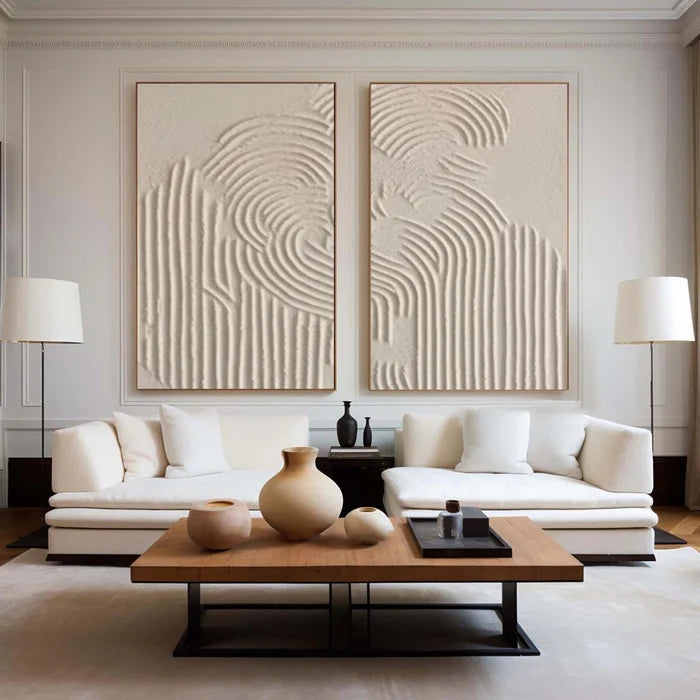
How to Hang Art: Height, Hardware, and Level Lines
The difference between a room that looks curated and one that looks accidental is rarely the art itself — it is where the center of each piece lands. Hang a canvas 10 cm too high and the whole wall feels wrong without anyone knowing why. This guide covers the two rules that solve most hanging problems (the 57-inch eye-level rule and the two-thirds width rule), then walks through hardware, heavy pieces, layouts, and rental-friendly options, step by step.
The 57-inch rule: where the center should land
The most reliable default for hanging art is to place the center of the artwork at 57 inches (about 145 cm) from the floor. That number is the average adult eye level in many design guides — a comfortable viewing height whether you are standing in a hallway or sitting across a room. It is a starting point, not a law: above a sofa or a bed, the piece is usually positioned relative to the furniture instead, roughly 15–20 cm above the top of the backrest or headboard.
To use the rule: measure 57 inches up the wall, mark it, then position your artwork so that mark sits at the piece's vertical center. For a set of two or three, the same rule applies to the group as a whole — our sets of three are designed to be hung as one composition — treat the full arrangement as one shape and center that.
The two-thirds rule: sizing art over furniture
When art hangs above a sofa, console, or bed, the standard proportion is that the artwork (or the full arrangement) should span about two-thirds of the furniture's width. A 200 cm sofa calls for roughly 130–150 cm of art width. This creates visual balance: the art feels connected to the furniture below without being dwarfed by it.
If you already own a piece that does not meet the rule exactly, you can still fix the composition — center it over the furniture, and let the rule guide how much wall you give it on each side rather than resizing the art. For a gallery wall, apply the two-thirds rule to the whole cluster's width.
Tools and hardware: what you actually need
Before you lift a hammer, gather the right fixings for the piece's weight. The most common failure when hanging art is using a nail rated for a photo to hold a canvas that weighs several kilograms.
| Artwork weight | Recommended hardware | Note |
|---|---|---|
| Under 5 kg (11 lb) | Picture hook or 5–6 kg rated drywall anchor | Two hooks for wide pieces |
| 5–10 kg (11–22 lb) | Heavy-duty picture hooks or toggle/grip anchors into drywall | Locate a stud whenever possible |
| Over 10 kg (22 lb) | Mount into a wall stud, or use two stud anchors | Plaster-backed and textured canvases fall here |
For a wall made of drywall, a stud finder is the first tool you should reach for: securing the hanger into a wooden or metal stud is the most secure option for anything heavy. For plaster walls, use fixings designed for plaster (sometimes called plasterboard or cavity anchors) and avoid pressing hard enough to crack the surface.
Heavy canvases and textured art: special care
Large and textured pieces are the ones that need real hardware, because their weight is easy to underestimate — a 120 cm plaster piece can be considerably heavier than it looks. Two extra steps protect both the wall and the artwork. First, check whether the canvas has wire or a fixed hanging bar; a bar distributes weight better than a single D-ring. Second, use two wall fixings for any piece wider than about 80 cm, so it cannot pivot or slip to one side. After hanging, give the piece a gentle tug and confirm it does not shift before you leave it.
If you are unsure of the weight, weigh it on a bathroom scale before choosing hardware. This is especially worth doing for gallery-wrapped canvases with thick stretcher bars, which are heavier than a framed print of the same size.

Mark, level, and hang: a repeatable sequence
Follow the same sequence every time and hanging stops being fiddly:
- Mark the center. Find the horizontal center of your wall (or the furniture below) and mark it with a pencil dot.
- Set the height. Measure 57 inches (or your chosen layout height) and mark the target center of the artwork.
- Transfer to the hanger. Measure from the top of the artwork down to its hanging point (wire apex, D-ring, or bar), and mark that distance down from the target center to find where the hook goes.
- Install the hardware. Drill or set the anchor, then the hook, at that mark.
- Hang and level. Place the piece, stand back, and use a small spirit level on the top edge to confirm it is straight; adjust the wire or reposition slightly if needed.
- Verify from seating. Sit where you normally sit and check the piece reads naturally at eye level.
For multi-art layouts, do all the measuring and marking with paper templates taped to the wall before you install any hardware — it is far easier to move paper than to re-drill.

Gallery-wall layouts: spacing that looks intentional
A gallery wall is a grid or a collection hung as one unit. The details that make it work are the gaps and the shared line. Keep the gap between frames consistent — 6 to 8 cm (2.5 to 3 inches) is a comfortable default for most rooms — and anchor the group to one shared horizontal line or to the center of the arrangement. Lay everything out on the floor first, photograph it, and only then transfer to the wall. If the pieces are different sizes, balance the visual weight: a large piece offset by two smaller ones, not all the small ones clustered on one side.
In narrow hallways, use a single low or vertical piece rather than a wide grid; in staircases, follow the angle of the steps with framed pieces centered on each step line.
Rental-friendly hanging: minimal damage options
Not everyone can (or wants to) drill permanent holes. A few approaches keep art up without a landlord dispute:
- Adhesive picture-hanging strips rated for the weight of your piece — good for lightweight canvases.
- Command-style hooks for small works on smooth painted walls; always follow the weight rating and removal instructions.
- Leaning art on a shelf, console, or the floor for a casual, changeable look with zero damage.
- Picture rail systems (where the room has one) that avoid wall fixings entirely.
For heavier originals in a rental, your safest options are repairing any holes before you leave, or negotiating hanging as part of the tenancy — textured and canvas originals deserve proper hardware, and a filled pin-hole is far easier to fix than a crashed painting.
FAQ
What is the 57 rule for hanging pictures?
The 57-inch rule places the center of the artwork at roughly 57 inches (145 cm) from the floor — the average eye level for most adults. Use it as a starting point and adjust for furniture and room proportions.
What is the 2/3 rule for wall art?
The 2/3 rule says the artwork width should be about two-thirds of the width of the furniture beneath it (such as a sofa) for balanced proportion.
What is the correct way to hang artwork?
Choose hardware rated for the piece's weight, find the wall stud or use the right anchor, mark center and top points, level the hanger, and verify the hanging wire or hook position so the art sits straight.
Hang it once, hang it right. Check the size guide to pick the right dimension, see how different widths work above furniture, and browse the collection for your next piece.