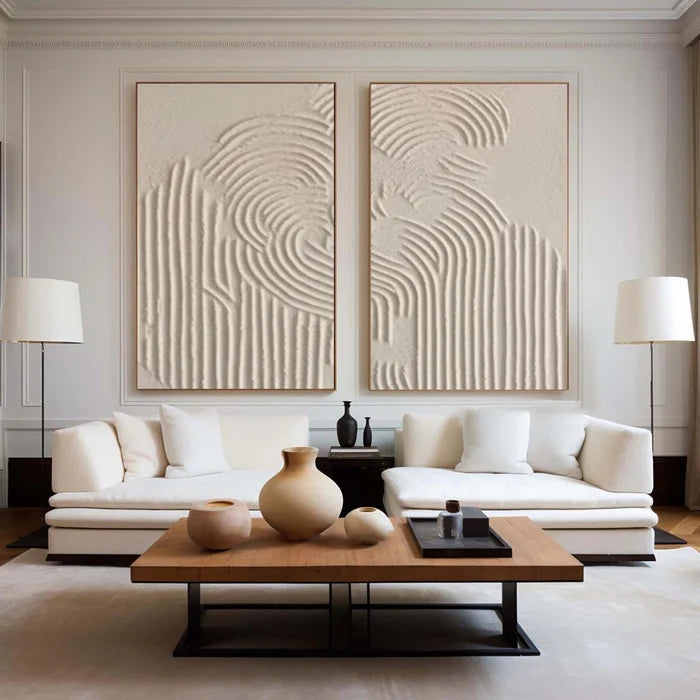
Three-Dimensional Art in Interior Design: Beyond the Flat Wall
Interiors have spent a century flattening walls: flat paint, flat panels, flat prints. The result is a room that photographs well and holds the eye for seconds. Three-dimensional art - textured canvases, raised plaster, sculptural relief - is the correction movement: it gives a wall depth of its own, and depth is the scarce resource in modern rooms. This guide covers what 3D art physically does to a space, how it changes room perception, where it earns its place room by room, and how to select and verify real depth so the wall gets the presence you are paying for.
What 3D art gives a room that flat art cannot
Flat art decorates a surface; 3D art becomes part of the room's architecture. A raised canvas casts its own shadows, changes through the day, and gives the eye an object to circle rather than an image to read. Three measurable consequences follow. First, it adds perceived dimension - the room feels deeper because the wall itself has relief. Second, it adds a light event - the surface responds to sun and lamp, creating a moving focal point that still images cannot match. Third, it adds a tactile invitation - people reach for texture, and that small interaction makes a space feel lived-in rather than staged.
Those three effects are why 3D art appears so often in minimalist rooms: when color is removed, the only remaining interest is surface, and raised surface carries the whole design.

How depth changes the perception of a room
Depth is a spatial tool. A textured canvas with strong relief creates a layering effect - the eye reads the wall, then the peak of the relief, then the shadow behind it, and the room gains a foreground it did not have before. In narrow rooms, that layering gives the wall a purpose beyond enclosure; in large rooms, it breaks the flatness that makes bigger spaces feel emptier. The mechanism is the same as interior architecture: any third layer between eye and wall adds perceived space, whether it is a bookshelf or a raised canvas - except the canvas adds it without taking any floor area.
That is the designer's argument for 3D art in one sentence: it is spatial furniture that lives entirely on the wall, adding depth where floor-mounted pieces cannot go.
The hierarchy: relief, scale and placement
Real 3D art needs three decisions set in order. Relief first - how far the surface rises; deeper relief reads as a stronger spatial event and needs stronger light. Scale second - the raised surface must claim enough wall that the relief reads as an object, not a sample; a too-small textured piece in a large room reads as a texture swatch rather than depth. Placement third - the depth only performs where light crosses it at an angle. Set the relief, then size the scale, then find the wall the light already loves, and the piece will read as architecture instead of decoration.
When these three are aligned, a single 3D canvas can do the work of a full gallery wall: one object, one light event, one tactile invitation, replacing ten flat frames.
3D art by room: where depth earns its keep
| Room | What 3D art contributes | Best depth |
|---|---|---|
| Living room | Evening focal point under a picture light | Medium to heavy |
| Entry / hallway | Passing-motion highlight; welcome object | Medium to heavy |
| Bedroom | Soft morning rake; calm depth | Light to medium |
| Office | Focused surface without glare | Light to medium |
| Dining | Seated-view drama at dinner lighting | Medium |
The pattern: rooms seen at rest reward medium depth and a picture light; rooms passed quickly reward heavy depth; rooms lit softly reward gentle relief. Let the table be the first filter, then refine by the room's actual windows and lamps.
Pairing 3D art with furniture without competing
Depth attracts the eye, so pair it with restraint. The reliable composition is one 3D piece as the wall's only object, balanced by furniture that is lower and calmer - a low console, a simple bench - so the room gains one clear vertical event. If the furniture already has strong texture - a woven chair, a sculptural lamp - let the wall stay quiet and let the 3D art be the single speech. Two raised textures in one sight line start arguing; one raised texture with flat, quiet companions reads as designed.
The same rule governs companions on the wall itself. A raised canvas next to busy flat art rarely works; next to an empty wall it sings. When adding a second wall piece, keep it flat, small and boring, so the 3D object keeps sole custody of the depth.

Lighting 3D art as architecture, not as a picture
Treat 3D art the way you would treat a sculptural feature, because that is what it is. A picture light mounted directly above and angled down at about 45 degrees makes the crests glow and the texture throw readable shadow; a ceiling spot aimed straight at the surface flattens the relief and wastes the depth. When possible, place the canvas on a wall where daylight already rakes it, and save the picture light for the hours the room is actually used - the evening, when a 3D canvas becomes the slowest-moving show in the house.
The 45-degree habit applies to lamps too: a floor lamp beside the piece, aimed across the surface from one side, gives the same sculpture effect at table height. Depth is a lighting decision as much as a purchase, and the relighting costs nothing compared with the canvas.
Scale rules for 3D pieces in different rooms
Scale decides whether depth registers. As a working rule, claim about half to two-thirds of the clear wall width with the piece - a larger midpoint than flat art usually needs, because the raised surface must read as an object before its color can matter. In a hallway, one strong vertical piece of about 60 to 90 cm claims the corridor; in a living room, the 91 x 61 cm range and upward gives the wall presence; in a bedroom, a calm 60 x 50 cm at the headboard line keeps the depth gentle. Tape the footprint to the wall first, stand at the room's main viewing point, and let the rectangle decide.
The margin rule protects the effect: keep at least a hand's width of clear wallon every side of the piece. 3D art needs emptiness around it the way sculpture needs a pedestal, and a crowded wall quietly cancels the depth of the one raised object within it.
Verifying real depth before you install
- Look for a side or angled photo in the listing; relief must show as raised crests, not drawn shadow.
- Read the materials: linen canvas and professional oil or acrylic indicate a built object, not a print.
- After arrival, run a flashlight low across the surface; moving highlights confirm physical depth.
- Press the edge of the highest ridge; firm, non-flaking paste confirms a quality binder.
- Stand across the room; if the wall reads as an object rather than a picture, the scale and depth are right.
Five checks take ten minutes and require nothing beyond a lamp and a fingertip. They matter because 3D is the one wall-art category where the value is a physical fact, not a taste.
Maintaining depth: the small habits that keep relief honest.
A 3D canvas earns its place by keeping its relief readable for years, and the maintenance is shorter than it sounds. Dust the ridges with a soft dry brush every couple of months, working top to bottom in the direction of the relief, and never wipe a textured surface with a damp cloth - water can settle in the valleys and disturb the binder over time. Keep the piece out of direct continuous sun, which fades any paint and hastens color shifts across the crests, and out of rooms where cooking steam or smoke settles on surfaces. Genuine relief is robust to normal life; it only asks not to be treated like a flat print or a kitchen shelf.
The reward is that the depth does not dull. A well-cared textured canvas keeps its shadow play, its moving highlights and its tactile invitation for decades, which is longer than most interiors keep their wall coverings - and that permanence is part of why depth, once installed, stops being a decoration and becomes part of the room's language.
When flat is still the right answer
For honesty's sake: 3D art is not always the answer. Flat art outperforms in three situations - tight color matching, where relief's tonal shifts are unwanted; quiet offices where even subtle texture reads as distraction beyond the working line of sight; and very small or very cluttered rooms, where the eye already has enough objects and a clean flat surface gives it rest. The best interiors mix the two: one 3D anchor per room, flat pieces elsewhere, and the contrast between them makes both better.
The final principle: 3D art is a spatial claim. It says this wall is not a backdrop; it is a place. Used once per room, scaled boldly, lit at 45 degrees and left alone with quiet furniture, a raised canvas changes how the whole space feels - not because it is trendy, but because depth is the one thing flat rooms are always missing, and the wall is the last place people expect to find it.
To explore more options, see the textured painting collection and white 3d textured art.