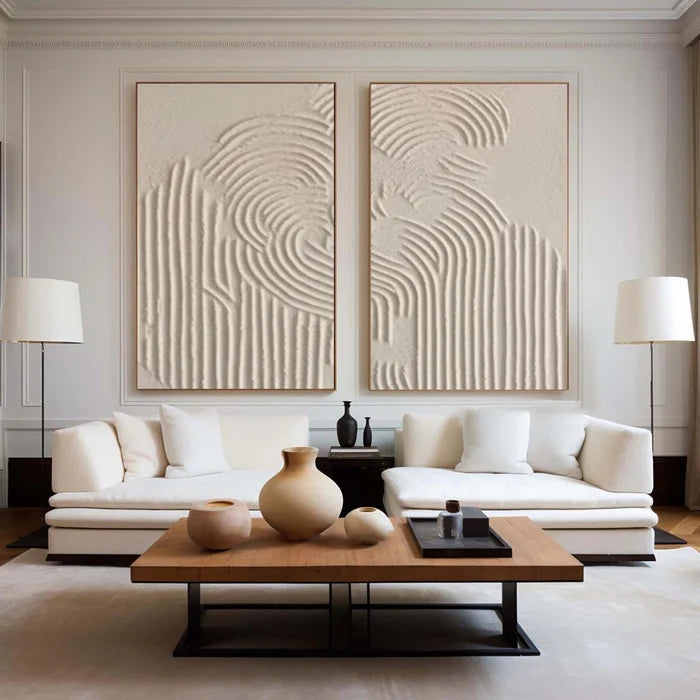
Vertical Wall Art: Where It Works and Why
Vertical wall art works wherever the eye needs to travel up: narrow walls, doorways, stairwells, and tall ceilings. The vertical line adds height, fills a slim space, and changes how a room reads — a tall piece makes a low ceiling feel higher and a narrow wall feel intentional. The principle is simple: vertical art works best where the space is taller than it is wide.
How Vertical Lines Change a Room
The vertical effect also depends on the room's light: a tall piece beside a window borrows the daylight and reads brighter, while one in a shaded corner needs a directed lamp. The light is part of the vertical format, and the placement should give the piece the light it needs to hold the wall.
The vertical effect also works in furniture terms: a tall piece beside a door or window frames the opening, and a vertical composition above a compact console repeats the furniture's slim line. The format ties the art to the architecture, which is why vertical pieces feel intentional rather than accidental in narrow spaces.
Vertical lines carry the eye upward, which changes the room's perceived proportions. A tall piece on a narrow wall draws the gaze from floor to ceiling and makes the wall feel taller; a vertical composition beside a door fills the space a horizontal piece would ignore. The effect is optical, not physical — the room does not change size, but it reads differently.
The vertical collection is built around the principle, and the hanging height calculator does the height math for any wall. The vertical piece is the tool for spaces that are taller than they are wide.
Narrow Walls and Doorways
The doorway wall also teaches the margin rule: a piece with clear space on both sides reads as intentional, while one that touches the door frame reads as cramped. The margin is part of the vertical choice, and the clear sides let the height do the work.
The doorway wall also follows a rule: the piece should sit clear of the door swing and the light switch, with the eye line landing beside the door rather than behind it. The placement is part of the choice, and the vertical format makes the wall beside a door a destination instead of dead space.
Narrow walls are vertical art's natural home: a wall beside a door, between two windows, or at the end of a hallway is too slim for a wide piece and perfect for a tall one. The piece fills the width without crowding it, and the vertical line keeps the eye moving up instead of feeling boxed in.
The how to choose vertical art article covers the sizing logic, and the rule is simple: the piece's width should stay comfortably inside the wall's width, while the height can claim most of the wall.
Stairwells and Tall Ceilings
The stairwell piece also needs a viewing point: the composition is judged from the stairs at an angle, so the piece should read from both the bottom and the top of the climb. The angle is part of the choice, and the vertical format holds it from both views.
The stairwell also rewards a sequence: a series of vertical pieces climbing the wall follows the steps and turns the ascent into a gallery. The sequence needs the same rhythm as a set — even spacing and a consistent palette — and the vertical format keeps each piece legible at the stair's angle.
Stairwells and tall ceilings are where vertical art earns its keep most visibly: the eye travels up the stairs, and a vertical piece gives it a destination. A tall piece on a stairwell wall follows the climb, and a vertical composition in a room with high ceilings grounds the space while the height fills it.
The rule for tall spaces is scale honesty: the piece should be tall enough to hold the wall, not a small rectangle lost in a high room. The vertical format is the honest match for the space's proportions.
Hanging Height for Vertical Pieces
The height also follows the ceiling: a piece that stops short of the ceiling line reads as intentional, while one that crowds the crown reads as oversized. The ceiling line is the vertical piece's upper boundary, and the clearance is part of the composition.
The height also follows the furniture: a vertical piece above a console centers on the console's line, and one above a shelf centers on the shelf. The vertical format is judged against the furniture beneath it, and the eye-level rule adapts to each anchor.
Vertical pieces follow the eye-level rule with a twist: the center sits near eye level from the main viewing point, and the top edge does the ceiling work. A tall piece in a stairwell is judged from the stairs, and a vertical piece in a room is judged from the doorway — the viewing point decides the height.
The abstract collection shows the vertical formats available, and the height is set by the viewing point, not by the ceiling. The piece's center at eye level, and the top edge adding the height.
Vinchy Art Studio Recommendation
The studio also recommends the two-view test: a vertical piece should hold the wall from the doorway and from the main seat, and the height should serve both. The preview confirms the format before the piece ships.
The studio also advises reading the vertical piece from the room's entry and the room's seat: the piece should hold the wall from both views, and the height should serve the more demanding one. The preview step confirms the piece before it ships.
In the Vinchy Art studio, vertical pieces are chosen for the space's shape: the wall that is taller than it is wide wants a vertical format, and the piece should claim the wall's height while staying within its width. The studio recommends the vertical collection for narrow walls, doorways, stairwells, and tall ceilings, with the height set by the viewing point. The preview step confirms the piece before it ships.
Conclusion
The final word on vertical art is the format's fit: the wall taller than wide, the piece claiming the height, the margins clear, and the light placed. The vertical line does its work when the placement supports it.
The final word on vertical art is the space's shape: the wall that is taller than it is wide wants the format, and the piece should claim the height while staying within the width. Add the doorway and stairwell placements, set the height by the anchor, and the tall space gains its center.
Vertical wall art works wherever the eye needs to travel up: narrow walls, doorways, stairwells, and tall ceilings. The vertical line adds height, fills the slim space, and changes how the room reads. Choose the format by the wall's shape, set the height by the viewing point, and the tall space gains its intentional center.
Vertical Art Checklist
- Wall measured: taller than it is wide
- Piece width inside the wall's width
- Height claiming most of the wall
- Center at eye level from the viewing point
- Top edge doing the ceiling work
- Tall spaces checked from the stairs or doorway
FAQ
Where does vertical wall art work best?
Narrow walls, doorways, stairwells, and tall ceilings — spaces that are taller than they are wide. The vertical line adds height, fills the slim space, and frames the architecture.
Does vertical art make a room feel taller?
It can: the vertical line carries the eye upward, and a tall piece on a narrow wall makes the wall read as taller. The effect is optical, not physical, and the ceiling clearance keeps it intentional.
How wide should a vertical piece be?
Comfortably inside the wall's width, clear of the door swing and the light switch. The width fits the narrow space, while the height claims most of the wall.
What height works for a vertical piece?
The center at eye level from the main viewing point, with the top edge doing the ceiling work. Stairwell pieces are judged from the stairs, and furniture pieces from the anchor beneath.
Can vertical art work in a wide room?
Yes, as an accent — a vertical piece in a wide room adds height without filling the width, and it frames a doorway or window nicely. The horizontal option usually leads in a wide space, and the vertical becomes the counterpoint.
Shop Vertical Art
The shopping checklist for a vertical piece is short: wall shape, width inside the line, margins clear, light planned, two-view height, and a preview to confirm. A vertical piece that passes the checklist is the one the tall space keeps.
The shopping checklist for a vertical piece is short: wall taller than wide, width inside the wall's line, height claiming the wall, center at eye level from the viewing point, and a preview to confirm the format. A vertical piece that passes the checklist is the one the narrow wall keeps.
Shop the vertical collection above at Vinchy Art for hand-painted, made-to-order pieces — with custom sizes and preview before shipping.