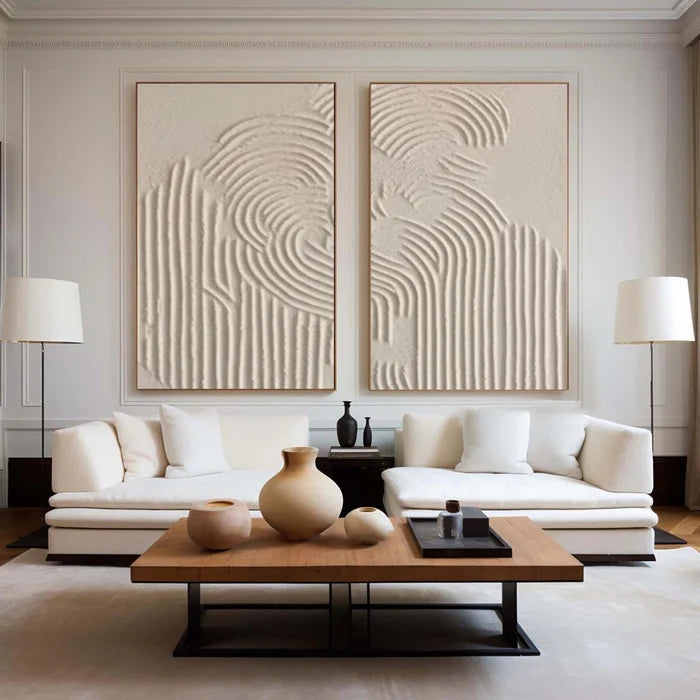
Wabi-Sabi for Small Homes: Making Imperfect Beauty Fit
Small homes have a special relationship with wabi-sabi: the philosophy loves bareness, and small rooms force bareness on you. What sounds like a match often goes wrong anyway, because the usual advice - add texture, add natural objects, warm everything up - can crowd a small wall faster than it decorates it. The real skill is choosing the fewest pieces that still change how the room feels. This guide shows how to bring imperfect, hand-made beauty into a small apartment or compact house without shrinking the space further or burying it in objects.
Why small rooms need texture more, not less
Small spaces suffer from visual starvation. When every wall is flat paint and every surface is smooth, the room reads as a box, and the only escape is the window. Texture interrupts that: a modest plaster ridge or canvas weave gives the eye something to feel at arm's length, which is exactly the distance small rooms are viewed from. A tiny room with one honest textured surface feels furnished; the same room with three small framed prints feels busy.
That trade-off is the core rule for small homes: one textured canvas replaces several flat objects. The room gets its depth from a single surface, so the rest of the wall can stay empty - which is what makes a compact space feel larger.
The scale trick: smaller canvas, closer relief
In a small room, size matters less than proportion. A 50 x 40 cm canvas beside the entry door can do more than a 90 cm piece placed wrong, because the relief is visible the whole time you pass. The practical rule: in a room under 12 square metres, let one wall carry a painting between 40 and 60 cm wide, and let the relief be the event. Wabi-sabi at small scale means the surface is interesting up close - fine ridges, visible strokes, a palette that glows in side light - rather than the composition being dramatic from far away.
What most people get wrong is buying a big flat piece to make the room feel larger. The wall gets coverage, but the room keeps its flatness. A smaller canvas with real depth gives the eye a station to land on at close range, which is the honest version of the same wish.

One wall, one voice
In a compact room, give the painting a wall of its own. The classic small-space failure is stacking: a canvas above a sofa that already has cushions, a throw, and a plant, so nothing registers. The wabi-sabi correction is discipline: one textured canvas, one quiet sideboard or stool below it, nothing else on that wall. The eye then reads the three elements as a small installation, and the room gains a focal point without gaining mass.
If the wall is truly narrow - a 60 cm hallway section, a slot between door frames - hang the canvas level with your chest and leave 40 cm of empty wall around it. The empty margin is part of the art; it is what lets a hand-made surface read as intentional rather than as a gap-filler.
Placement order: floor first, wall second
Decide the floor before the wall. Small rooms ask what the art is doing for the useful space first: does the painting open the corner where you read, calm the wall you face when the bed is made, or give the entry a reason to stop? Each of those jobs changes size and height. A reading-corner piece hangs lower, near seated eye level; an entry piece hangs higher, at standing eye level; a bedroom piece sits where morning light first crosses it.
The verification is simple: sit or stand where you will actually use the room and look at the wall from that exact position. If the canvas is at that height and the relief reads at that distance, the placement works no matter what the gallery rule says.
Hiding the furniture: neutral anchors, textured accents
Small homes are full of furniture, so the art has to agree with the largest object near it. The reliable pattern is: keep the big thing neutral - a light sofa, a pale sideboard - and let the textured canvas carry warmth on top. A warm sand or soft clay canvas above a light sofa reads as the room's heartbeat; the same canvas above a busy patterned sofa disappears or fights.
If your furniture is already warm - terracotta cushions, wood shelving - choose a quieter canvas in ash and stone tones, and let the room's existing warmth be the accent. In both cases the painting negotiates with the furniture instead of shouting at it, which keeps a small room from feeling like a crowded market stall.
Getting light to work in a small room
Small rooms usually have one good light source and several dark corners, so place the textured canvas where light crosses it rather than where you first see it. Side light from a window or a small lamp at 30 to 45 degrees makes plaster ridges cast soft shadows; overhead light flattens the same surface. Moving a lamp two feet is the cheapest way to test this before you commit.
The hour matters as much as the direction. Sunrooms and western walls get raking evening light that sets relief alive; eastern walls get gentle morning sweep. Match the canvas to the wall's best hour: deeper ridges where light is strong and angled, shallower texture where light is even and dim, so the surface never becomes a muddy gray patch.
Choosing small-format work that holds its own
Not every small canvas has presence, so inspect for three things. First, relief that rises far enough to catch side light - run a phone flashlight at a shallow angle and look for raised highlights and shadow lines. Second, a palette that stays clear at arm's length: small rooms read colors up close, so muddy low-contrast neutrals flatten instead of calming. Third, hand-made variation - an occasional stroke, a ridge that ends where a human hand stopped - because that variation is what keeps a small abstract from looking like a printer swatch.
If a piece passes those three checks at 40 to 60 cm, it will carry a small room. If it fails any of them, no amount of careful placement will rescue it.

Arrangement options for very small walls
- Single small canvas: the safest choice; one textured surface, one clear job, zero visual weight.
- Two small verticals stacked: works on tall narrow walls; keep them a hand's width apart and let one be slightly heavier in relief.
- One canvas plus one natural object: a branch in a pot, a stack of books - pairs the texture with an imperfect companion without adding a second frame.
- Set of two matching sizes: good above a narrow sideboard; stagger the heights slightly to keep the hand-made honesty.
The rule across all four: stop while the wall still has empty space. A small home's luxury is the gap between objects, and wabi-sabi is the style that shows it off best.
Furniture that works as the second texture.
In small homes the canvas rarely stands alone; it stands over something. Choose the something with the same honesty the canvas has - a stool with visible grain, a low shelf with a natural edge, a console in raw oak - and the room gains texture without adding frames. The pairing rule is one: the object below must not match the canvas. A warm sand textured canvas over a wooden stool reads as deliberate contrast; the same canvas over a beige shelf reads as a match made of apology.
Keep the object low and simple. In a room under 12 square metres, a canvas at eye height with a low object beneath it builds a vertical rhythm the small wall can carry; adding a second frame or a tall plant in the same sight line overloads it. If in doubt, remove the plant before the canvas, because the empty vertical is the small room's real asset.
One test that predicts the whole room
Before buying, tape the intended footprint of the canvas to the wall with masking tape, in ordinary paper. Live with the rectangle for two days, then put the actual piece decision aside and ask: does the rectangle itself improve the corner? If the empty zone already feels right with the taped outline, the real canvas will too. If the taped outline feels wrong, the painting will not fix it - move the footprint first. This two-day tape test costs nothing and prevents the most common small-home mistake, which is treating art as a cure for a bad layout instead of a reward for a good one.
Why small and imperfect go together.
The last thing small homes should do is apologize for being small. A hand-painted canvas with an asymmetric ridge, a soft uneven edge, a palette pulled from earth rather than from a catalog - these marks say the room was made by someone, not ordered complete. In a compact space, that honesty is exactly what stops a tiny apartment from reading as a waiting room. Choose one textured canvas that fits the wall's real proportions, light it from the side, leave the wall around it quiet, and the imperfect beauty will do more for the square metres than any gallery wall could.
To explore more options, see wabi-sabi art and square-format paintings.