Zen Home Decor: Design Principles for a Quieter Living Space
Zen home decor is less a visual style and more a set of decisions that reduce noise — visual, material, and mental. The principles are simple and unforgiving: clear the space, use natural materials, control light, and let every object earn its place. This guide turns those principles into an actionable plan for any room, on any budget, without a full redesign.
It helps to define what zen decor is not: it is not minimalism for its own sake, nor bare emptiness, nor a particular furniture brand. It is a functional relationship between a room and the person in it — the room should lower cognitive load. Every object that stays should either serve a need, hold a memory, or bring honest beauty; everything else is noise competing for your attention. That framing makes zen decor a decision discipline rather than a shopping list, which is why the principles belong to every home.
The core principles of zen decor
Five principles carry the whole aesthetic:
- Subtraction — fewer objects, clearer surfaces, emptier walls.
- Natural materials — wood, linen, stone, clay — that age with grace.
- Muted palette — warm whites, earth tones, soft greys, gentle greens.
- Controlled light — soft, warm, layered — not harsh overhead.
- Deliberate placement — each item in a considered spot, with space around it.
When these are present, a room reads zen regardless of its size, budget, or era.
Decluttering as a design move
Decluttering is not a chore before the design — it is the design. Start with one surface: clear it, keep only what belongs there, and resist refilling. Then let the wall follow: a wall with one strong piece beats a gallery of small fillers. The rule of thumb is uncomfortable but effective — if an object has no function, memory, or beauty, it is noise. Removing it is the cheapest zen upgrade available.
Materials, light, and space
After editing comes substitution. Swap a plastic object for ceramic or wood; a glossy surface for matte linen or stone; a bright overhead bulb for a warm lamp. Leave physical space — an empty corner, a clear table, a quiet wall — because emptiness is part of the design, not a gap to fill. The zen room breathes; it does not accumulate.

Art that supports a zen room
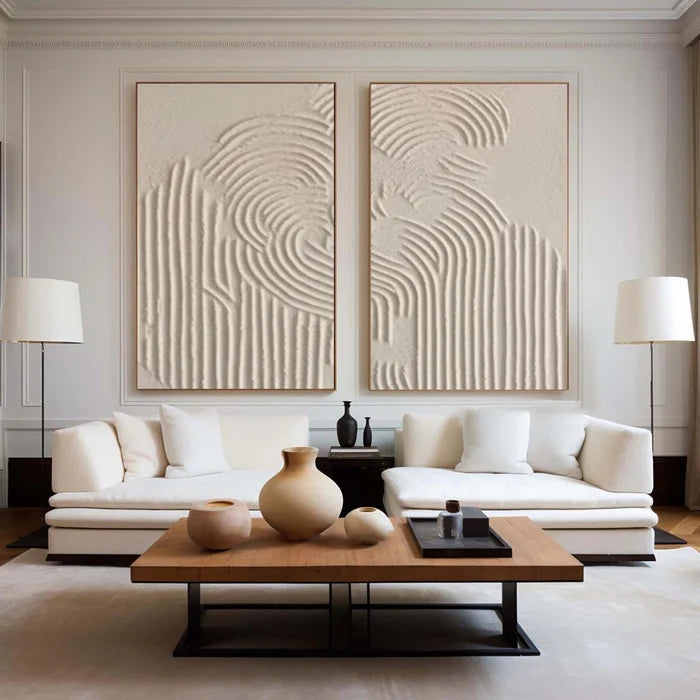
Art earns its place in a zen room when it adds calm rather than stimulation. That points to muted palettes, generous negative space, and real texture — a textured plaster piece in warm white, an earth-tone abstract, a quiet canvas with space to breathe. The zen wall art collection gathers pieces designed for this, and the wabi sabi collection sits close beside it. One calm piece per room is the usual right answer.

Room-by-room zen ideas
- Living room: one textured focal wall, low warm light, clear tables.
- Bedroom: a calm canvas above the bed, muted bedding, no clutter on nightstands.
- Entryway: a quiet piece + a wooden console; nothing else.
- Bathroom: stone and wood accents, one small muted canvas (away from steam).
- Home office: a textural piece in view for calm; hide the cables.
Each room repeats the same move: edit, substitute natural materials, control light.
Zen decor on any budget
Zen is the most budget-friendly style because its raw materials are subtraction and attention. You can create a zen corner for near-zero: clear the space, lower the light, place one object you love. Where you do spend, spend on the focal piece — one genuine textured original, correctly scaled — because that anchors the calm. The budget follows the principle: few things, better things, well placed.
Mistakes that break the calm
The recurring mistakes are predictable: over-decluttering into sterility (zen is not emptiness for its own sake), adding too many "zen" objects until the room is cluttered with calm, replacing natural texture with glossy prints, and using harsh white light that flattens everything. Each is a form of noise wearing a zen costume. The fix is the same — remove, lower, simplify — until the room quiets.
Practical personalization: keep one object purely for joy — a child’s drawing, a sentimental piece, a favorite color — and design the calm around it. Zen does not demand uniformity; it demands intention. The difference between a serene room and a sterile one is often exactly this: a single meaningful element, deliberately placed, that keeps the space alive. Let the principles handle the noise, and let that one object handle the warmth.
Making a zen space your own
Zen decor should not become a prescription. The goal is a room that lowers your own mental noise — which means the palette, the materials, and the focal piece should reflect what actually calms you. If warm wood and beige calm you, use them; if a green accent is part of your peace, keep it. The principles are the frame; your life fills it.
FAQ
What is zen home decor?
It is decorating with order, natural materials, muted color, controlled light, and empty space, so the room reduces rather than adds to mental noise. Subtraction is the core move.
How do I make my home feel zen?
Clear one surface at a time, keep only what has function or meaning, swap glossy for natural materials, lower the light, and leave space empty. Start with one room.
Is zen decor expensive?
It can be the cheapest style there is — the raw materials are subtraction and attention. Spend only on the one focal piece that anchors the calm.
Quiet the room, one decision at a time. Start with the zen wall art collection and the wabi sabi collection, and match the piece to your wall with the size guide.