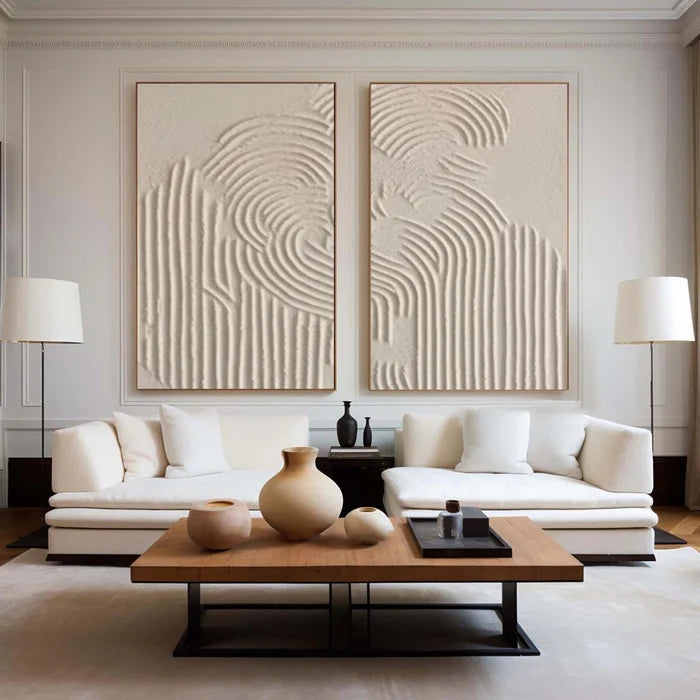
57 Inches Eye Level: Hanging Height Rules for Textured Paintings
The most common hanging mistake is not choosing the wrong wall — it is choosing the right wall at the wrong height. A painting hung a few centimeters too high feels permanently adrift; one hung a few centimeters too low crowds everything below it. Museums solved this problem a century ago with a rule so simple that it survives all trends: place the center of the artwork at eye level, conventionally about 57 inches (roughly 145 cm) from the floor. This guide explains how that rule works, where textured paintings bend it, and how to mark the exact spot on your wall with materials you already own.
Why 57 inches, and what it actually means
The 57-inch figure is not a law of physics; it is an average. The average adult eye sits between about 57 and 60 inches above the floor when standing, so a group of people looking at one wall will each have a slightly different "eye level." The convention settles on 57 inches because it comfortably serves most viewers, and galleries use it as a default that feels right across rooms and body heights. The rule is stated as the center of the work — the midpoint of the canvas, not its top edge and not its bottom — aligned with that height on the wall.
For a framed piece, the center you measure is the center of the framed whole, not of the image alone. For an unframed gallery canvas, the center is simply the midpoint of the canvas itself. The practical difference is small but worth stating: a thick frame shifts the visual mass, and your eye centers on the artwork, not the frame. Measure to the art, and let the frame follow.
Where the rule bends for seated rooms
Eye level changes with the situation. In rooms where people sit — a sofa in the living room, a bed in the bedroom — the relevant eye height is lower, because the picture is mostly seen from a seated or reclining position. This is where the reflex to hang everything at 57 inches goes wrong: a painting above a bed set at standard gallery height floats far above the pillows, and the same error appears above a low sofa. Practitioners commonly lower the reference to around 52–55 inches centered for seated viewing, or size the gap so the bottom edge sits 15–20 cm above the furniture line. There is no single perfect number for every room; the rule is a starting point, and the furniture is the correction.
You can test the fit before committing a nail with a paper mock-up. Cut a rectangle of kraft paper or newspaper to the exact canvas dimensions — product pages list precise sizes in centimeters, and Vinchy Art offers its textured canvases in steps from 61×51 cm to 91×61 cm — then tape it to the wall at your candidate height and live with it for a day. Check it from every seat you use, not just from the doorway. The paper has no weight and no texture, but it answers the height question honestly, which is the variable you are deciding.
Textured works: the eye-level bias to fix
Texture changes the perceived center of a painting in a subtle way. Because the raised ridges catch light at their own level, the eye reads the textured band as the "content" of the piece even when it sits above the geometric middle. Designers often respond by centering the darkest or most heavily textured band at eye level rather than the mathematical center of the board — the classic fix when a painting "feels high" on the wall even though the tape measure says it is correct.
The practical method: stand at your viewing distance and mark the spot where your eye actually lands on the canvas — halfway up is the default, but on a textured work it is often the band where the relief is densest. Raise or lower the canvas by a few centimeters until that band is at your eye line. A 3–6 cm shift is usually enough, and it is a correction you can feel the moment you step back. This is why hanging sessions should always end with a step back, not a level check.

Marking the spot: a tape-and-string method
When the decision is made, transfer it to the wall accurately. The classic method needs only a tape measure, a pencil, and a piece of string or chalk line:
- Measure the height of your canvas. Half of that number is the drop from the top edge to the center — call it the half-height.
- Measure from the floor to the chosen eye level (57 inches standing, lower for seated rooms) and mark that point on the wall.
- From the wall mark, measure upward by the half-height. That new mark is where the TOP of the canvas belongs — and it is the edge you hang, since the hanging hardware sits behind the top.
- For a two-hook system with wire, measure the wire drop: hang the wire over a nail at the same height as the marks and measure from the top of the canvas to the wire apex, then add that difference to your top mark.
Working from the top edge is the detail most instructions skip, and it is why so many first hangs land low or high: people mark the center and hang the hook at the center, forgetting that the painting hangs from its top. If the math feels fussy, the string trick removes the arithmetic entirely — suspend a weighted string from the proposed hook point, and the bottom of the string marks where the canvas center will sit.
Height rules for sets and galleries
For a two- or three-piece set, the rule applies to the group as one artwork: find the center of the whole arrangement, set that at eye level, and space the panels evenly around it. Vinchy Art sells many sets — for example a set of two or three matched canvases that share one palette — and treating them as a unit is exactly why they read as one composition rather than three separate decisions. When the panels differ in size, balance by aligning the group's visual center at the 57-inch line rather than hanging each panel at its own height.
In a gallery wall of mixed sizes, small pieces can sit below the line as long as they interact with the anchor piece above them; nothing about the rule requires every canvas to center on 57 inches. The rule governs the dominant anchor, and the satellites arrange themselves around its geometry.
A checklist for the day of the hang
Reduce the routine to checks instead of judgments:
- Confirm the center measurement on the canvas, not the memory of the page.
- Mark the wall at standing eye level, then adjust for seated viewing where the furniture demands it.
- Set the top-edge mark with the half-height math, and re-verify with a level.
- Step back to your main viewing position — the doorway, the sofa, the bed — and confirm the eye lands where you planned.
- Adjust in small moves: an anchor hole that missed by 2 cm is better corrected by moving the D-ring on the canvas than by drilling a second hole through the wall.
One more thing worth doing for textured works: check the height under direct side light. A directional lamp or evening light changes how the relief reads, and a canvas that looked too low at noon can look perfectly placed under a lamp. Judge the final height at the time of day you use the room most.
Common mistakes the rule fixes before they happen
Three errors account for most awkward hangs, and each has a cheap correction. The first is hanging from the center mark: the hook goes at the wall center, but the canvas hangs from its top, so the piece lands low. The string trick kills this error in one step. The second is applying the standing rule to a seated room without adjustment: a 57-inch center above a long sofa places the canvas far above the seated sight line, and the room feels institutional. Move the reference down and recenter on the texture band. The third is trusting the rules, plural — different guides give 60 inches, "center at eye level," and "bottom third," and the conflicting advice freezes action. The resolution is simple: pick one rule, use it as the anchor, and make small corrections until the room feels right. Rules are shared mental starting points; the sitting test is the deciding witness.

When you can ignore the rule
The eye-level rule is a default, not a requirement, and knowing when to ignore it is part of using it. Over a tall headboard, a dramatic console, or a media wall, the canvas anchors to the furniture line rather than the eye — set the gap so the bottom of the art sits a comfortable 15–20 cm above the piece below and let the composition dictate. In a room with no fixed furniture, the doorway is your reference: the first sight line from the door should land on the textured band. What never changes is the principle underneath all the numbers: hang for the moment the room is actually seen, and verify from that viewpoint, not from the ladder.
To explore more options, see vertical paintings and our full painting collection.