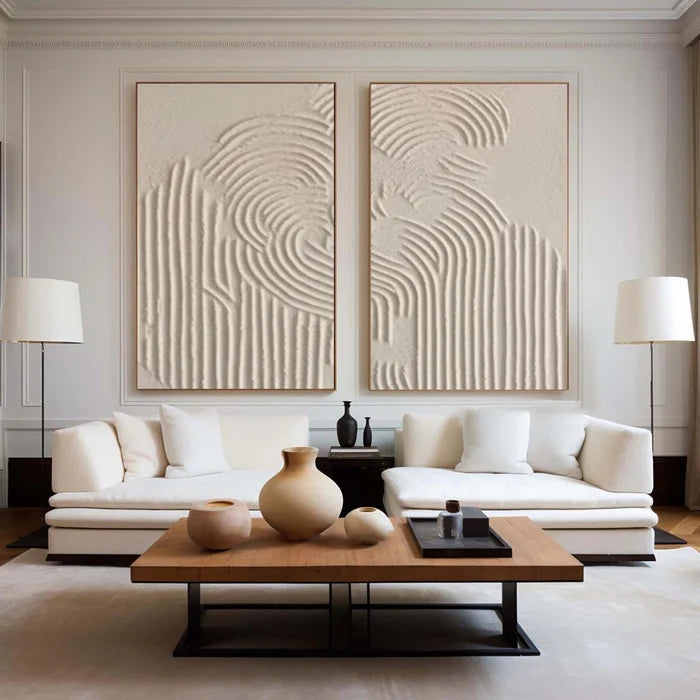
Oversized Textured Art for Small Rooms: When Big Actually Fits
The instinct in a small room is to buy small art. It is also, more often than not, the wrong instinct. A small canvas floats on a small wall the same way it floats on a large one, and the room ends up feeling smaller because every wall reads as "almost decorated." Oversized art — a piece that fills a substantial part of the wall — does the opposite: when it covers the wall generously, the eye stops measuring the room and starts reading the painting. This guide covers when large textured art genuinely fits a compact room, the two or three practical conditions that make it work, and a simple tape test to decide before you buy.
Why big art is the small-room trick
Scale is a perception game played in reverse. A 91×61 cm canvas on a 4-meter wall leaves so much empty wall on both sides that the eye enlarges the space around it; a canvas that spans most of the wall pulls the composition together and the room stops feeling like a hallway with furniture. Interior guidance has a consistent pattern here: in a compact room, one generous statement reads as calm and deliberate, while several small pieces read as clutter. The effect is strongest with texture, because relief gives the large surface something to do at close range — a big flat print on a small wall can feel like a poster, while a big textured canvas rewards exactly the viewing distance a small room provides.
The honest limits are two. First, the canvas must still clear the furniture line — a horizontal offset of a few centimeters between art and sofa edges is a feature, a canvas that fully swallows a console can read as a mistake. Second, the wall needs a visual "rest" at the edges; the classic guidance is to keep roughly 20–30 cm of wall visible on each side of a very large piece in a compact room, so the scale reads as chosen rather than accidental.
The conditions that make oversized work
Three conditions decide whether a big canvas rescues a small room or sinks it:
- Clear wall space. Large art needs approximately the whole wall or a clean band of it. Windows, doors, or a radiator that cut the field of view will fight the piece; if the wall has architecture, plan the canvas to relate to it — centered in the largest clear span.
- A tonal fit. In a small room the wall is a big field of color, so the canvas palette should be in conversation with the room rather than in opposition to it. A textured piece in beige or warm neutrals enlarges a compact room more than a dark, saturated one of the same size, because the surface reads as air instead of mass.
- Viewing distance. A small room means the viewer is close. This is the texture advantage: at 1.5–2 meters a raised surface still has detail to give, while a flat print shows nothing new. A piece that is "too big" for the wall is frequently just too big for the distance — and with textured art the close distance is exactly the zone that rewards it.
A useful habit: judge an oversized candidate from the seated position of the room, not from the center of the floor. In a studio or compact living room the sofa is the main viewpoint, and a canvas that fills the sight line from the sofa seat will feel correct even when it looks huge from the doorway.
The light factor only small rooms have
Compact rooms usually have fewer light sources and more walls in shadow, which changes how a textured surface performs. A raised canvas is a light instrument: with a single lamp to one side, its ridges cast soft shadows across themselves, and the same piece can look entirely different at noon versus evening. This can work for the room — one directional light turns a big textured canvas into a changing surface — but it also demands a test: before hanging permanently, live with the piece for an evening with the lamps on.
If the room is genuinely dim, favor pieces with moderate relief over extreme peaks (deep ridges swallow light and can look muddy in shadow) or add a small picture light above the canvas. A 61×51 cm canvas under a dedicated light can hold a small wall better than a 91×61 cm piece in darkness — light, not size, is the real driver of how much a textured surface reads at night.
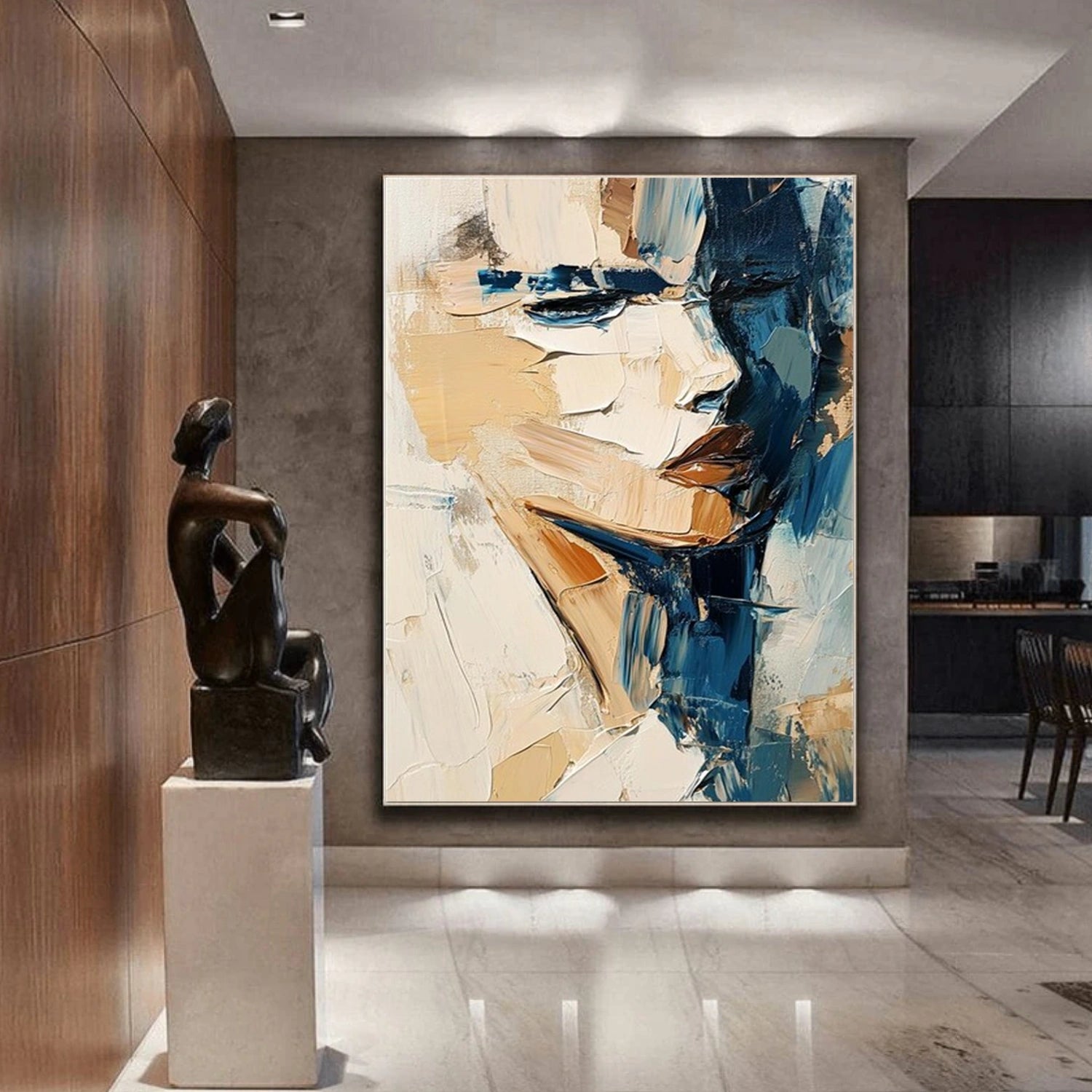
One big canvas vs. a set in a small room
If the wall target is roughly a meter wide, a single large canvas and a pair of smaller panels both qualify, and the choice changes the room. A single wide canvas gives one continuous surface — the calmest option, and the easiest to light and level. A pair adds a rhythm and lets the composition breathe around an obstacle like a window; Vinchy Art sells matched texture sets, for example set-of-two canvases sharing one palette, which read as one piece from across the room.
The small-room tie-breaker is the floor plan. In a room with a true focal wall — the wall facing the door or the wall behind the sofa — spend on one statement piece. In a room seen from many angles, like a studio with the couch in the middle, a set can mirror the angles and feel less "poster-like" from the side. Measure the clear span, apply the eye-level rule to the group, and let the room's sight lines decide.
The cardboard test that settles the size question
Before ordering a big canvas, run the cardboard test. Build a full-size mock-up of the candidate at its true dimensions — tape packing boxes together until the rectangle matches, for example, 91×61 cm — and lean or tape it on the wall for a few days. Live with it from every seat, and photograph it with your phone at the standing and seated views. Three days of cardboard answers questions that spec sheets cannot: whether the wall has the visual rest, whether the furniture clears the bottom line, and whether the room feels larger or smaller with the shape on the wall.
This test has a known bias to watch for: paper and cardboard are flat, so an oversized textured canvas will read slightly better on the wall than the mock-up suggests, because the relief adds substance. If the cardboard version looks good, the real canvas will almost certainly look better. The reverse is also true — if the cardboard feels oppressive in the room, no amount of texture will fix the scale.
Budget and format clues when shopping small
When the room is small, the price question sharpens: overspend on one statement, not on several maybes. The catalog pattern is a useful guardrail — Vinchy Art prices single canvases from about $219 to $489 and sets from about $369 to $819, with the larger formats at the upper end. In a compact room the 91×61 cm canvas at the top of the single range is usually the right splurge, because one generous surface does the work of three smaller pieces and costs less than a three-panel set that aims at the same wall. Watch the format detail too: a canvased work that arrives rolled in a rigid tube needs stretching or a frame before it hangs, while a framed delivery in its wooden transit box can go straight on the wall — a real difference in effort for a large piece in a small space.

Hanging and proportion notes for compact rooms
When the decision is made, a few compact-room details keep the result polished. Hang the piece so its center sits around eye level as measured from the main viewing seat, and give it a small amount of breathing room above furniture as described. For a wide canvas on a narrow wall, center it on the wall’s clear span rather than the wall's geometric middle; the eye forgives an off-center room arrangement far more than it forgives art fighting a window frame. Finally, choose the hanging hardware to match the format — Vinchy Art ships pieces either rolled in a rigid tube or framed in a wooden box, and a framed 91×61 cm canvas is heavy enough to warrant two anchors or a stud screw, using the measured weight rather than the size name.
The verdict on going big
Oversized textured art belongs in small rooms more often than buyers believe, under three conditions: a clear wall span, a tonal fit, and light that reaches the surface. When those are met, one generous canvas repairs a room’s scale in a way that several small pieces cannot. When they are not met, the same canvas can make the room feel like a storage closet. Run the cardboard test, read the room from its seats, and judge with the lamps on — the right big piece will feel inevitable, and that feeling is the whole point of the exercise.
To explore more options, see vertical paintings and our full painting collection.