

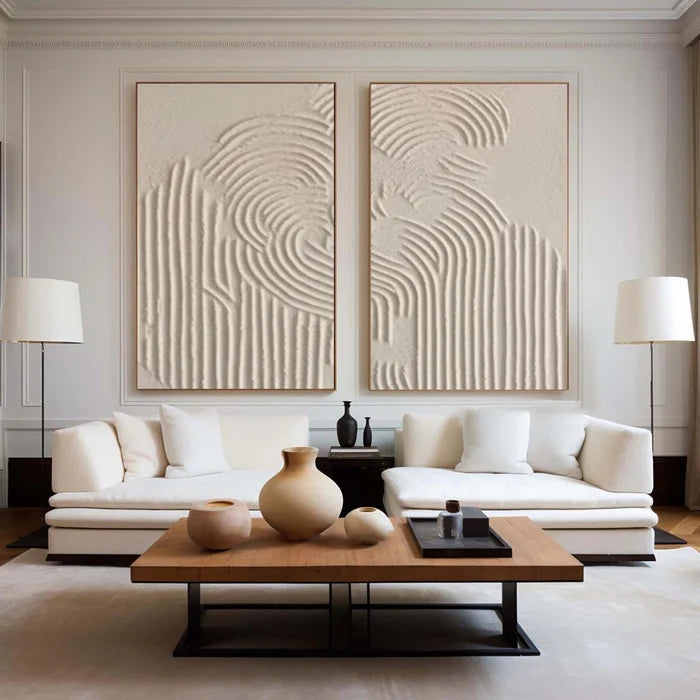

Choosing abstract art for hotel lobby spaces that need scale presence and brand identity
A hotel lobby rarely fails because it lacks furniture—it fails when the wall behind it feels anonymous. Abstract art for hotel lobby environments is often expected to solve that in one move: establish mood, signal brand identity, and hold visual weight across large, open volumes. The challenge is not just choosing something “large and modern,” but selecting work that reads correctly from a distance, holds interest up close, and survives daily guest traffic without looking like a printed afterthought. For procurement teams and designers, the decision sits at the intersection of aesthetics, durability, and logistical feasibility—and that is where handcrafted, large-scale abstract painting starts to outperform generic solutions.
Why scale alone does not guarantee impact
In expansive lobbies, oversized artwork is necessary but not sufficient. A wide canvas can still disappear if the composition lacks contrast or directional movement. Abstract paintings that succeed in hospitality settings tend to carry visual structure—layered brushwork, tonal variation, or textured surfaces that catch light differently throughout the day.
This is particularly important in spaces with changing lighting conditions. Morning daylight, afternoon glare, and evening warm lighting all alter how color is perceived. A flat print often collapses into a single tone under these shifts, while a hand-painted surface retains depth because of physical paint variation. The result is a piece that remains visually active instead of fading into the background.
Aligning abstract art with hotel brand identity
Abstract art is not neutral—it can either reinforce or dilute a hotel’s positioning. A coastal resort, a business hotel, and a boutique design property each require different visual language, even when all choose “abstract.”
Color palette becomes the first anchor. Earthy neutrals and mineral tones tend to communicate calm and understated luxury, while high-contrast black and white compositions suggest structure and urban energy. Accent colors can echo interior materials—bronze fixtures, marble veining, or upholstery fabrics—without becoming overly literal.
Equally important is the rhythm of the composition. Soft, diffused forms support relaxed environments, while sharper gestures and linear elements introduce momentum, which suits high-traffic, transitional spaces.
The practical advantage of textured paintings in hospitality settings
Texture is not just an aesthetic decision—it is a functional one. In high-end boutique hotel lobbies, textured abstract art is often preferred because it interacts with architectural lighting in a way flat surfaces cannot.
Directional lighting—spotlights, wall washers, or natural side light—creates subtle shadows across raised paint or plaster textures. This shifting interplay adds dimension without requiring additional decorative elements on the wall.
A common issue in large hotel lobbies is that printed artwork looks adequate during installation but appears flat and lifeless once the lighting scheme is finalized. The absence of surface variation means the piece cannot respond to light, leaving the wall visually underpowered compared to the rest of the space.
Textured paintings also tend to mask minor surface wear better than glossy prints, which can show scratches or reflections more easily in high-traffic environments.
Commissioning for scale and consistency across multiple spaces
Hotel projects rarely involve a single artwork. More often, designers need a cohesive visual language across lobbies, corridors, suites, and public areas. This introduces a different level of complexity—consistency without repetition.
Hand-painted abstract collections can be developed as a series, where palette, texture, and compositional logic remain aligned while each piece retains individuality. This is particularly useful for:
-
Large lobby feature walls paired with smaller companion pieces in adjacent areas
-
Multi-property branding where each location needs variation within a shared identity
-
Phased renovations where artwork must integrate with both existing and updated interiors
For teams evaluating options, browsing a dedicated Commercial Projects Portfolio can clarify how scale, color direction, and series development translate into real installations.
Hand-painted versus printed art in commercial environments
The decision between handcrafted paintings and printed artwork often comes down to perceived cost efficiency, but the long-term visual and operational differences are significant.
In hospitality environments where first impressions directly influence guest perception, this distinction is not purely aesthetic—it affects how the space is remembered.
Logistics that matter in hotel art procurement
Beyond design, successful implementation depends on operational clarity. Large-scale abstract art must be planned with installation, handling, and long-term maintenance in mind.
Canvas size and panel segmentation are often determined by elevator access, loading docks, and on-site assembly constraints. Framing decisions also affect both durability and visual weight; for example, floating frames can add structure without overwhelming minimalist interiors.
Color matching is another critical layer. Even slight deviations can become obvious when artwork sits against custom wall finishes or branded color schemes. This is where custom painting—rather than selecting pre-made work—reduces risk.
Reducing uncertainty in remote art selection
One of the main concerns for procurement teams is committing to artwork without seeing it in person. Digital tools and advisory support have become essential in closing that gap.
A practical approach includes using a room preview tool that allows designers to upload lobby photos and test artwork scale and placement before ordering. This helps avoid one of the most common mistakes: selecting pieces that are technically large but still undersized relative to ceiling height or furniture grouping.
Art advisory support can also assist in aligning palette and composition with material boards, ensuring the artwork integrates rather than competes with the interior design.
Studios like Vinchy Art, which focus on handcrafted abstract paintings for interiors, typically combine these tools with the ability to adjust size and color direction—making them more adaptable to commercial requirements than fixed catalog options.
When abstract art is the wrong choice
Despite its flexibility, abstract art is not always the best solution. Hotels that rely heavily on cultural storytelling or location-specific narratives may benefit more from representational or locally inspired work.
Similarly, overly minimal abstract pieces can feel underwhelming in large, high-ceiling lobbies that require strong focal points. In these cases, either scale must increase significantly or composition must become more dynamic to compensate.
Recognizing these limits early prevents costly revisions after installation.
Working with a studio as a long-term partner
For hotel groups and design firms managing multiple projects, consistency and reliability matter as much as creativity. A studio that understands commercial timelines, can produce cohesive series, and supports customization becomes a practical partner rather than just a supplier.
If your project involves defining a lobby focal point, coordinating artwork across multiple zones, or aligning visuals with a brand palette, it is worth starting a direct conversation through a dedicated service such as a B2B Art Concierge. This allows requirements—scale, color, timeline, and installation constraints—to be addressed before production begins.
Frequently Asked Questions
What size abstract art works best for a hotel lobby?
Large-scale pieces typically work best, often spanning a significant portion of the main wall or aligning proportionally with furniture groupings. The exact size depends on ceiling height and viewing distance, but undersized artwork is one of the most common and visible mistakes.
Can abstract art be customized to match a hotel’s brand colors?
Yes, hand-painted abstract art can be tailored to specific palettes, allowing it to align with brand identity, interior materials, and lighting conditions more precisely than pre-made or printed options.
Is textured art difficult to maintain in commercial spaces?
Not necessarily. Textured paintings are generally stable and can be easier to maintain visually because they do not show reflections or minor surface imperfections as clearly as glossy prints.
How do hotels ensure consistency across multiple artworks?
Consistency is achieved by developing a series with shared palette and compositional logic while allowing variation in each piece. This creates cohesion without making spaces feel repetitive.
Can large artworks be installed in buildings with access limitations?
Yes, many large works are designed in panels or sized according to building access constraints, allowing for easier transport and on-site installation.